

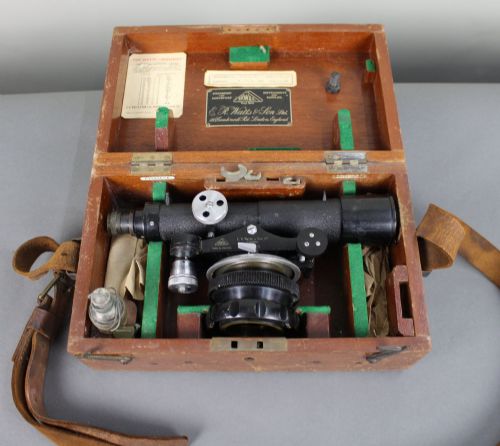


Vintage Brass Level
These vintage brass level pieces are precision instruments combining metal and wood, valued by collectors for their scientific history.
Vintage Brass Level
A vintage brass level is a scientific or surveying instrument designed for measuring elevations and angles, originating from periods such as the nineteenth century up to the mid twentieth century. Buyers seeking this phrase encounter instruments housed in mahogany cases alongside related scientific apparatus like theodolites and transit instruments.
The selections available range from early Victorian drainage levels and George IV altazimuth theodolites to Edwardian industrial pressure gauges and precision levels with clinometers. Makers and retailers include notable firms such as E.R. Watts & Son Ltd, W&S Jones, L Casella & Co, Cooke Troughton & Simms, Elliott Bros. of London, Alexander Adie of Edinburgh, W. H. Harling, and W.F. Stanley.
Most items on this page reflect Victorian Scientific, Industrial Scientific, and Edwardian Industrial styles, alongside occasional anomalies like a nineteenth century Indian low table. The core of what is found remains functional surveying gear constructed with brass components, glass vials, and wooden fittings.
Materials and construction
These instruments utilise solid brass for the main bodies, sighting tubes, and delicate adjustment mechanisms, providing the necessary weight and durability for field use. Glass is employed for bubble vials and lens components, while silvered metal often forms the calibrated dials and compass faces.
Enclosing many of these pieces are fitted wooden cases fashioned from mahogany or teak, sometimes accompanied by leather straps or protective padding. Steel parts appear in internal screws and fixings, combining with the softer brass and dense timber to create robust portable equipment.
Vintage Brass Level Retail Price Guide 2026
Typical asking prices for vintage brass level among the pieces listed under this phrase on Sellingantiques today, from the lower quarter to the upper quarter. They describe what is for sale here now, not the wider market.
A nineteenth century Indian low table slips quietly among the surveying gear.
Variations in quality
Quality in these instruments depends upon the precision of the signed engraving, the reputation of the maker or retailer inscribed on the brass plate, and the complexity of the optical and levelling mechanics. Pieces associated with established London and Edinburgh makers display finer graduation marks and smoother mechanical action.
The survival of the original fitted wooden housing, such as a mahogany case, and supplementary accessories like clinometers or portable transit components elevate the standing of an instrument. Simpler utility models contrast with signed precision equipment intended for professional surveying.
E.R. Watts & Son Ltd·W&S Jones·L Casella & Co·Cooke Troughton & Simms·Elliott Bros. of London·Alexander Adie of Edinburgh·W. H. Harling
The Vintage Brass Level Glossary
- Clinometer
- An instrument for measuring angles of slope or inclination with respect to gravity. It often appears integrated into precision levels.
- Theodolite
- A precision instrument for measuring horizontal and vertical angles in surveying and triangulation. These feature rotating telescopes mounted on graduated circles.
- Transit Instrument
- A telescope mounted on an axis perpendicular to its optical axis, used for observing celestial or terrestrial objects as they pass a meridian. Some portable versions use brass and glass construction.
- Vernier
- A secondary sliding scale that allows readings to a fraction of the divisions on the main graduated scale. It aids in achieving precise measurements on scientific instruments.
- Altazimuth
- A mounting that allows an instrument to be rotated in both altitude and azimuth axes. This permits tracking in vertical and horizontal planes.
Vintage Brass Level: Frequently Asked Questions
What is a vintage brass level?
A vintage brass level is a historical surveying instrument built to establish horizontal planes, utilising metal components and glass vials.
These devices were standard equipment for engineers and architects during the nineteenth and early twentieth centuries.
How were these levels used?
Surveyors mounted them on tripods to measure elevation differences across building sites, drainage projects, and land surveys.
Operators sighted through the telescope while adjusting levelling screws until the internal bubble vial centered.
How do I display a brass level?
Many collectors place these instruments on shelves, desks, or in cabinets alongside their original fitted mahogany cases.
The polished brass components and glass optics create strong visual interest in a study or library setting.
How do I identify the maker?
Makers' names, retailer signatures, and patent titles are typically engraved directly onto the brass body or dial plates.
Inscribed names connect the piece to specific workshops in London and Edinburgh from the nineteenth or twentieth century.