



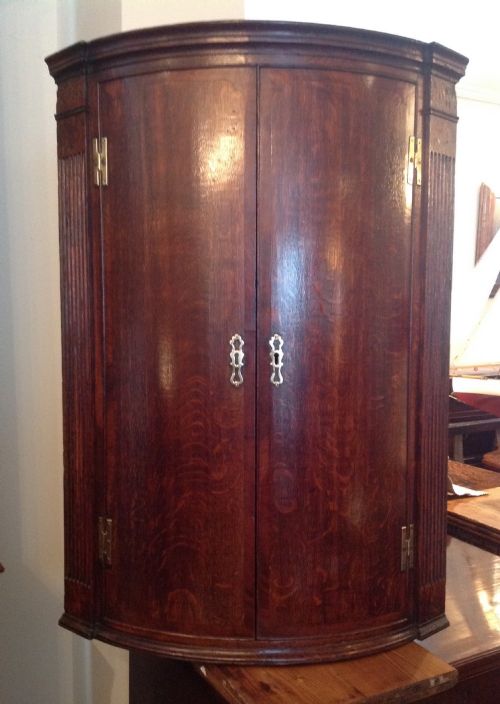


Vintage Bowfront Corner Unit
A vintage bowfront corner unit makes clever use of awkward angles, offering curved doors and generous shelving.
Vintage Bowfront Corner Unit
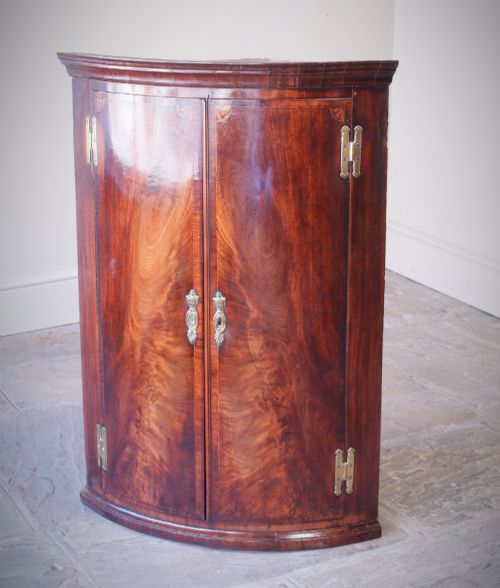
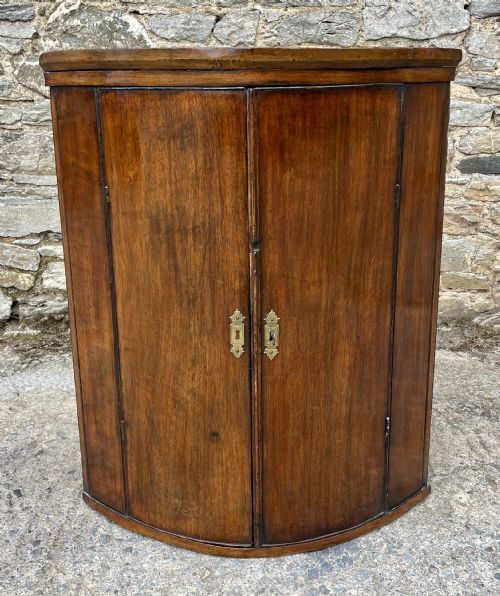
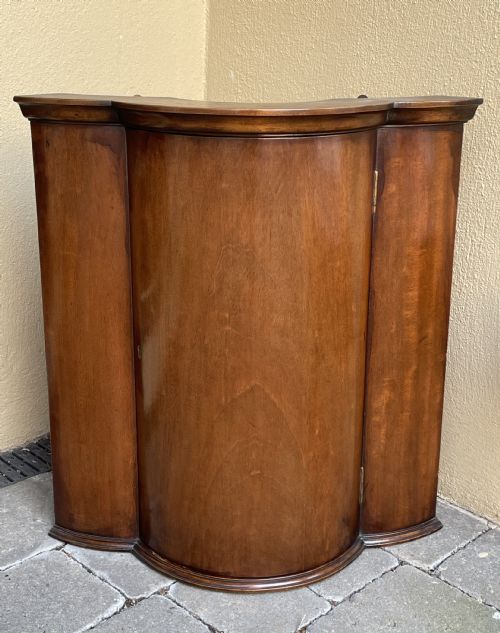
A vintage bowfront corner unit is designed to fit snugly into the intersection of two walls while presenting a rounded, convex front profile. These pieces appear primarily as hanging cupboards or standing cabinets from the Georgian and 19th Century periods.
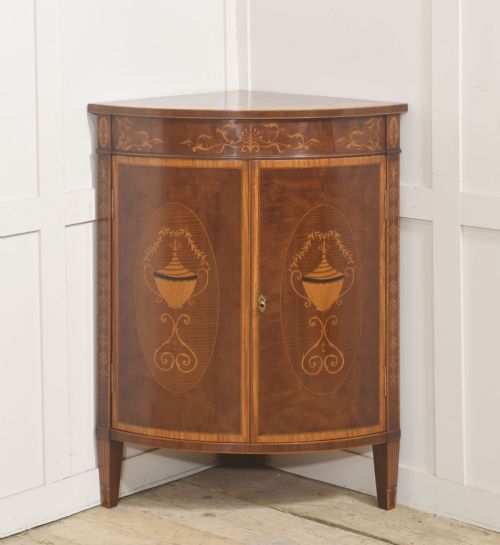
The selection on this page relies heavily on mahogany timbers, alongside oak, pine, and painted or japanned surfaces. Most examples draw upon Georgian, Sheraton Revival, Edwardian, and Chinoiserie styles to shape their storage spaces.
How they were made
Cabinet makers constructed these cupboards using solid timbers and rich veneers such as mahogany, often incorporating satinwood inlay and gilt details. Woodworkers shaped the curved bow fronts carefully to create a smooth, rounded exterior that met flush against corner walls.
Many versions feature brass hardware, including key escutcheons and hinges, to support the heavy wooden doors. Painted and japanned finishes also appear, particularly on Chinoiserie examples which rely on decorative lacquer work.
Vintage Bowfront Corner Unit Retail Price Guide 2026
Typical asking prices for vintage bowfront corner unit among the pieces listed under this phrase on Sellingantiques today, from the lower quarter to the upper quarter. They describe what is for sale here now, not the wider market.
The listings span multiple centuries, ranging from mid-18th-century pieces to Edwardian examples.
What varies in quality
Quality rests upon the selection of timber figure, such as the richness of the mahogany grain and the precision of any satinwood inlay. Finer pieces display careful joinery on the curved bow front, ensuring the doors align seamlessly with the frame.
The choice of decorative technique also separates standard production from finer work, seen in the depth of japanned Chinoiserie lacquer or the crispness of brass hardware. Simple oak or pine standing cabinets represent utility, whereas detailed Georgian and Sheraton Revival pieces show greater design ambition.
The Vintage Bowfront Corner Unit Glossary
- Bowfront
- A convex, curved cabinet front that swells outward in the centre. This shape softens the hard angles of a room while adding internal depth.
- Chinoiserie
- European decorative art imitating Chinese motifs and techniques. This style utilises painted or japanned surfaces often found on 19th-century pieces.
- Japanned
- A European form of decorative lacquer finish resembling Asian lacquerwork. It is typically applied in dark tones with raised gold ornamentation.
- Satinwood Inlay
- Contrasting light-coloured wood inserted into a darker timber surface for decoration. It frequently highlights the borders of Georgian and Sheraton Revival cabinet doors.
- Hanging Cupboard
- A wall-mounted storage cabinet designed to be secured above floor level. These units save floor space in smaller rooms.
Vintage Bowfront Corner Unit: Frequently Asked Questions
What is a bowfront corner unit?
A bowfront corner unit is a storage cabinet built with a curved, convex front designed to fit neatly into the corner of a room.
These pieces typically feature single or double doors opening to reveal internal shelving for display or storage.
How were these cabinets used?
Historically, these cupboards served to store porcelain, glassware, or household provisions while occupying otherwise unused corner space.
Today, they continue to function as practical storage or display furniture in dining rooms and living areas.
Are these units freestanding or wall-mounted?
The inventory includes both hanging wall cupboards and standing floor cabinets.
Hanging versions attach directly to wall studs, whereas standing versions rest firmly on the floor.
What woods are most common?
Mahogany is the predominant timber seen across Georgian and later 19th-century examples.
Other materials include oak, pine, and painted or japanned surfaces with satinwood inlay.
How do I identify a Georgian piece?
Georgian and George III pieces generally date from the 18th or early 19th century and feature traditional mahogany construction.
Later interpretations often follow Sheraton Revival or Edwardian styles, reflecting the design tastes of those periods.