





Vintage Black Earrings
Vintage black earrings bring a dramatic, dark silhouette to the ear, spanning Victorian gravity through to mid-century modernist geometry.
Vintage Black Earrings
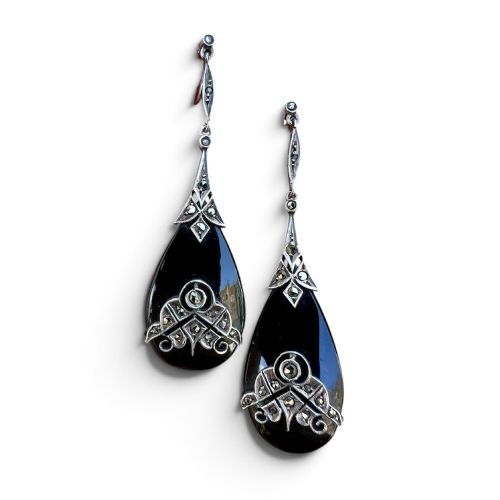
Vintage black earrings comprise a diverse assortment of dark-toned jewels spanning the nineteenth century up through the nineteen-sixties. Buyers exploring vintage black earrings encounter various distinctive silhouettes, ranging from Edwardian drop designs and Art Deco teardrops to simpler mid-century studs.
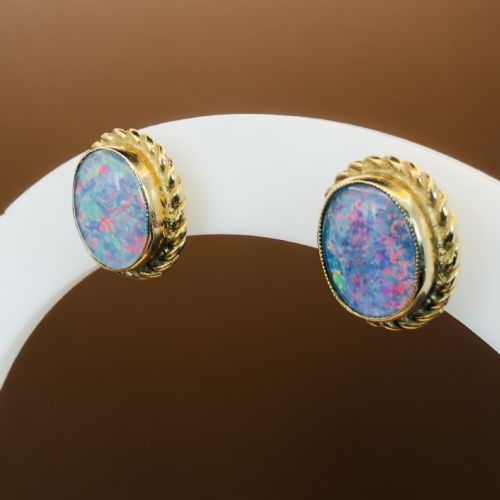
The selection frequently includes precious metals such as nine-carat and fifteen-carat gold alongside sterling silver settings. Dark visual elements are typically delivered through natural materials like onyx, black opal doublets, banded agate, and tourmaline, or through dark enamelling and paste.
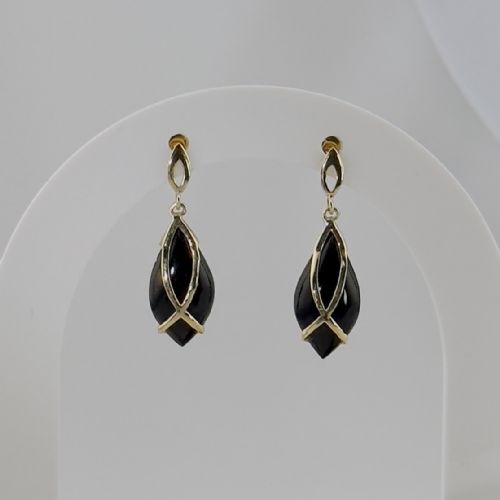
A significant portion of the pieces date from the nineteen-sixties, offering bold geometric gold and onyx combinations, while earlier Victorian and Edwardian examples lean into intricate diamond and enamel motifs. This span ensures buyers find everything from theatrical drop pendants to understated everyday studs.
Materials and construction methods
Craftsmen utilised both precious metals and contrasting dark stones to build depth and contrast within each mount. Gold in varying purities, including nine-carat, fourteen-carat, and fifteen-carat, pairs alongside sterling silver settings and chrome elements.
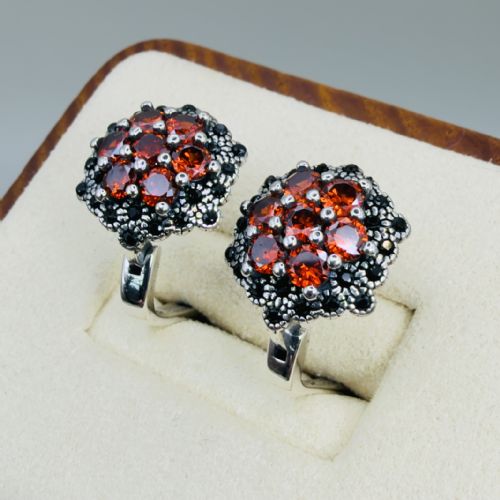
Stones such as onyx, black opal, and tourmaline were shaped into teardrops, pear cuts, and flat panels, occasionally accented with diamonds, pearls, or marcasite. Enamelling and paste were also employed to introduce dark expanses and reflective sparkle into the design.
Vintage Black Earrings Retail Price Guide 2026
Typical asking prices for vintage black earrings among the pieces listed under this phrase on Sellingantiques today, from the lower quarter to the upper quarter. They describe what is for sale here now, not the wider market.
Some Edwardian bow-drop earrings even come equipped with hidden screwbacks, proving Victorian patience knew no bounds.
Evaluating craftsmanship and condition
Quality rests primarily in the precision of the stone-setting and the integrity of the precious metal work, whether in pavé diamond arrangements or hinge-back constructions. Finer examples display secure bezel or claw settings that protect fragile edges, particularly on softer materials like opal or paste.
The choice of materials also dictates distinction, moving from utilitarian chrome and bakelite compositions up to substantial fifteen-carat gold mounts set with genuine diamonds and banded agate.
The Vintage Black Earrings Glossary
- Onyx
- A chalcedony quartz prized for its uniform dark tone and smooth surface polish. It is frequently carved into teardrops or flat plates for drop and stud configurations.
- Marcasite
- Small, faceted iron pyrite crystals set closely together to create a steely, metallic sparkle. This material is typical in geometric Art Deco jewellery.
- Doublet
- A composite gemstone formed by cementing a thin slice of precious stone, such as black opal, to a darker backing material. This construction enhances colour play while providing structural support.
- Paste
- Hand-cut and polished lead glass used historically to imitate diamonds or other precious gemstones. It provides brilliance without the cost of mined stones.
- Hinge back
- A secure mechanical fastening type featuring a hinged post that snaps into a notched catch behind the earlobe.
Vintage Black Earrings: Frequently Asked Questions
How do I date these earrings?
Dating relies heavily on material composition, cut, and fastening styles. Edwardian pieces often incorporate silver-topped gold set with rose-cut diamonds, whereas nineteen-sixties items favour bolder yellow gold geometric forms.
Fittings also change across decades, moving from early screwbacks and specialised clips to modern hinge backs and standard posts.
Are these materials fragile?
Certain components require careful handling depending on their composition. Enamel, paste, and softer stones like opal doublets need protection from sharp impacts and harsh chemicals.
Sturdier elements like solid gold, silver, and onyx tolerate regular wear far better when stored independently in soft pouches.
What metals were commonly used?
A range of precious and industrial metals appears across different periods. Victorian and Edwardian makers frequently combined yellow gold with silver toppings to brighten diamond settings.
Mid-century designers utilised nine-carat and fourteen-carat yellow gold almost exclusively, alongside occasional twentieth-century industrial materials like chrome.