


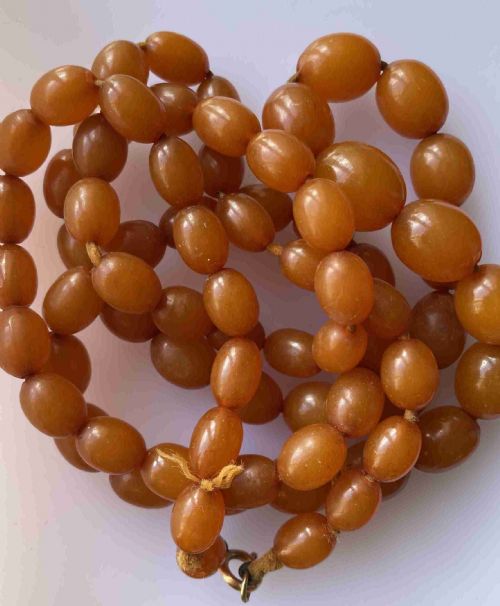


Vintage Baltic Amber Jewellery
Vintage baltic amber jewellery brings warm, sunlit tones to your collection through pieces shaped by decades of history.
Vintage Baltic Amber Jewellery
Vintage baltic amber jewellery encompasses necklaces, bracelets, earrings, and matching sets shaped from fossilised tree resin. These pieces draw attention for their rich colour range, moving from pale butterscotch to deep egg yolk hues.
The selection on this page leans heavily towards necklaces featuring graduated beads, raw polish forms, and pendant designs. You will encounter items spanning the nineteenth century, the Edwardian era, and the nineteen-thirties, alongside mid-century gold and silver creations.
Materials and construction
Makers set natural baltic amber into sterling silver or nine-carat gold mounts, securing the organic material with metal prongs or threaded settings. Many bead necklaces rely on traditional stringing methods to hold uniform or graduated amber pieces in place.
The working of the resin ranges from raw polish finishes that retain natural contours to smooth round beads and carved drops. Metal elements often carry silver marks and initials that record the touch of the maker.
One twenty-eight-inch necklace tips the scales at a hefty eighty grams, carrying massive history around the neck.
Assessing quality and character
Quality rests in the depth and clarity of the amber itself, particularly in the prized egg yolk and butterscotch tones that show natural internal variation. Heavier bead counts and substantial weights elevate a piece above simpler designs.
The integration of precious metals like sterling silver and nine-carat gold, complete with clear hallmarks and maker initials, separates finer workshop output from unmarked metal settings.
The Vintage Baltic Amber Jewellery Glossary
- Amber
- Fossilised tree resin prized for its warm golden and orange hues. It forms the primary material for this category.
- Butterscotch
- A dense, opaque yellow shade of amber highly sought after by collectors. This colour tone often appears in nineteenth-century and nineteen-thirties beads.
- Graduated beads
- A sequence of beads that scale down in size from the centre towards the clasp. This arrangement creates a balanced drape on necklaces.
- Raw polish
- A finishing technique that smooths the rough edges of natural amber while preserving its organic shape. It highlights the uncultivated texture of the resin.
Vintage Baltic Amber Jewellery: Frequently Asked Questions
How do I date amber jewellery?
Dating relies on stylistic clues like Art Deco geometries or Edwardian delicacy, alongside any metal hallmarks present on the settings.
Changes in clasp types and stringing methods also help pinpoint the decade of manufacture.
What is egg yolk amber?
Egg yolk amber refers to a dense, opaque variety resembling the rich yellow tone of a cooked yolk. It is particularly characteristic of older bead necklaces.
This appearance stems from microscopic air bubbles trapped within the fossilised resin.
Is silver used in these pieces?
Sterling silver frequently serves as the mounting material for pendants, bracelets, and earring sets. These metal components often feature maker marks.
Gold also appears in select drops and studs from the mid-twentieth century.
How should I care for amber?
Amber is a soft organic material that benefits from gentle cleaning with a soft cloth rather than harsh chemical dips. Store pieces separately to prevent scratching from harder metals.
Keep them away from perfumes and hairsprays to protect the surface lustre.