


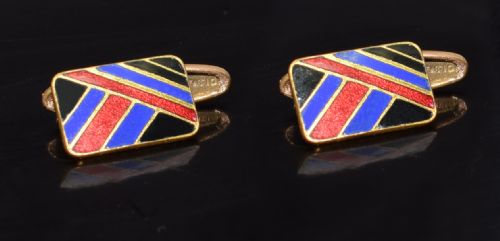
Vintage Art Deco Cufflinks
These vintage art deco cufflinks bring geometric precision and crisp colour to a shirt cuff, forged during the height of the modernist movement.
Vintage Art Deco Cufflinks
When you search for vintage art deco cufflinks, you are looking at twentieth-century menswear accessories defined by clean lines, geometric patterns and purposeful symmetry. The selection spans the nineteen-twenties through to the nineteen-forties, capturing an era when dress codes demanded architectural restraint and functional elegance on the wrist.
The most common examples on this page are matching pairs of gents cufflinks executed in enamel and silver or gold, typically dating from around nineteen-thirty. These pieces rely on contrasting blocks of colour, often green or black, paired with modernist shapes that sit flat and secure against the cuff.
Archival pieces show that solid nine-carat and eighteen-carat gold examples also appear, sometimes featuring engine-turned patterns or precious stones like sapphires. Whether rendered in base metals with vitreous enamel or substantial gold frames, each pair reflects the distinct design vocabulary of the period.
How they were made
Craftsmen built these accessories using precious metals such as nine-carat and eighteen-carat gold, alongside silver, silver plate, brass and silver-tone base metals. The structural framework often received an engine-turned texture, machine-engraved into the metal to create repetitive geometric patterns that catch the light.
Colour came from the application of vitreous enamel, fused to the metal surface through high-temperature firing to produce durable, glossy panels of green, blue or black. Artisans also integrated bezel-set gemstones like sapphires into solid gold mounts, securing them within strict geometric borders.
Listings span the nineteen-twenties, nineteen-thirties and nineteen-forties, using enamel, gold, silver and brass.
What varies in quality
Quality rests primarily on the substance of the metal and the integrity of the decorative medium, moving from base metals and plated brass up to solid nine-carat and eighteen-carat gold. Substantial gold weight and clear British hallmarks offer tangible evidence of superior manufacture and precious metal content.
The precision and preservation of the enamel set the finer pieces apart from standard production. Intact vitreous enamel without chips or restoration, combined with crisp engine-turning and secure chain links or swivel backs, marks the difference between everyday utility and exceptional workshop output.
Payton Pepper And Co·Henry Griffiths·Henry Hobson
The Vintage Art Deco Cufflinks Glossary
- Enamel
- A glassy substance fused to metal through firing to provide vivid colour and a smooth surface. This technique created the distinct geometric panels seen on period menswear.
- Engine-turned
- A decorative mechanical technique that etches precise, intricate geometric patterns into metal. It adds texture and depth to gold and silver surfaces.
- Modernist
- A design style prioritising clean lines, function and geometric abstraction over ornate historical revival. It forms the core aesthetic of the era's accessories.
- Vitreous enamel
- Glass powder melted onto metal at high temperatures to form a permanent, hardwearing coloured coating. It resists fading and maintains its gloss over decades of wear.
- Hallmark
- An official stamp applied to precious metals indicating purity, maker and place of assay. It provides definitive proof of metal standard and origin.
Vintage Art Deco Cufflinks: Frequently Asked Questions
How do I fasten them?
Most pairs utilise traditional chain links or rigid bars with pivoting toggle backs to secure the cuffs through double-sided buttonholes.
Simply align the two faces and slip the toggle or chain through the fabric layers to lock the accessory in place.
Are they solid gold?
The listings include both solid nine-carat and eighteen-carat gold examples alongside silver, brass and silver-tone base metals.
Look for official hallmarks stamped on the metal to confirm the exact precious metal standard.
How should I clean them?
Clean metal and enamel surfaces gently with a soft, dry microfibre cloth to remove everyday oils and dust.
Avoid chemical dips and ultrasonic cleaners, as harsh liquids can dislodge or damage historical enamel work.
Can I wear them daily?
These sturdy vintage accessories were built for regular gentlemanly wear and suit modern double-cuff shirts.
Take care to store them separately to prevent scratching the enamel panels against other metal items.