


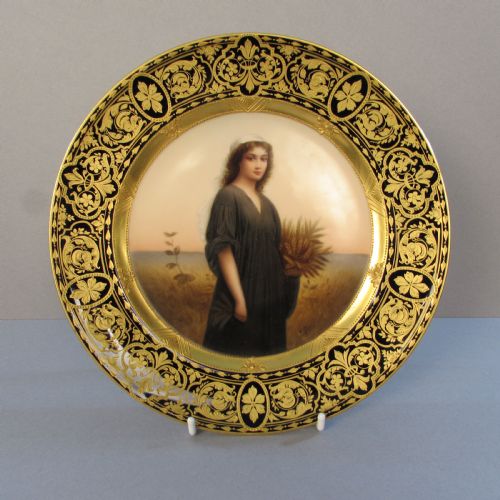

Vienna Porcelain Dish
A vienna porcelain dish brings classical narrative painting and rich gilding into your home, offering miniature gallery art on fine ceramic.
Vienna Porcelain Dish
A vienna porcelain dish is typically encountered on this page in the form of cabinet plates, chargers, and trays spanning the nineteenth century up to nineteen twenty. These items serve primarily as decorative wall or cabinet displays rather than utilitarian tableware, often featuring mythological or historical scenes.
The aesthetic draws heavily on neoclassical, grand regency, and royal vienna style traditions, frequently pairing cobalt blue grounds with extensive gold leaf and gilding. Pieces range from large chargers depicting subjects like Caesar at the grave of Alexander the Great to smaller cabinet plates focusing on figures such as Cupid and Psyche.
How they were made
The manufacture relies upon high-grade porcelain shaped into plates, trays, and chargers, which then receive detailed hand-painted enamel work depicting complex figural narratives. Artisans apply gold leaf, gold gilt, and intricate gilding around borders and central motifs to create rich decorative contrast against deep cobalt blue grounds.
Many of these items bear signatures from individual painters such as Wagner, S. Stanley, Sibl, or C. Kiesel, indicating specialist studio work rather than purely industrial output. Production methods during the nineteenth century prioritised meticulous artistic execution over mass volume.
Several plates capture dramatic mythological moments, including Caesar pausing solemnly at the grave of Alexander the Great.
What varies in quality
The primary distinction in quality lies in the execution of the hand-painted narrative scenes and the precision of the signatures. Finer pieces demonstrate superior draughtsmanship in facial expressions and anatomy, whereas simpler examples rely more heavily on standard decorative borders with less detailed centre panels.
The application of gold leaf and gilding also separates the work, with top examples showing crisp, raised, or heavily burnished gold tooling. The depth and evenness of the cobalt blue glaze further determine the overall visual impact of a plate or charger.
Hutschenreuter
The Vienna Porcelain Dish Glossary
- Cabinet plate
- A decorative plate intended for display in a cabinet or on a wall rather than for dining use. These often feature elaborate painted scenes and gilt borders.
- Charger
- A large ornamental dish or plate placed beneath other courses or displayed independently for its decorative merit. In porcelain, these provide a broad canvas for narrative artwork.
- Gilding
- The application of gold leaf or gold powder onto the ceramic surface to create metallic highlights. It often frames the central painted subject.
- Enamel
- Vitreous coloured glass fused to the porcelain surface during firing to create permanent, vibrant illustrations. It allows for the fine detail seen in classical portraiture.
- Neoclassical
- An artistic style drawing inspiration from the classical art and culture of ancient Greece and Rome. This informs the mythological subjects frequently found on these dishes.
Vienna Porcelain Dish: Frequently Asked Questions
What subjects do they show?
These pieces predominantly depict mythological, historical, and allegorical scenes such as King Tristan's death, the birth of Adonis, and Bacchus with Ariadne. Artists drew heavily on classical literature and romantic narratives.
Portraits of named figures like Esther, Aurora, and Psyche also appear frequently as the central focus of the painted composition.
How were they displayed?
Cabinet plates and chargers were made primarily for display in formal reception rooms rather than for food service. They sat on specialised stands, inside glass-fronted cabinets, or hung directly on walls.
Their substantial size and rich gold gilt decoration made them focal points for interior decoration in nineteenth-century homes.
How do I date a piece?
Dating relies heavily on stylistic markers, recorded signatures, and period classifications ranging across the nineteenth century up to nineteen twenty. Pieces associated with the royal vienna style often reflect historicism and revival movements.
Markings, where present on the reverse, alongside the specific painting technique help narrow the production era.
Are they safe to use?
These decorative items are intended for display rather than practical dining use due to their delicate enamel work and extensive gold leaf. Regular handling or washing can wear down the hand-painted details.
Preserving the original surface requires keeping them safely in cabinets or mounted securely on walls away from heavy traffic areas.