

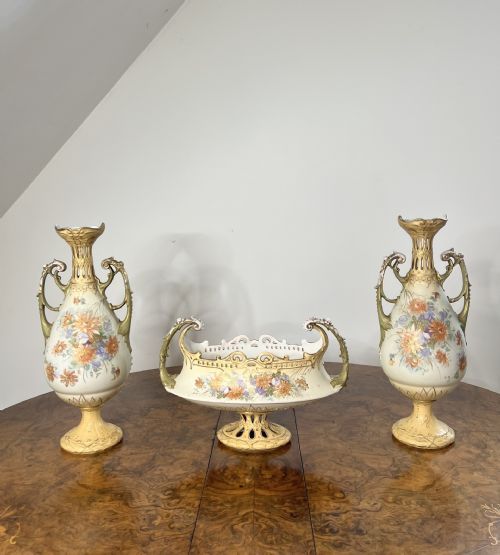


Vienna Ceramic Urn
These vienna ceramic urn pieces bring nineteenth-century neoclassical and art nouveau presence to a room, offering hand-painted detail and classical form.
Vienna Ceramic Urn
A vienna ceramic urn search covers decorative urns, lidded vases, ewers, and garniture sets spanning the nineteenth and early twentieth centuries. These objects display classical forms derived from historical models, alongside flowing art nouveau lines produced by Austrian makers.
The pieces appearing on this page range from mid-nineteenth-century classical revival works to later art nouveau creations designed around nineteen hundred. Buyers commonly encounter paired vases, lidded vessels, and centrepieces decorated with enamel and gilding.
Origins trace directly to Vienna, encompassing royal porcelain output and independent houses such as Ernst Wahliss. Forms vary from monumental lidded urns to slender jugs and multi-piece garnitures designed for mantelpieces and display tables.
Materials and decoration
The primary bodies utilise porcelain and earthenware, shaped into vessels, ewers, and garniture sets before receiving smooth glazed ceramic finishes. Firing techniques prepared these surfaces for detailed painting and metal leaf application.
Decoration relies heavily on hand-painting, complemented by enamel pigments, gold leaf, gilt, and extensive gilding. Artisans applied these metallic elements to highlight handles, rims, and neoclassical or art nouveau motifs across the ceramic body.
Vienna Ceramic Urn Retail Price Guide 2026
Typical asking prices for vienna ceramic urn among the pieces listed under this phrase on Sellingantiques today, from the lower quarter to the upper quarter. They describe what is for sale here now, not the wider market.
Ernst Wahliss named one art nouveau vase model 'Pergamon', connecting Austrian kilns directly to ancient Anatolian architecture.
Assessing quality
Quality rests upon the precision of the hand-painted figural or floral scenes and the crispness of the moulded relief work. Superior examples demonstrate expert brushwork and controlled application of gold leaf rather than mechanical transfer printing.
The richness and preservation of the enamel and gilding determine the visual impact of the piece. Well-preserved surfaces retain their original metallic brilliance and pigment depth without rubbing or loss across high-relief elements.
Ernst Wahliss·Royal Vienna
The Vienna Ceramic Urn Glossary
- Garniture
- A matching set of three or more decorative vessels designed to be displayed together on a mantelpiece or sideboard. These typically include a central urn flanked by matching vases or ewers.
- Ewer
- A large jug with a wide spout and a decorative handle, historically used for water but produced in ceramic as an ornamental display piece.
- Gilding
- The application of gold leaf or gilt paint to ceramic surfaces to highlight decorative borders, handles, and classical motifs.
- Neoclassical
- A revival style drawing inspiration from the classical art and architecture of ancient Greece and Rome, featuring symmetrical forms and restrained ornamentation.
- Art Nouveau
- An international style of art and architecture prevalent around nineteen hundred, characterised by fluid, organic lines and natural motifs.
Vienna Ceramic Urn: Frequently Asked Questions
What is a vienna ceramic urn?
A vienna ceramic urn is a decorative ornamental vessel produced in Austria during the nineteenth or early twentieth century, featuring glazed porcelain or earthenware bodies with hand-painted details.
These pieces often adopt neoclassical or art nouveau styles, serving as striking decorative focal points for a room.
How were garniture sets used?
Garniture sets were traditionally arranged as matching centerpieces on mantelpieces, tables, or large sideboards to create visual symmetry in a formal interior.
The central urn stood flanked by matching smaller vases or ewers to form a balanced decorative display.
How do I care for my urn?
Care involves gentle dusting with a soft, dry cloth to protect delicate enamel and gold leaf decorations from abrasion.
Avoid using liquid cleaners or abrasive materials, which can permanently damage the glazed ceramic surfaces and metallic details.
How do I distinguish periods?
Distinguishing periods relies on observing the decorative vocabulary, shifting from strict nineteenth-century neoclassical revival motifs to flowing art nouveau designs around nineteen hundred.
Form, painting style, and maker marks help assign pieces to specific decades within this broader timeline.