

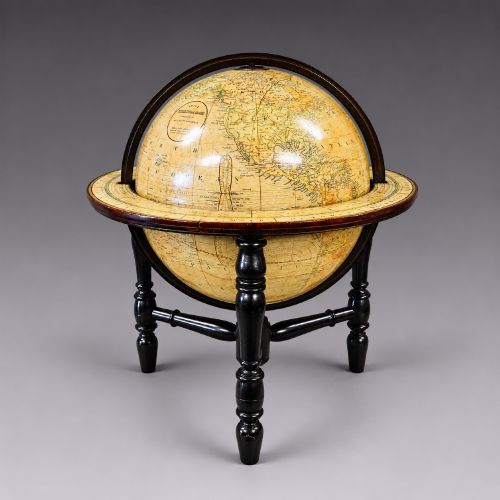


Victorian World Globe
These Victorian world globe pieces bring nineteenth-century geography into the study.
Victorian World Globe
When you search for a victorian world globe, you encounter terrestrial globes mapping the earth across desk, table, and floor-standing formats. The Victorian world globe spans smaller desk sizes up to substantial eighteen-inch examples on stands.
You meet various forms on this page, including table globes, miniature globes, and specific desk pieces by known cartographers. Alongside standard globes, the selection includes functional oil lamps featuring terrestrial globe shades.
These items originate predominantly from the nineteenth century, with specific examples dated towards nineteen hundred or sitting within the Edwardian period. Their presence ranges from compact German miniature models to large pairs of library globes.
Materials and construction
Construction relies on a combination of wood, plaster, and paper applied to form the sphere. Cartography is printed on paper gores that are carefully pasted over the plaster and plaster-coated spheres.
Support structures utilise brass, mahogany, and ebonised wood for stands, desk mounts, and bases. Varnish provides a protective surface over the paper maps, while glass appears in specific lamp shade configurations.
Victorian World Globe Retail Price Guide 2026
Typical asking prices for victorian world globe among the pieces listed under this phrase on Sellingantiques today, from the lower quarter to the upper quarter. They describe what is for sale here now, not the wider market.
Listings feature paper, brass, mahogany, and ebonised wood across nineteenth-century and Edwardian dates.
Understanding quality
Quality rests upon the clarity and accuracy of the cartography printed on the paper gores. Precision in the mounting and the stability of the brass and mahogany stands distinguish finer pieces from simpler items.
The survival of original varnish and the crispness of the geographical lettering govern the visual success of the piece. Matching pairs and larger diameters command greater presence in a study.
Smith·Malby's·Crunchley
The Victorian World Globe Glossary
- Terrestrial globe
- A spherical representation of the earth showing landmasses, oceans, and political boundaries. These objects served educational and decorative purposes in nineteenth-century interiors.
- Gores
- The lunate paper strips printed with map details that are fitted precisely around the sphere of a globe. Multiple gores join together to cover the curved plaster surface.
- Library globe
- A large terrestrial or celestial globe, often floor-standing and fitted to a substantial wooden frame. These pieces occupied scholarly rooms and formal studies.
- Ebonised wood
- Timber treated with a finish to imitate expensive ebony. This dark material provides a sharp contrast against the brass hardware and printed paper maps.
Victorian World Globe: Frequently Asked Questions
What is a Victorian world globe?
A Victorian world globe is a nineteenth-century geographical sphere showing the earth, mounted on a stand or base for desk, table, or floor placement.
These pieces reflect the cartography and manufacturing techniques of the period, using paper gores applied over plaster spheres.
How were table globes used?
Table globes served as practical reference tools for studying geography, navigation, and world events in nineteenth-century homes and studies.
They also functioned as decorative objects, demonstrating learning and global awareness within a formal interior.
How do I identify a Victorian globe?
Identification involves examining the political boundaries, place names, and cartographic styles depicted on the paper gores. Materials such as brass, mahogany, and ebonised wood further point to nineteenth-century manufacturing methods.
What materials make up these globes?
Makers constructed the spheres using plaster built over a core, then covered them with printed paper gores and protective varnish.
Stands and mountings typically incorporate brass, mahogany, and other woods, including ebonised finishes.