


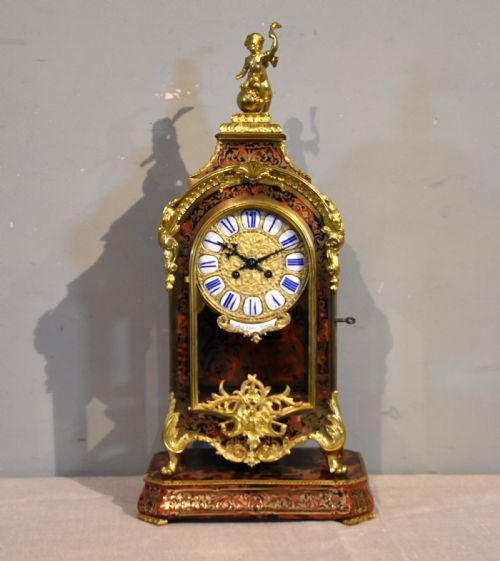


Victorian Tortoiseshell Table Clock
A victorian tortoiseshell table clock brings rich organic pattern and bright gilt brass to a mantel, offering a striking centrepiece for a traditional room.
Victorian Tortoiseshell Table Clock
A victorian tortoiseshell table clock combines organic amber and dark shell veneers with gleaming mounts, taking the form of mantel clocks, bracket clocks, and boudoir clocks. These horological pieces emerge primarily from nineteenth century French and English workshops, often reflecting elaborate revival aesthetics.
The versions most commonly met on this page span the Victorian era alongside related nineteenth century dates, rendered in both genuine tortoiseshell and clever faux tortoiseshell finishes. Makers frequently employed Boulle marquetry techniques, pairing the distinctive shell with brass inlay to create highly decorative timepieces.
How they were made
Craftsmen built these clocks using wooden carcases overlaid with delicate sheets of tortoiseshell or faux tortoiseshell, secured alongside cast brass and ormolu mounts. Many examples incorporate intricate Boulle brass inlay, requiring precise cutting of metal and shell together to form elaborate scrolling patterns.
Movements were paired with enamel dials, glass bezels, and polished silver or gilt components to complete the functional interior. Artisans often drew upon French Rococo Revival and Louis XV styles, shaping the wooden foundations into curvaceous silhouettes before applying the decorative veneers.
Victorian Tortoiseshell Table Clock Retail Price Guide 2026
Typical asking prices for victorian tortoiseshell table clock among the pieces listed under this phrase on Sellingantiques today, from the lower quarter to the upper quarter. They describe what is for sale here now, not the wider market.
Listings feature nineteenth century dates spanning the Victorian era up to the 1930s, utilising brass, enamel, tortoiseshell, ormolu, and glass.
What varies in quality
The standard of a victorian tortoiseshell table clock rests upon the crispness of the cast ormolu mounts and the intricacy of the brass inlay work. Finer examples display seamless alignment where the shell meets the metal, whilst simpler pieces rely on plain faux tortoiseshell surfaces without elaborate marquetry.
The depth of colour in the genuine shell and the retention of the original mercury gilding on the bronze elements separate superior objects from ordinary ones. Additionally, the presence of matching wall brackets or fully signed French and English movements elevates the horological and decorative merit.
J Batson & Son
The Victorian Tortoiseshell Table Clock Glossary
- Boulle
- A method of marquetry using brass and tortoiseshell inlaid together, named after the famous French cabinetmaker Andre-Charles Boulle. This technique creates a rich contrast of dark organic shell and bright metallic patterns.
- Ormolu
- Gilded bronze used for decorative mounts and feet on furniture and clocks. The process involves applying a mercury and gold amalgam to cast bronze before heating.
- Mantel clock
- A clock designed to stand on the shelf above a fireplace, often featuring decorative architectural or sculptural cases. These timepieces served as both functional instruments and prominent interior ornaments.
- Boudoir clock
- A small, intimate clock intended for a private sitting room or bedchamber. They are typically dainty in scale and richly embellished.
- Faux tortoiseshell
- A painted or treated imitation designed to mimic the mottled amber and brown patterns of natural shell. Artisans used this alternative to achieve a similar decorative effect at a different cost.
Victorian Tortoiseshell Table Clock: Frequently Asked Questions
What is a tortoiseshell clock?
A tortoiseshell clock is a timepiece encased in genuine or simulated shell veneer, usually accented with brass and ormolu mounts. These pieces were designed to display status and taste on mantelpieces and tables.
They reflect historical revival styles, particularly French Rococo and Louis XV designs popular during the nineteenth century.
How do I date a clock?
Dating involves examining the style of the case, the materials used, and any signatures on the dial or movement. Nineteenth century examples often feature distinct revival ornamentations and brass inlay.
Comparing the mechanical components and the type of tortoiseshell veneer helps narrow the period of manufacture.
Where were they placed?
These clocks were traditionally positioned on mantelpieces in formal reception rooms, drawing rooms, or private boudoirs. Their decorative cases ensured they functioned as prominent visual art as well as timekeepers.
Smaller variants were easily moved to side tables or desks where their intricate details could be admired up close.
What is Boulle work?
Boulle work is a decorative marquetry technique where brass and tortoiseshell are cut together in matching patterns. This creates contrasting panels of dark shell and bright metallic inlay.
Master craftsmen utilised this method on luxury French clocks and cabinets throughout the nineteenth century.