



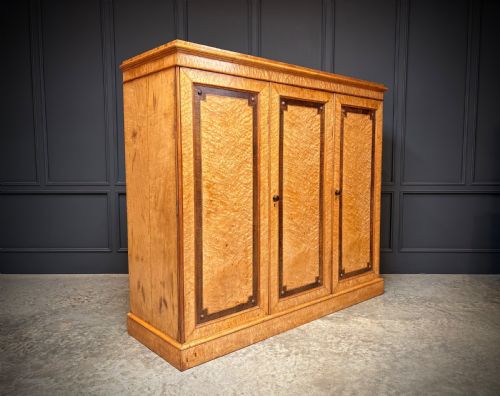


Victorian Three Door Armoire
A victorian three door armoire is a grand timber wardrobe offering generous hanging and shelving space, built to anchor a substantial bedroom.
Victorian Three Door Armoire
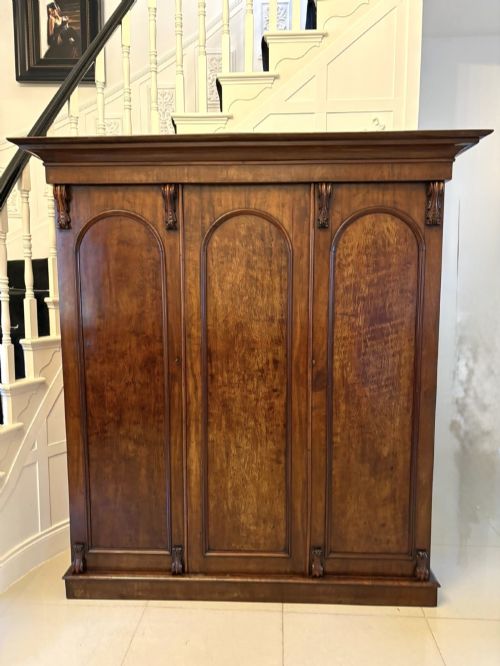
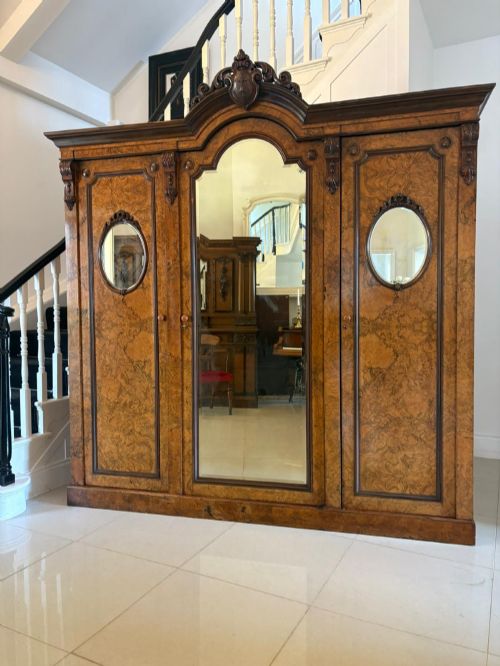
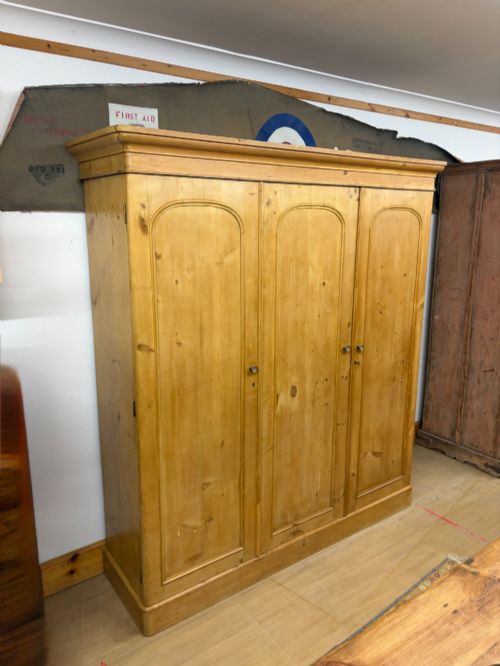
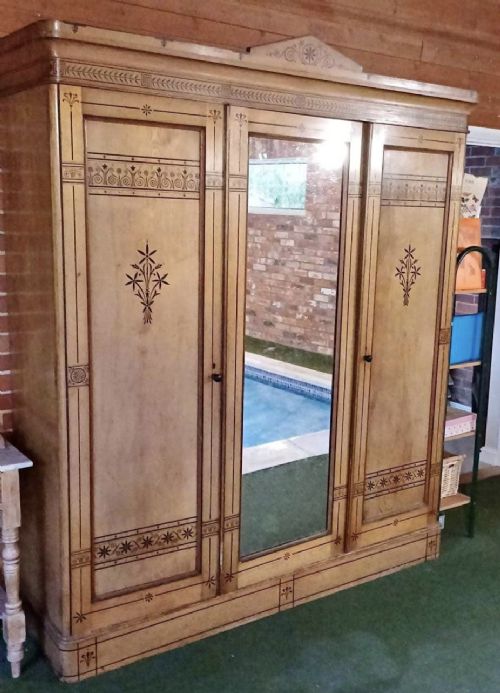
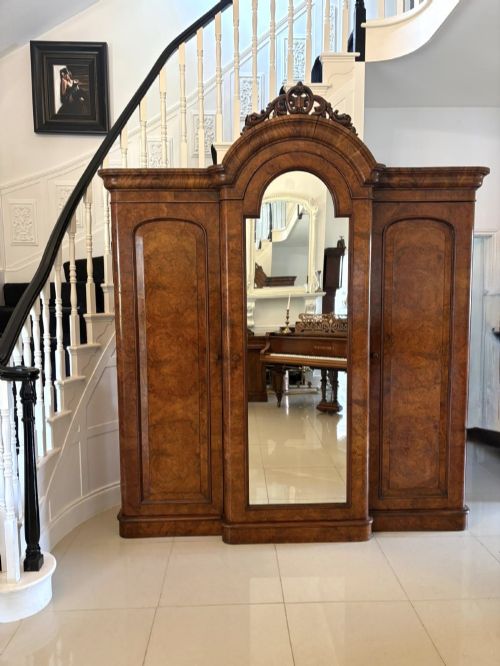
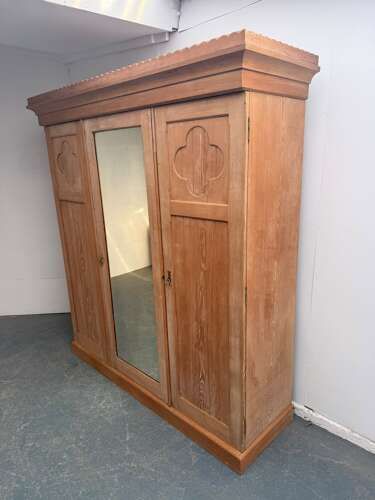
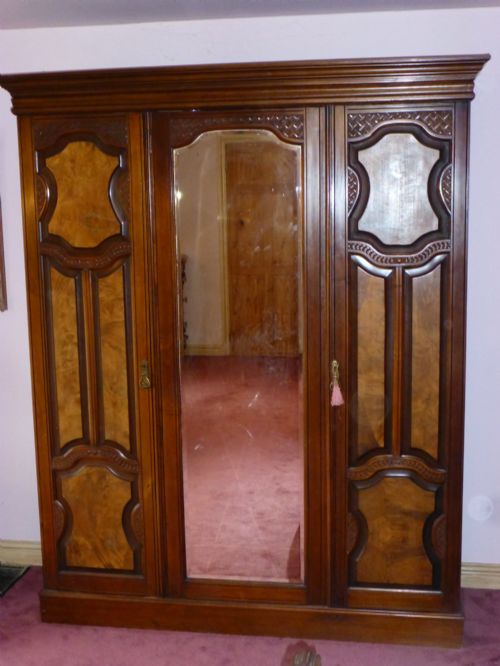
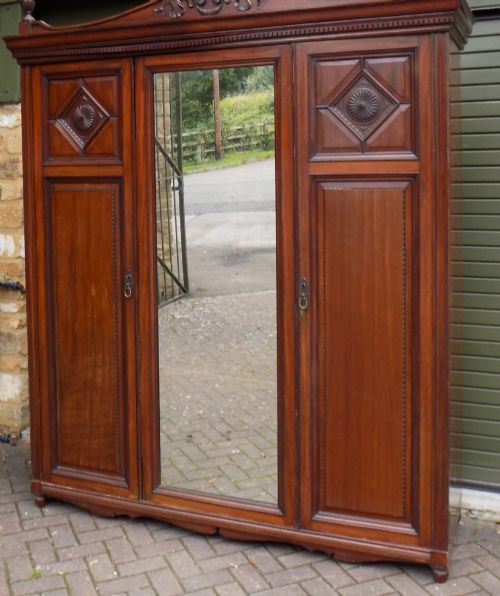
A victorian three door armoire provides large-scale bedroom storage, typically featuring a central mirrored or panelled door flanked by two hanging wings. These substantial wardrobes appear in styles ranging from plain pitch pine and mahogany to decorative burr walnut and satin birch.
Most examples found on this page date from the nineteenth century, encompassing various revivals such as Gothic, Aesthetic Movement and Arts and Crafts. The form frequently includes internal compactum drawers and sliding trays behind the central doors alongside full-length hanging compartments.
How They Were Made
Cabinet makers utilised dense hardwoods such as mahogany and walnut, often applying highly figured burr veneers to the principal exterior surfaces. Secondary timbers like pine provided internal framing and drawer linings.
Decorative elements relied on timber selection, carved panels, brass handles and mirrored glass inset into the central door. Construction methods combined frame and panel joinery to accommodate seasonal wood movement across large expanses.
Victorian Three Door Armoire Retail Price Guide 2026
Typical asking prices for victorian three door armoire among the pieces listed under this phrase on Sellingantiques today, from the lower quarter to the upper quarter. They describe what is for sale here now, not the wider market.
Several wardrobes hide compactum drawer banks behind mirrored doors, originally designed to keep gentleman's collars out of sight.
What Varies in Quality
Quality rests upon the choice of timber veneers, the crispness of any carved ornamentation and the architectural proportion of the cornice and plinth. Master cabinet makers selected finely figured burr walnut or mahogany and arranged the grain symmetrically across the facade.
Interior fittings differentiate standard hanging cupboards from superior compactum wardrobes equipped with fitted linen slides, jewellery drawers and brass-mounted hanging rails. Solid timber thickness and original bevelled mirror glass further separate standard production from high-grade workshop output.
Holland and Sons
The Victorian Three Door Armoire Glossary
- Compactum
- A multi-function wardrobe combining hanging space, shoe lockers and internal drawers within a single carcass. This configuration maximises storage efficiency in nineteenth-century bedrooms.
- Burr Walnut
- Timber taken from the gnarled growth of a walnut tree, yielding complex, swirling grain patterns. Cabinet makers prized this material for decorative door panels.
- Aesthetic Movement
- A late nineteenth-century design style emphasising artistic craftsmanship and simpler geometric lines. Pieces from this movement often utilise light timbers like satin birch.
- Pitch Pine
- A durable resinous softwood utilised for robust country house furniture and simpler wardrobes. It provides a distinct linear grain pattern.
- Breakfront
- A cabinet facade where the central section projects forward from the flanking wings. This architectural arrangement creates depth and shadow across the front of the wardrobe.
Victorian Three Door Armoire: Frequently Asked Questions
How do I fit a large wardrobe in a modern room?
These large wardrobes are designed to dismantle into manageable sections, usually comprising a cornice, plinth, central carcass and two flanking hanging robes. Assembly requires basic hand tools and patience to ensure the frame squares correctly on uneven modern floors.
Positioning the piece away from direct heat sources protects the timber and veneer from drying out and splitting over time. Professional delivery and installation is often recommended given the overall weight and height of the structure.
What is a compactum wardrobe?
A compactum is a specialised variant featuring an internal chest of drawers, sliding linen trays and shelving integrated alongside standard hanging compartments. This multi-purpose layout replaced several smaller bedroom pieces in nineteenth-century homes.
The central section typically houses the smaller drawers and mirrored door, flanked by full-length hanging spaces on either side. Such configuration offers exceptional organisation for clothing without requiring additional drawer units.
How do I care for antique timber finishes?
Maintaining the finish involves occasional application of traditional beeswax to nourish the wood and preserve the lustre of the polish. Avoid synthetic silicone sprays and keep the piece out of direct sunlight to prevent fading.
Cleaning should be restricted to a soft, dry cloth to remove dust from carved details and mouldings. Regular inspection of door hinges and locks ensures the heavy doors hang true without sagging.
Can these wardrobes be dismantled for transport?
Nineteenth-century wardrobes were constructed with knockdown capability using internal bolts, slot-in cornices and removable backboards. This modular design allowed large pieces of furniture to be carried up staircases and through narrow doorways.
Marking the components during disassembly simplifies the reassembly process and ensures every panel returns to its original position. Keeping original screws and hardware intact maintains structural stability.