

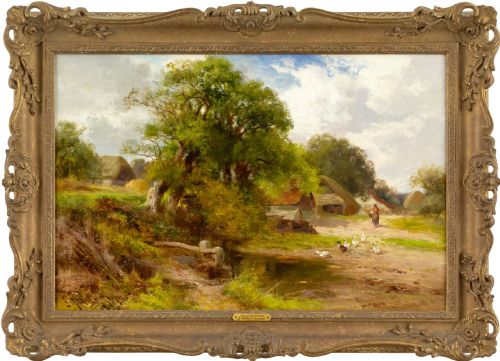


Victorian Sussex Landscape
These Victorian Sussex landscape pieces capture quiet rural scenes along rivers, mills, and coastal lanes.
Victorian Sussex Landscape
A Victorian Sussex landscape depicts the countryside, villages, and coastal views of southern England through oils or watercolour. These works record local landmarks such as old mills, river bridges, and harvest fields around places like Steyning, Burpham, and Hastings. The selection on this page centres primarily on framed watercolours and oil paintings dating from the late nineteenth century.
The subjects focus on pastoral and rural life, featuring sheep in lanes, cornfields, and cottages under expansive skies. Dating ranges from eighteen seventy through to the early twentieth century, reflecting both the Victorian period and slightly later Edwardian revivals. Buyers encounter framed pieces utilising traditional media on paper or canvas, often housed in period gilt wood frames.
Materials and Technique
Artists captured these views using oil paint on canvas or watercolour applied to paper, mounted behind glass where appropriate. Oil paintings employ thick impasto and layered brushwork to build texture in fields and skies, whilst watercolours rely on delicate washes to render atmospheric light.
Framing forms an integral part of the construction, employing carved gilt wood to house and protect the painted surface. Many works retain their original nineteenth-century frames, which complement the tonal palette of the landscape.
Victorian Sussex Landscape Retail Price Guide 2026
Typical asking prices for victorian sussex landscape among the pieces listed under this phrase on Sellingantiques today, from the lower quarter to the upper quarter. They describe what is for sale here now, not the wider market.
Recorded periods span from eighteen seventy through to nineteen forty, with a strong concentration around eighteen ninety.
Assessing Quality
Quality rests upon the artist's ability to handle light and atmosphere, distinguishing skilled regional painters from basic amateur works. Stronger compositions command attention through confident brushwork and balanced tonal contrasts across fields, water, and sky.
The preservation of the paper or canvas alongside the originality of the gilt wood frame contributes significantly to the integrity of the piece. Works that retain clear artist signatures, legible location inscriptions, and stable paint layers represent the stronger examples.
John Horace Hooper·Charles Gregory·Henry Charles Fox·Harry Pennell·Henry John Kinnaird·William Luker Snr·Yeend King
The Victorian Sussex Landscape Glossary
- Watercolour
- A painting method where fine pigment is suspended in water-soluble binders and applied to paper. This technique produces transparent washes ideal for capturing soft skies and river reflections.
- Oil on Canvas
- A medium consisting of pigments suspended in drying oils, applied over a stretched fabric support. It allows for rich textures and deep colour saturation suitable for harvest and pastoral scenes.
- Gilt Wood
- Timber that has been coated with a thin layer of gold leaf or metallic gilt finish. These frames are typical of nineteenth-century presentation for fine art.
- Pastoral
- A genre of art depicting rural life and idealized country landscapes. Such scenes frequently include agricultural workers, livestock, and quiet lanes.
Victorian Sussex Landscape: Frequently Asked Questions
What subjects appear in these paintings?
These works depict rural views across southern England, focusing on local landmarks, rivers, and agricultural life.
Common motifs include Sussex cottages, harvest fields, toll bridges, and coastal landscapes near villages.
How do I date a Victorian landscape?
Dating relies on stylistic clues, artist active periods, and framing materials recorded in the title and medium.
Most examples date from the late nineteenth century, reflecting the prevailing landscape traditions of the period.
Are these works painted on canvas or paper?
The listings show a split between oil paintings on canvas and watercolours executed on paper.
Watercolours are typically mounted behind glass, whilst oils remain exposed on their stretcher frames.
Where are the depicted locations?
The scenes focus specifically on Sussex locations such as Steyning, Burpham, Hastings, and Pevensey Bay.
Many titles explicitly name the exact village, river, or bridge captured by the artist.