


Victorian Street Scene Art
Victorian street scene art captures 19th-century urban and rural thoroughfares through detailed paintings, watercolours, and framed prints.
Victorian Street Scene Art
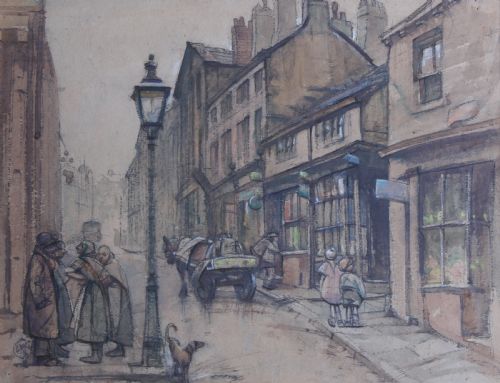
Victorian street scene art transports viewers directly into nineteenth-century thoroughfares, featuring figures, horses, carts, and architecture across Britain and continental Europe. When exploring this genre, buyers frequently encounter works created during the Victorian and Edwardian periods, stretching from the 1870s through to the early 1900s.
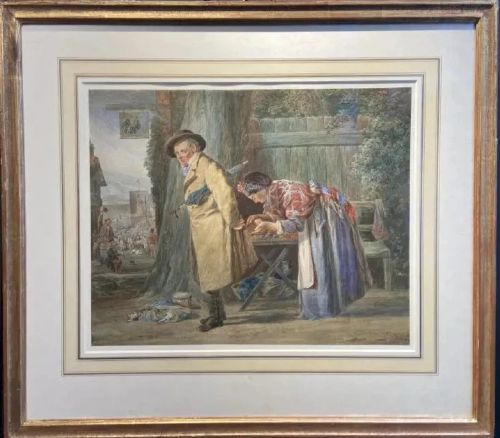
The primary forms on this page consist of oil paintings on canvas or board alongside watercolours on paper, often presented within original giltwood frames or under glass. Subjects range from bustling London markets and moonlit northern towns to French and Dutch cityscapes filled with daily commerce.
Compositions often highlight social realism, genre scenes, and architectural views, recording the movement of vendors, cab passengers, and pedestrians in towns like York, Whitby, and Paris. These pieces function simultaneously as historical records of urban life and as collectible examples of nineteenth-century fine art.
Materials and technique
Artists creating these urban scenes utilised oil paint or watercolour applied to canvas, paper, or wooden panels, frequently incorporating ink for fine architectural detailing. Supports were then housed behind glass or secured within wooden and giltwood frames, sometimes enhanced with gold leaf accents.
Techniques varied from the layered brushwork of oil paintings depicting atmospheric street sellers to the fluid washes characteristic of period watercolours. Framing methods often relied on contemporary workshops to supply protective wooden surrounds that matched the period aesthetic.
Several artists captured the exact moment a cab was hailed or a chestnut was sold on a busy Victorian pavement.
Judging quality
Quality in these works rests upon the artist's ability to render human figures, horses, and architectural perspective convincingly within a busy urban composition. Stronger examples display confident brushwork and atmospheric lighting, such as moonlight or winter twilight, rather than stiff or formulaic townscapes.
The survival of original framing materials and the physical condition of the paper, canvas, or board also influence the standing of a piece. Works retaining their period giltwood frames and clear provenance tend to represent the higher tier of available examples.
Felix Stone Moscheles·Joseph H Barnes·David Roberts·Louis Haghe·Albert Ludovici Jnr·Léon Joseph Voirin·Cornelis Christian Dommersen·William George Meadows·Lewis J Wood·Robert Hollands Walker·Joseph W Milliken·Walter Meegan·David Small·Charles H Poingdestre·William Manners·Walter Emsley·William Greaves·Tom Dudley·Matthew Hale·Henry Schafer
The Victorian Street Scene Art Glossary
- Social Realism
- An artistic movement depicting everyday working conditions and social activities with an unvarnished perspective. This style focuses on the lives of ordinary people in urban and rural environments.
- Genre Realism
- Painting that portrays aspects of everyday life by depicting ordinary people engaged in common activities. These works frequently show figures in streets, markets, or domestic settings.
- Giltwood
- Wood that has been coated with gold leaf or a gold-coloured finish. This material is commonly found on period frames designed to complement nineteenth-century paintings.
- Lithograph
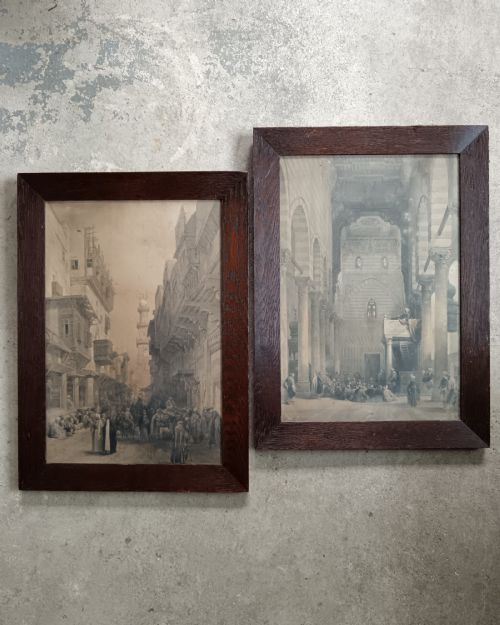
- A print made from a method based on the incompatibility of grease and water, executed on stone or metal plates. David Roberts' Cairo views utilise this reproductive technique.
- Watercolour
- A paint consisting of pigment suspended in a water-based solution, typically applied to paper. It allows for transparent washes that capture light and atmospheric weather effects.
Victorian Street Scene Art: Frequently Asked Questions
What periods do these artworks cover?
The listings span the nineteenth century and the early twentieth century, with particular concentration in the Victorian and Edwardian eras. Pieces date from the 1870s through to the 1910s.
This timeframe encompasses varied artistic movements including social realism, continental views, and late nineteenth-century genre painting.
How should I display a watercolour?
Watercolours on paper require protection from direct sunlight to prevent the pigments and paper stock from fading over time. Glazing with conservation glass helps shield the delicate washes.
Keeping them away from damp environments ensures the paper support remains stable within its frame.
Are original frames important?
Original giltwood and wooden frames provide historical context and demonstrate how the artwork was presented during the nineteenth or early twentieth century. They often feature maker stamps or labels from period framing businesses.
Retaining these surrounds preserves the physical integrity and presentation intended by the original owners.
What subjects appear in these scenes?
Artists recorded daily urban life, featuring street sellers, cab passengers, horse-drawn carts, and market days in towns and cities across Britain and Europe. Architectural backdrops include cathedrals, town halls, and residential streets.
Night scenes involving moonlight or winter twilight also feature prominently among the watercolours and oil paintings.