



Victorian Slate Mantelpiece
A victorian slate mantelpiece brings robust architectural presence and classical weight to a room, built to anchor period interiors.
Victorian Slate Mantelpiece
A victorian slate mantelpiece embodies the heavy architectural ambition of the nineteenth century, utilising dense stone to create substantial fireplace surrounds and architectural models. These pieces draw on Victorian classical revival and French taste, offering a stark, monumental silhouette designed to command a room.
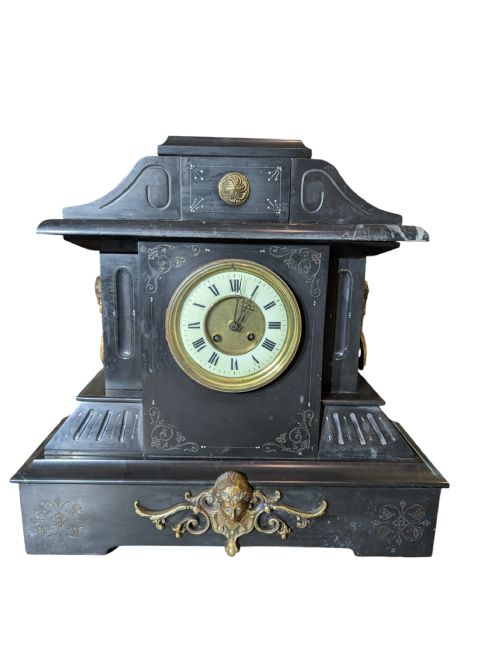
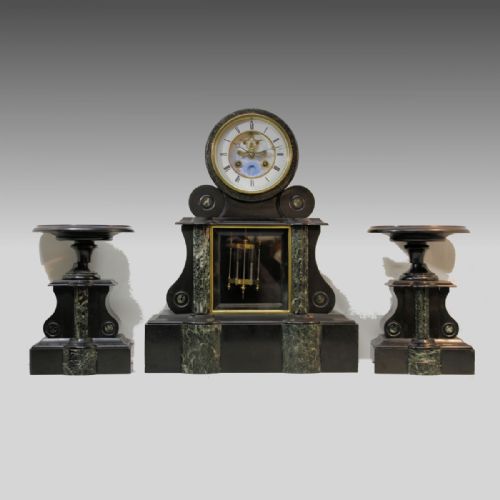
The objects seen here predominantly include black slate and Welsh slate fireplace surrounds alongside related architectural models and marble-cased clocks of the period. Buyers most frequently encounter weighty black slate structures, sometimes accented with marble inlays, dating from the mid to late nineteenth century.
Materials and construction
Craftsmen built these heavy structures using black slate and Welsh slate, often sourcing dense stone from quarries in regions such as Caernarfonshire. The stonemasonry relies on precise cutting and polishing to achieve a smooth, matte or reflective dark surface that mimics more costly marbles.
Surrounds and related mantel clocks incorporate contrasting materials like brass, glass, and inlaid marble to break the solid dark expanse. Movements within the accompanying clock forms utilise eight day mechanisms, while surface decoration occasionally employs enamel and ebonised wood details.
Listings feature items spanning the Victorian era, specifically highlighting the decades from eighteen-fifty through eighteen-ninety.
Assessing quality and execution
The standard of a victorian slate mantelpiece rests upon the precision of its stonemasonry and the ambition of its classical detailing. Finer examples display crisp architectural moulding, balanced proportions, and seamless integration of contrasting marble inlays rather than plain, unarticulated surfaces.
Execution of secondary elements, such as brass dials, engraved chapter rings, and fully restored clock movements, separates standard production from superior decorative items. The depth of the polish and the structural integrity of heavy slate columns and lintels dictate the overall caliber of the piece.
Baby and Jannings
The Victorian Slate Mantelpiece Glossary
- Welsh Slate
- A fine-grained metamorphic rock quarried in Wales, prized for its durability and uniform dark texture in architectural stonemasonry. It forms the solid foundation for regional fireplace surrounds and architectural models.
- Black Slate
- A dense, dark stone utilised during the Victorian era to imitate grand classical marbles and provide a heavy, formal appearance. This material takes a high polish and resists heat well.
- Marble Inlay
- Pieces of contrasting coloured marble embedded into the primary slate body to create geometric or floral patterns. This technique brightens the dark stone surface.
- French Empire Style
- A decorative aesthetic drawing on classical Roman and Greek motifs, characterised by bold symmetry and architectural dignity. It heavily influenced nineteenth-century mantelpiece design.
- Eight Day Movement
- A mechanical clock movement that requires winding once a week, commonly found in the mantel clocks associated with these fireplace surrounds.
Victorian Slate Mantelpiece: Frequently Asked Questions
How heavy is a victorian slate mantelpiece?
These surrounds are exceptionally heavy due to the dense nature of solid slate and marble construction. They require secure wall fixing and robust floor support.
Moving or installing them demands professional assistance to prevent structural damage or injury.
Were these mantelpieces actually used for fires?
Yes, they served as the primary architectural framing for coal-burning fireplaces in nineteenth-century homes. The stone successfully withstood the heat generated by the hearth.
Today, many survive either as decorative surrounds or as smaller architectural models.
How do I clean a slate surround?
Dust the surface regularly with a soft, dry cloth to prevent grime accumulation on the polished stone. Avoid harsh chemical cleaners that can strip the natural finish.
Applying a light mineral oil can occasionally restore the deep black lustre of the slate.
How do I date these pieces?
Dating relies on stylistic clues, such as the presence of Victorian classical revival motifs or French Napoleon III influences. Accompanying hardware, brass dials, and movement types also help narrow the decade of manufacture.
Evidence on this site points primarily to the decades between eighteen-fifty and eighteen-ninety.