




Victorian Ship in Case
These nineteenth century victorian ship in case models bring the scale and movement of old sailing vessels directly onto a mantel or shelf inside a glazed wooden frame.
Victorian Ship in Case
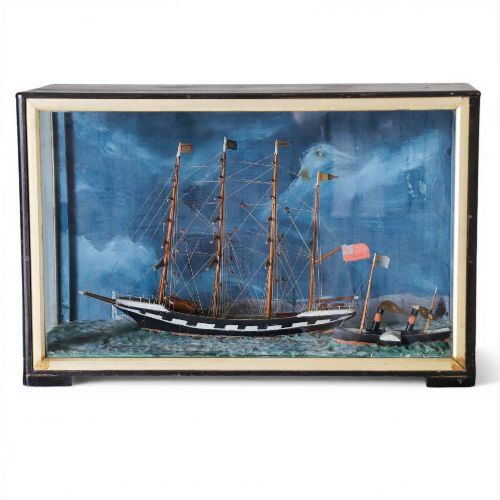
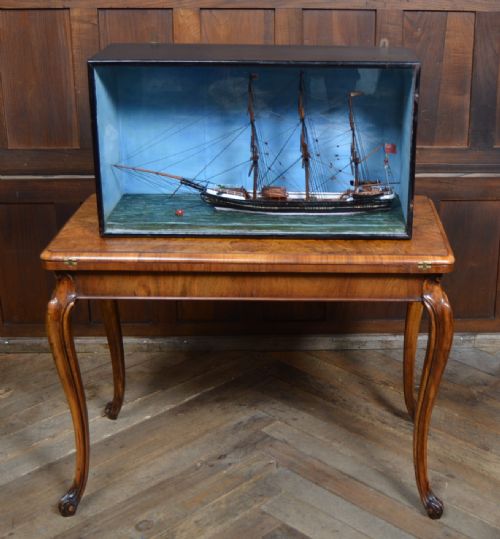
A victorian ship in case represents the height of maritime folk art, capturing full-rigged sailing ships, racing vessels and steam barges frozen mid-voyage inside a protective glazed housing. Buyers seeking a victorian ship in case typically encounter nineteenth century maritime dioramas, shadow boxes and cased model ships created by makers working in the English and French traditions.
The objects span varied forms from standard table models to wall-mounted shadow box dioramas and straw work creations. Most pieces date across the nineteenth century, including specific years like eighteen sixty, eighteen eighty and nineteen hundred, reflecting the golden age of sail and maritime craftsmanship.
Materials and construction
Makers built these pieces using wood and canvas to shape the hull and sails of the vessels, often mounting them against painted plaster backdrops that mimic tumultuous seas and Turneresque seascapes. Gilt, brass and fabric frequently add decorative detail to the frames and rigging, while heavy glass enclosures protect the delicate internal work from dust and damage.
Folk art construction methods rely on resourcefulness, demonstrated by examples incorporating straw work into the maritime scenes alongside traditional shipbuilding techniques scaled down for display.
The archive records nineteenth century satinwood bookcases alongside oak barometers.
Assessing quality in maritime models
Quality rests upon the fidelity of the rigging, the depth of the painted backdrop and the proportion of the vessel housed within the case. Superior examples display intricate detailing in the canvas sails and hull construction, whereas simpler pieces rely on basic forms without the atmospheric depth of a painted Turneresque seascape.
The integrity and clarity of the original glass housing alongside the joinery of the wooden frame influence the overall presence of the piece, separating standard folk art items from more ambitious nineteenth century dioramas.
Henry Hughes
The Victorian Ship in Case Glossary
- Maritime Diorama
- A three-dimensional model depicting ships at sea within a contained and glazed setting. These pieces combine painting and sculpture to create the illusion of depth and movement.
- Shadow Box
- A deep, walled picture frame enclosed with glass that holds a raised display. In maritime pieces, this format houses the hull and rigging of the model ship safely away from the room.
- Straw Work
- A decorative technique utilising split straw applied to a surface in geometric or pictorial patterns. In maritime folk art, it creates shimmering textures on sea surfaces or frames.
- Turneresque Seascape
- A painted backdrop showing dramatic, atmospheric weather and turbulent water in the manner of J.M.W. Turner. It provides the background drama for sailing ship models.
- Folk Art
- Objects created by self-taught or traditional artisans using accessible materials like wood, canvas and plaster. These pieces value practical ingenuity and personal expression over factory standardisation.
Victorian Ship in Case: Frequently Asked Questions
How were these cased ship models originally displayed?
These maritime scenes stood on mantelpieces, desks or sideboards in captains' quarters and maritime homes. The glass case protected the delicate canvas sails and rigging from household dust and sea air.
Today, they suit similar prominent surfaces where light can pass through the front glass to illuminate the painted backdrop and miniature rigging.
What periods do these pieces date from?
The available pieces originate primarily from the nineteenth century, with specific examples dated around eighteen sixty, eighteen eighty and nineteen hundred. This period encompasses high Victorian maritime folk art.
Construction details and framing styles help separate the mid nineteenth century works from later turn-of-the-century models.
Are the backdrops always painted?
Most models feature painted plaster or canvas backdrops showing open ocean, coastal views or Turneresque seascapes. These backgrounds give flat shadow boxes a sense of deep perspective.
Some simpler folk art examples rely entirely on the physical model itself without an elaborate painted sky.
How do I care for a cased ship model?
Keep the piece away from direct sunlight and excessive humidity to protect the old wood, canvas and painted plaster. Dust the exterior glass gently with a soft cloth.
Avoid opening the sealed case, as the internal environment has protected the fragile paper, thread and straw elements for over a century.