
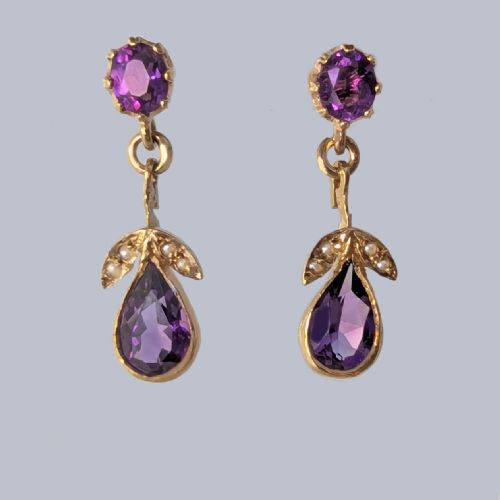


Victorian Seed Pearl Earrings
Victorian seed pearl earrings bring delicate, shimmering lustre to the earlobe, combining tiny pearls with rich gold and vibrant gemstones.
Victorian Seed Pearl Earrings
Victorian seed pearl earrings comprise antique and revival pieces that showcase minute, perfectly drilled pearls mounted in elaborate gold or silver settings. These delicate jewels often take the form of floral clusters, drop pendants, or symbolic motifs like horseshoes and doves.
Most examples encountered here date from the nineteenth century or arrive as mid-century Victorian revival pieces from the nineteen sixties. They appear frequently paired with amethysts, turquoise, garnets, or diamonds, reflecting the varied tastes of their makers.
Buyers will find both simpler drop configurations and more complex multi-stone parure sets that include matching pendants. The overarching design language leans heavily into organic, floral, and romantic themes characteristic of the period.
Materials and methods
The construction relies heavily on fine metallic foundations of nine-carat, fourteen-carat, and fifteen-carat gold, alongside silver and rose gold variants. Artisans meticulously wired or glued minute seed pearls onto backing plates to form intricate floral clusters and delicate swags.
Gemstones such as turquoise, amethyst, garnet, and tourmaline are frequently bezel or prong-set alongside the pearls to add contrasting colour and focal weight. Hinging and dormeuse mechanisms provide secure wear, while some pieces incorporate silver-backed gold settings typical of high-period jewellery manufacture.
Listings feature nine-carat, fourteen-carat, fifteen-carat, and eighteen-carat gold, alongside silver and rose gold.
Defining quality
Quality reveals itself in the uniformity and tight arrangement of the seed pearls, where secure setting prevents individual beads from loosening over time. The precision of the underlying gold or silver work, from hand-twisted wire to finely chased floral motifs, dictates the piece's overall refinement.
The Victorian Seed Pearl Earrings Glossary
- Seed pearl
- A tiny, naturally formed or early cultured pearl measuring under two millimetres in diameter. They are traditionally pierced and threaded onto fine silk or wire.
- Cluster earrings
- A jewellery design featuring a central stone or motif surrounded by a ring of smaller gems. In this context, pearls frequently encircle a coloured gemstone.
- Dormeuse
- A type of French earring designed with a comfortable backing mechanism originally intended for sleeping. They sit close to the lobe with a hinged wire closure.
- Parure
- A matched set of jewellery designed to be worn together, typically comprising earrings, a necklace or pendant, and sometimes a brooch or bracelet.
- Victorian Revival
- A later aesthetic movement, notably seen around nineteen sixty, that faithfully emulates the forms, materials, and motifs of the nineteenth century.
Victorian Seed Pearl Earrings: Frequently Asked Questions
Are these earrings made of solid gold?
The metallic components typically consist of solid gold alloys ranging from nine-carat up to eighteen-carat, alongside silver and rose gold variations. Hallmarks or specific carat stamps often appear on the fittings to verify the metallic content.
Some nineteenth-century pieces utilise a combination of gold and silver, a traditional technique where silver was placed on the face to brighten gemstone settings while gold formed the supportive reverse.
Can I wear antique earrings every day?
While these pieces were built to last, their age and delicate seed pearl construction demand a more mindful approach to daily wear. Reserve them for special occasions or thoughtful everyday use to protect the tiny pearls from accidental knocks.
Checking the security of the hooks, drops, and settings with a jeweller periodically ensures that no tiny pearls or gemstones are lost during routine rotation.
How do I distinguish Victorian from revival pieces?
Original nineteenth-century pieces often display hand-beveled mounts, organic wear patterns, and older closure styles like wire hooks or early safety mechanisms. The gold alloys used may also lack modern standard assay marks.
Revival pieces, such as those produced in the nineteen sixties, typically feature crisp modern hallmarks, standardised fittings, and manufacturing cleanliness that points to twentieth-century workshop production.