


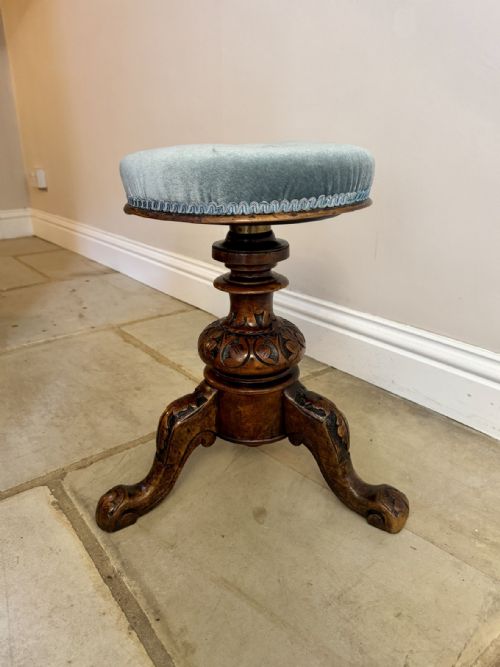
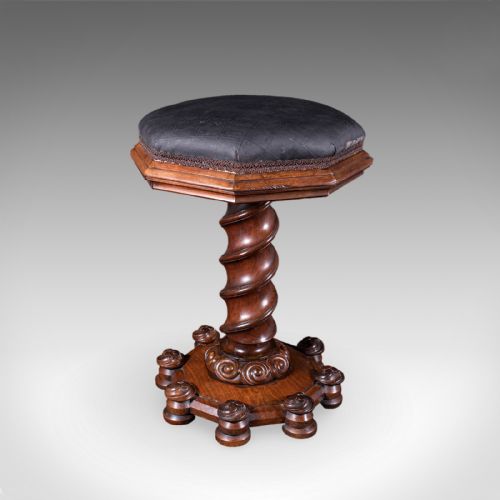


Victorian Revolving Piano Stool
A Victorian revolving piano stool offers practical height adjustment alongside period character, making it a versatile seat for both music rooms and dressing tables.
Victorian Revolving Piano Stool
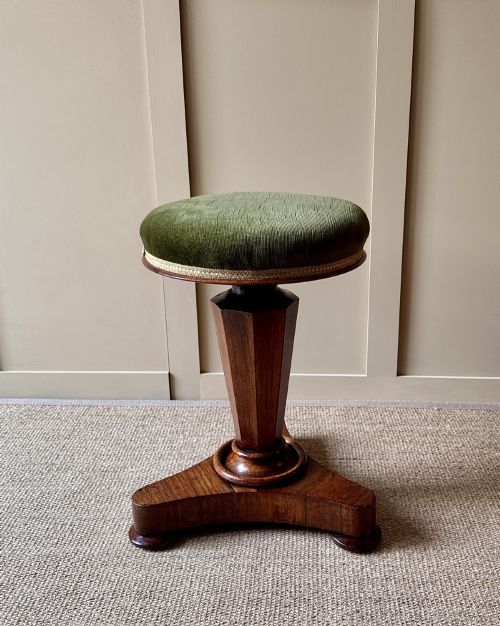
A Victorian revolving piano stool combines mechanical function with domestic seating, designed primarily to assist musicians at the keyboard. Most examples found here date from the nineteenth century, spanning Victorian, William IV, and Regency periods, with various stool and chair configurations.
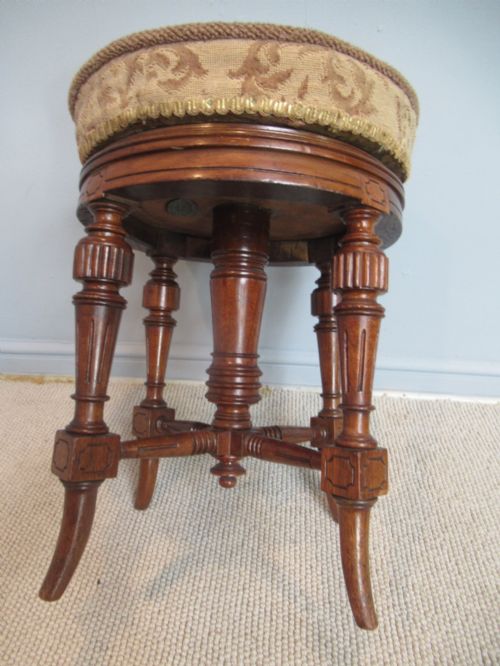
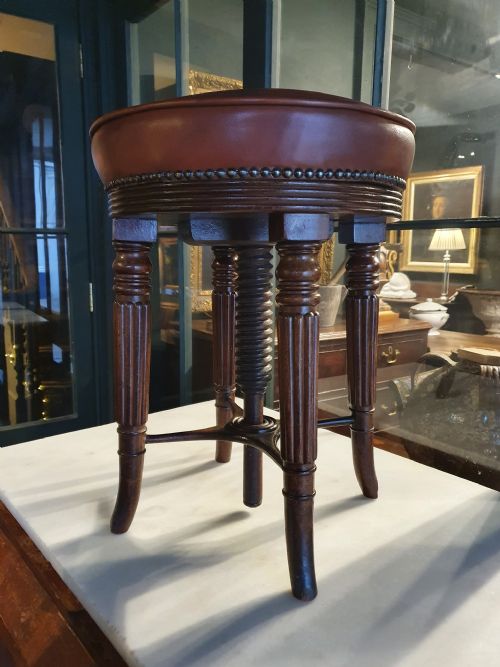
The primary forms on this page include standard swivel top music stools, rise and fall designs, and adaptable dressing table chairs. These pieces often feature circular or square upholstered seats atop central wooden screws or metal winding mechanisms.
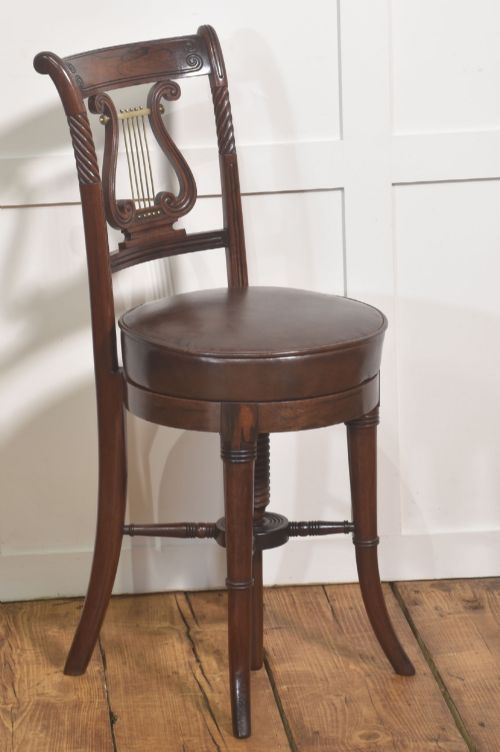
Origins and materials vary across the selection, ranging from standard British walnut and mahogany pieces to French walnut, Canadian items, and Burmese padouk harpist chairs. Industrial variants with cast iron components also appear alongside fine cabinetmaker pieces.
Materials and construction
Makers utilised dense timbers such as mahogany, walnut, rosewood, and padouk, often selecting them for their rich grain and structural stability. Secondary woods and ebonised finishes also appear, supporting carved details and turned legs.
Mechanical adjustment relies on central wooden screws or metal rise and fall mechanisms concealed beneath the seat framework. Upholstery materials recorded in the evidence include leather, velvet, fabric, and original woven textiles secured over padded tops.
Victorian Revolving Piano Stool Retail Price Guide 2026
Typical asking prices for victorian revolving piano stool among the pieces listed under this phrase on Sellingantiques today, from the lower quarter to the upper quarter. They describe what is for sale here now, not the wider market.
Some nineteenth-century musicians clearly required extra stability, as evidenced by heavy cast iron industrial swivel bases supporting modest wooden tops.
Judging quality
The distinction between standard utility seating and finer examples rests on the crispness of the timber carving and the sophistication of the turning. Master cabinetmakers executed intricate foliate carving and robust joinery that remained rigid through decades of height adjustment.
The engineering of the revolving mechanism marks a clear division in grade, as smooth, reliable winding action requires precise threading in wood or metal. Superior pieces maintain alignment without excessive wobble when extended to maximum height.
Material selection and decorative enrichment further separate the range, from plain hardwood country stools to elaborately figured rosewood and walnut frames with branded maker attribution or specialised music seat configurations.
Gillows·James Shoolbred
The Victorian Revolving Piano Stool Glossary
- Revolving
- Turning around a central axis to allow the sitter to rotate freely. This movement is typically achieved through a threaded screw column concealed within the central pillar.
- Rise and fall
- An adjustable mechanism that alters the height of the seat via a winding screw or ratchet system. It enables players to set their preferred posture relative to the keyboard.
- Swivel top
- A rotating upper seat section attached directly to the base structure. It permits lateral movement independently of the main supporting column.
- Padouk
- A dense tropical hardwood prized for its deep reddish-brown coloration and durability. It was occasionally employed for specialist seating such as harpist chairs.
- Ebonised
- Wood finished with a dark stain or lacquer to imitate the appearance of ebony. This treatment was popular for decorative Victorian and nineteenth century music furniture.
Victorian Revolving Piano Stool: Frequently Asked Questions
How do I adjust the height?
Most pieces operate via a central wooden screw or metal spindle hidden beneath the seat. Turning the top clockwise or anticlockwise raises or lowers the sitting platform.
Ensure the mechanism is clean and lightly lubricated if stiff, avoiding forced turns that might damage the internal threads.
Were these only used for pianos?
While designed primarily for keyboard instruments, many examples functioned as music stools for harpists and organists. Their adjustable nature also suited them for use at dressing tables.
Their compact footprint and swivel action made them adaptable seating across multiple domestic rooms during the nineteenth century.
How do I identify a William IV piece?
William IV examples typically exhibit robust proportions, bold scrolling supports, and carved pedestals reflecting the transition between Regency and early Victorian taste. Look for substantial mahogany frames and distinctive heavy turning.
They often feature simpler, heavier undercarriages compared to the lighter, more ornate walnut and rosewood designs of the later Victorian decades.
Can I use a swivel stool daily?
These nineteenth-century seats are structurally robust enough for regular modern use provided the mechanical joints remain stable. Regular use requires checking that the central screw column does not become over-extended.
Treat the height mechanism with care and avoid spinning rapidly while seated to preserve the historic joints.