






Victorian Reverse Glass Painting
Victorian reverse glass painting brings brilliant colour and protected detail straight from the back of the pane to your wall.
Victorian Reverse Glass Painting
A victorian reverse glass painting involves applying pigment, gold leaf, or decalcomania directly to the rear of a glass sheet so the final image is viewed through the front. The selection on this page spans wall art, games boards, trade signs, apothecary jars, and table lamps from the nineteenth century and the Edwardian era.
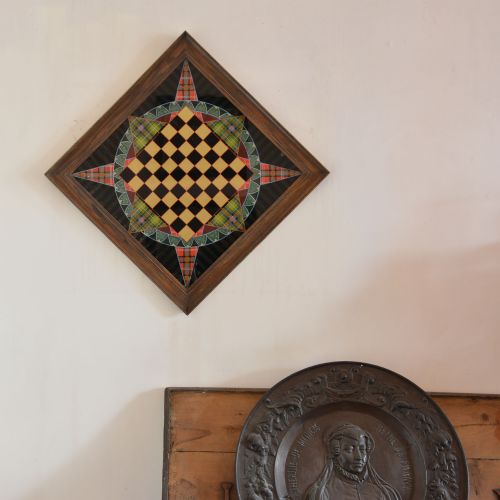
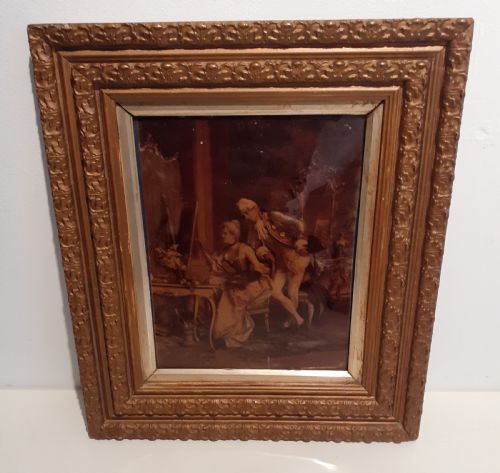
Most examples you will encounter take the form of framed wall mirrors, merchant signs, or chrystoleoms. Subjects range from Scottish games boards and armorial crests to equestrian scenes and sentimental portraits.
Makers utilised various regional styles, including Victorian folk art, commercial advertising, and continental or Egyptian revival designs. Framed pieces frequently incorporate original wooden or gilded wood surrounds.
Materials and technique
Makers painted directly onto the reverse side of glass panels, often building up complex layers of oil paint, paper, and pearl patent finishes. Working backward meant details, lettering, and highlights had to be applied before the background colours.
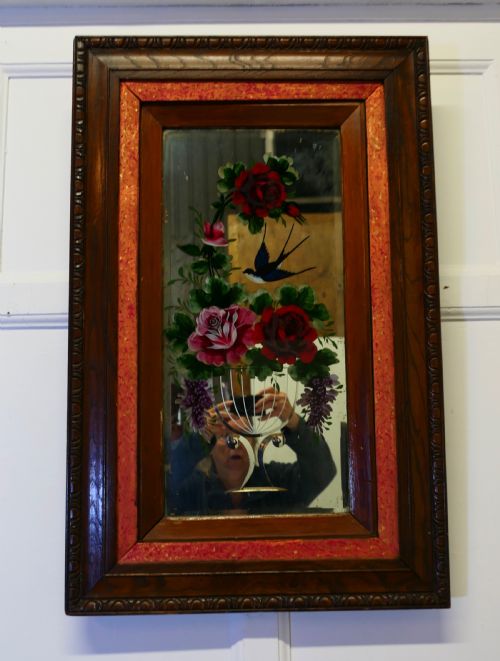
Many items incorporate gold leaf, eglomise techniques, or etched mirror plates to catch the light. Finished panels were then secured within wooden frames, gilt wood moulding, or original shop sign surrounds.
Dogs and courting couples stare out from behind glass panes while merchant signs cheerfully command attention across the decades.
Assessing quality and execution
The distinction between ordinary and exceptional pieces rests on the precision of the reverse brushwork and the complexity of the composition. Portraiture, detailed armorial crests, and layered chrystoleoms demand high technical skill compared to mass-produced commercial signage.
The survival of original gilding, untouched wooden frames, and undamaged glass plates elevates an object. Pieces retaining legible trade lettering or specific historical attribution represent the upper tier of this medium.
Thomas Lane·Schweninger
The Victorian Reverse Glass Painting Glossary
- Reverse glass painting
- A technique where the artist paints or applies gold leaf to the back of a glass sheet so the image is viewed through the front.
- Chrystoleum
- A coloured photograph or print applied to glass, hand-painted from behind, and finished with oil pigments.
- Eglomise
- A process involving the application of cold painting and gold leaf to glass, often using a geometric or mirrored ground.
- Decalcomania
- A transfer method used to apply printed designs onto glass surfaces before sealing.
- Armorial crest
- A heraldic design depicting a family or institutional coat of arms, frequently rendered in oil on glass.
Victorian Reverse Glass Painting: Frequently Asked Questions
Were these paintings meant for everyday use?
Many examples served practical purposes as shop signs, advertising mirrors, apothecary jars, and functioning chess or games boards.
Others were purely decorative wall art intended to brighten Victorian and Edwardian interiors.
What is a chrystoleum?
A chrystoleum is a specific type of Victorian picture made by placing a coloured print face down on glass, rubbing away the paper backing, and painting the remaining transparent layer by hand from behind.
This method produced a rich, glossy finish that mimics an oil painting.
How are these pieces dated?
Dating relies on stylistic clues, frame construction, lettering fonts, and specific technical patents recorded during the nineteenth and early twentieth centuries.
Subject matter such as Victorian folk art or Edwardian commercial advertising also helps place items within their historical window.