
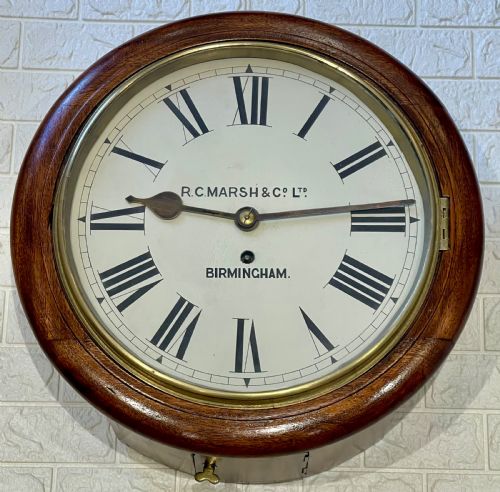


Victorian Office Dial Clock
These Victorian office dial clock pieces are robust timepieces built for daily utility, and collectors prize them for their clean lines and reliable fusee movements.
Victorian Office Dial Clock
A Victorian office dial clock serves as a dependable timekeeper designed for public spaces, railway stations, and administrative rooms. These wall clocks appear primarily as wall-mounted timepieces enclosed in circular wooden surrounds.
The versions most commonly met on this page include mahogany and oak cases housing clear painted steel dials behind protective glass. Pieces date across the nineteenth century into the twentieth century, reflecting standard municipal and commercial timekeeping.
Makers such as John Walker and J C Ralls produced these robust instruments, sometimes incorporating specific council markings like the London County Council wall clock. Form follows function rigidly, resulting in legible faces intended for reading across a large room.
How they were made
Makers constructed the circular outer cases using solid timbers like mahogany and oak, housing the internal mechanisms securely. Brass components within the movement work alongside painted steel dials to ensure steady mechanical operation.
Fusee movements power many of these pieces, regulating the pull of the mainspring through a conical pulley to maintain constant force. Heavy glass covers protect the dial face, held within hinged bezels that allow easy access for winding and setting.
Dating spans from the Victorian era into the mid-twentieth century, including railway and council pieces.
What varies in quality
Quality rests in the precision of the fusee movement and the crispness of the dial lettering rather than mere age. Finer examples retain original dial paint and well-figured mahogany or oak timber cases without heavy restoration.
The presence of a recognised maker's name on the dial elevates a piece above standard anonymous municipal timepieces. Attention to detail in the brasswork and the solidity of the timber housing distinguish superior examples.
John Walker·J C Ralls
The Victorian Office Dial Clock Glossary
- Fusee
- A conical pulley used with a cord or chain to equalize the torque of the mainspring as it unwinds. This mechanism ensures the clock maintains an even driving force for better timekeeping accuracy.
- Dial
- The face of the clock where the numerals and hands display the time. On these pieces, dials are typically painted steel protected by a glass cover.
- Timepiece
- A clock that indicates the time without including a striking mechanism to chime the hours. Office and railway clocks often take this simple form to avoid distracting noise.
- Bezel
- The metal or wooden ring that holds the glass door in front of the dial. It usually hinges open to allow access for winding the movement.
Victorian Office Dial Clock: Frequently Asked Questions
How do I wind a fusee wall clock?
Use the appropriate winding key inserted into the dial aperture, turning it gently until resistance indicates the spring is fully wound. Avoid over-winding to protect the historical mechanism.
Ensure you support the pendulum or secure the movement if the clock requires relocation after winding.
How can I date a wall clock?
Dating relies on examining the timber case style, the construction of the fusee movement, and any signature lettering on the dial face. Mahogany cases often point to mid-nineteenth century production, while later examples incorporate oak or twentieth-century municipal markings.
Comparing the dial typography with known maker records helps narrow down the decade of manufacture.
Why do some dials have convex glass?
Convex glass curved outward to reduce glare from interior lighting or windows, making the dial easier to read from various angles in a large room. This practical feature was common on office and station clocks.
It protects the painted steel dial while maintaining clear visibility across public spaces.