



Victorian Mountain Scenery Canvas
These Victorian mountain scenery canvas paintings capture dramatic peaks and quiet lochs, bringing the scale of the nineteenth century into a modern interior.
Victorian Mountain Scenery Canvas
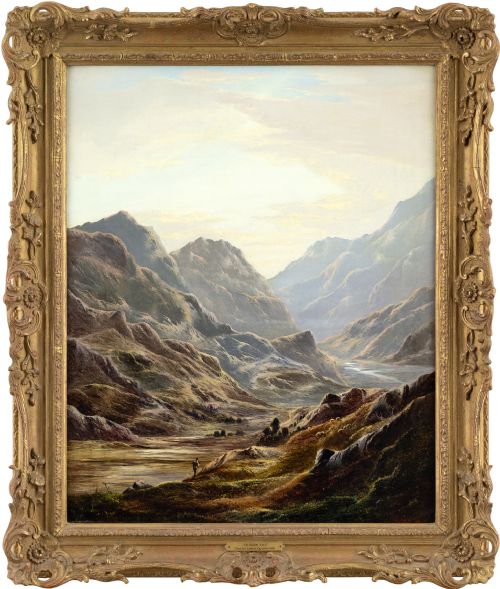
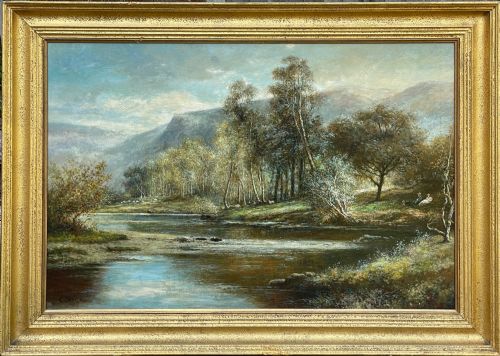
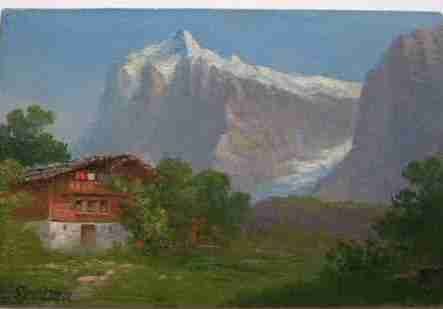
A Victorian mountain scenery canvas presents dramatic vistas of crags, lochs, and river valleys set within nineteenth century aesthetic traditions. These works capture specific topographical landmarks ranging from Scottish highlands to Welsh peaks and Bavarian castles.
The pieces on this page span the Victorian period alongside broader nineteenth century romanticism and realism. Viewers encounter compositions attributed to notable painters such as Alfred de Breanski and Charles Leslie.
Subject matter frequently centres on water and elevation, pairing mountain streams and glacial lakes with brooding skies. Large pairs and single canvases alike dominate the selection, offering expansive views suited for substantial wall spaces.
Materials and methods
Artists painted primarily using oil on canvas, applying pigment to build depth in both distant mountain ranges and foreground foliage. This medium allowed for subtle blending of atmospheric mist and clear reflections upon lake surfaces.
Frames play an integral role in presentation, constructed from wood and embellished with gesso and composition details. Many examples retain their original giltwood or gilt wood surrounds, which accentuate the warm tones within the painted scenes.
Victorian Mountain Scenery Canvas Retail Price Guide 2026
Typical asking prices for victorian mountain scenery canvas among the pieces listed under this phrase on Sellingantiques today, from the lower quarter to the upper quarter. They describe what is for sale here now, not the wider market.
The listings span from the Victorian era into the early twentieth century, utilising oil on canvas and giltwood frames.
Assessing quality
Excellence in these paintings rests upon the artist's handling of light and atmospheric perspective across rugged terrain. Masterful works convey the distinct geology of specific peaks rather than relying on generic formulas.
The integration of the original frame alters the visual impact, particularly when elaborate gesso mouldings complement the scale of the canvas. Preservation of the pigment surface without extensive overpaint distinguishes superior survivals.
Charles Leslie·John Grenville Fennell·Sidney Richard Percy·Karl Herrle·Stephen Enoch Hogley·Alfred de Breanski·Robert John Hammond·Hubert Sattler
The Victorian Mountain Scenery Canvas Glossary
- Canvas
- A heavy woven fabric stretched across a wooden stretcher to serve as a support for oil painting. It provides the textured foundation essential for nineteenth century brushwork.
- Giltwood
- Wood carved and covered with a thin layer of gold leaf. This material frequently frames nineteenth century landscape paintings to enhance their presence.
- Gesso
- A plaster mixture applied to wooden frames before gilding to create smooth surfaces for ornamentation. It allows crisp relief details along the frame moulding.
- Composition
- A moulded material made from Whiting, resin, and glue used to form decorative elements on frames. It mimics carved wood with high detail.
- Romanticism
- An artistic movement focusing on emotion, individualism, and the awe-inspiring power of nature. This style informs many depictions of towering peaks and stormy skies.
Victorian Mountain Scenery Canvas: Frequently Asked Questions
How do I hang a large canvas?
Heavy nineteenth century canvases require secure wall anchors fixed directly into masonry or studs. The substantial weight of giltwood frames demands robust hanging wire and rated hooks.
Position the centre of the painting at eye level to replicate gallery placement. Ensure the wall space allows the expansive mountain view to breathe without crowding.
Where were these landscapes painted?
Artists travelled extensively through British and European highlands to capture authentic terrain. Named locations include Scottish lochs, Welsh summits, and Alpine peaks.
Many works record specific topographical views known to nineteenth century tourists and naturalists. Painters often inscribed titles or locations on the reverse of the canvas.
What defines Victorian realism?
This approach focuses on accurate observation of nature, geology, and atmospheric conditions without excessive romantic exaggeration. Painters recorded the specific light of Welsh or Scottish valleys.
Figures engaged in everyday rural tasks often populate the foreground to establish human scale against vast mountains. Detail in rock strata and foliage remains paramount.