


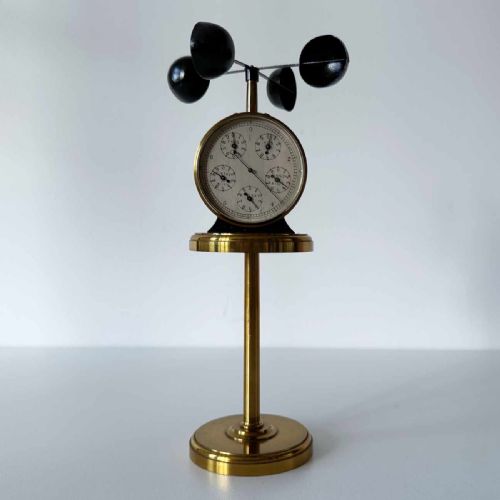


Victorian Meteorological Instrument
These Victorian meteorological instrument examples bring scientific precision and handsome nineteenth-century cabinetry directly into your study or hall.
Victorian Meteorological Instrument
A Victorian meteorological instrument is a practical device designed to measure atmospheric pressure, wind speed, or temperature during the nineteenth and early twentieth centuries. When you search for a Victorian meteorological instrument, you encounter barometers, barographs, anemometers, and weather stations housed in timber cases.
The versions you are most likely to meet on this page span the nineteenth century and the Edwardian period, often taking the form of aneroid barometers or cased recording instruments. These pieces originate from makers in London, Newcastle, and France, reflecting the era's obsession with recording atmospheric changes.
Makers housed these precision movements in sturdy oak, mahogany, and rosewood, sometimes combining multiple gauges into a single desk or wall-mounted weather station. They served both domestic utility and scientific inquiry in drawing rooms and observatories alike.
Materials and construction
Brass and glass form the functional core of every Victorian meteorological instrument, protecting delicate dials, linkages, and needles while offering a bright contrast to dark timber surrounds. Makers mounted sensitive metal barometric cells and thermometer tubes behind glazed bezels to keep dust from the works.
Cabinetmakers housed these mechanisms in dense hardwoods such as mahogany and oak, joining the timber with tight mitres and housing them in wall-mounted frames, heavy pedestals, or lidded desk boxes. Paper scales and printed record charts complete the interior layout, often bearing the maker's engraved signature.
Victorian Meteorological Instrument Retail Price Guide 2026
Typical asking prices for victorian meteorological instrument among the pieces listed under this phrase on Sellingantiques today, from the lower quarter to the upper quarter. They describe what is for sale here now, not the wider market.
Listings feature pieces spanning the nineteenth century and the Edwardian era, constructed from brass, glass, oak, and mahogany.
Assessing quality and execution
Quality in a Victorian meteorological instrument rests on the crispness of the engraved scale and the reputation of the firm that signed the dial, distinguishing precision laboratory pieces from standard domestic wall units. Maker-signed dials by established instrument houses command attention through fine division markings and robust mechanical linkages.
The joinery of the wooden case also signals the tier of the piece, with heavy carved mouldings, inlaid mother-of-pearl accents, or solid mahogany housings separating superior examples from simpler utilitarian boxes.
Short and Mason·Negretti and Zambra·J Hicks·F Robson Newcastle
The Victorian Meteorological Instrument Glossary
- Aneroid barometer
- An instrument that measures atmospheric pressure by the expansion and contraction of a sealed metal capsule, without using liquid mercury.
- Barograph
- A mechanical weather instrument that records barometric pressure continuously over a week onto a rotating paper chart.
- Anemometer
- A device used for measuring wind speed, often featuring rotating cups mounted on a brass pedestal or housing.
- Weather station
- A combined assembly containing multiple meteorological instruments, such as a barometer, thermometer, and hygrometer, mounted within a single wooden case.
- Bezel
- The brass or metal ring that holds the protective glass cover securely over the face of the instrument dial.
Victorian Meteorological Instrument: Frequently Asked Questions
What is a Victorian meteorological instrument?
It is a scientific device built in the nineteenth or early twentieth century to measure atmospheric pressure, wind speed, or temperature.
These pieces combine precise brass mechanics with traditional cabinet timbers like oak and mahogany.
How do barographs work?
A barograph uses an airtight metal drum connected to a series of levers that track air pressure shifts onto inked paper.
A clockwork cylinder rotates the chart drum once every seven days to provide a continuous trace.
Where should I place a barometer?
Mount your barometer on an interior wall away from direct sunlight, heating vents, and doors to ensure accurate pressure readings.
Stable indoor temperatures help protect the delicate internal brass linkages from unnecessary expansion.
How do I date these instruments?
Examine the style of the timber case, the typeface on the paper or metal dial, and any engraved maker signatures.
Design motifs shift from heavy Victorian Gothic framing to cleaner Edwardian lines and simpler scientific mountings.