
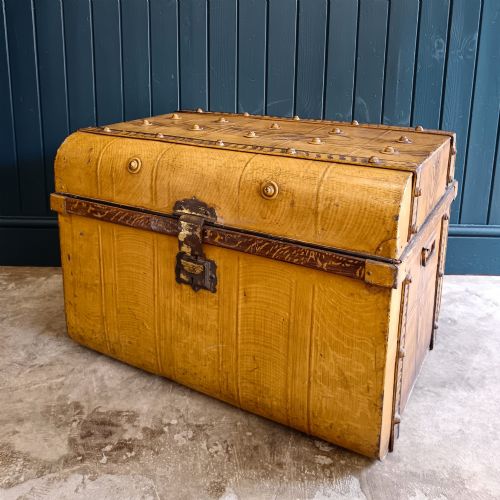


Victorian Metal Travel Trunk
These Victorian metal travel trunk examples are sturdy luggage pieces designed for transit, offering rugged character and practical storage for modern homes.
Victorian Metal Travel Trunk
A victorian metal travel trunk represents the utilitarian luggage of the nineteenth century, built to withstand the rigours of long-distance journeys by steamship, rail and carriage. Buyers searching for this phrase encounter a robust mix of forms, ranging from flat-topped steamer trunks to domed chests and specialised hat boxes.
The pieces on this page span the nineteenth century and the early twentieth century, showing influences from Victorian maritime and campaign traditions alongside rustic country examples. Most are constructed with protective metal bands or full metal bodies, often retaining traces of their original paint finishes or travel labels.
Origin variations include English oak and pine alongside more exotic imports such as East African teak and Anglo-Indian variants. Whether you need a low-profile chest to slide under a table or a large domed trunk for statement storage, these utilitarian objects double as practical furniture.
Materials and construction
Makers built these trunks using structural carcasses of pine or oak, reinforced with sheet metal, iron or steel plates to protect against rough handling in transit. Brass corners, hinges and latches provided both structural strength and decorative contrast against the dark metal and wood surfaces.
Internal linings varied according to purpose, with zinc linings utilised in military campaign trunks to keep moisture away from uniforms, while others featured paper or painted red interiors. Leather elements and faux-wood painted finishes appeared alongside exposed iron bands secured by rows of round-headed rivets.
Some nineteenth-century travellers painted bright red interiors inside their metal trunks, creating a surprising splash of colour when opened after a dusty voyage.
Assessing quality and condition
The skill of the maker shows in the neatness of the metal-binding, the tightness of the riveted joints and the preservation of any decorative faux-wood graining or painted finishes. A trunk that retains its functional strength alongside honest patination from actual travel carries more architectural presence than a purely decorative reproduction.
The Victorian Metal Travel Trunk Glossary
- Steamer trunk
- A low-profile travel trunk designed during the late nineteenth century to fit easily beneath the berth of a passenger ship or inside railway compartments.
- Campaign trunk
- Portable military furniture and luggage reinforced with brass and metal corners, built for officers on active service in the field.
- Zanzibar chest
- A heavy timber storage chest featuring brass studding and strapwork, often associated with trade routes linking East Africa, India and Britain.
- Hat box
- A specialised rigid container, sometimes constructed with leather and metal elements, shaped specifically to protect tall hats during travel.
Victorian Metal Travel Trunk: Frequently Asked Questions
What is a victorian metal travel trunk?
A victorian metal travel trunk is a heavy-duty storage container manufactured in the nineteenth century for luggage transport during an era of expanding global travel by rail and steamship.
These trunks combined wooden frames with iron, steel or zinc plating and robust brass hardware to survive rough handling by baggage handlers.
How were these trunks used originally?
Travellers packed clothing, personal effects and valuables inside these trunks when embarking on long sea voyages, railway journeys or military deployments across the British Empire.
Inside the home or cabin, their flat or domed lids allowed them to double as storage chests or tables while keeping contents secure from dust and moisture.
How do I live with a metal travel trunk?
These trunks function well as coffee tables in a living room, blanket boxes at the foot of a bed, or hallway storage for shoes and out-of-season items.
Their robust metal bindings and aged patination introduce industrial texture and historic character into both traditional and contemporary interiors.
How can I tell different trunk styles apart?
Flat-topped trunks were designed for stacking in luggage holds, whereas domed trunks shed rainwater more effectively and offered extra vertical storage space for garments.
Specialised examples include military campaign chests with zinc linings for damp climates, and compact steamer trunks built specifically for lower-clearance ship berths.