



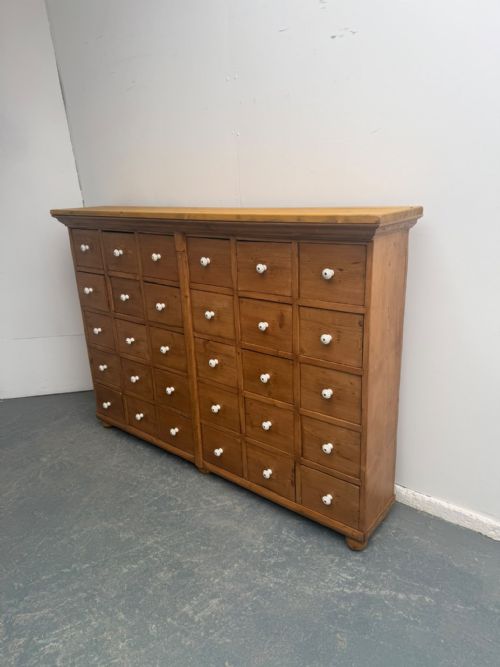



Victorian Merchant Chest
A victorian merchant chest is a practical storage piece built for trade, travel, or shop use, offering multiple drawers and sturdy timber construction.
Victorian Merchant Chest
When you search for a victorian merchant chest, you encounter utilitarian multi-drawer banks, campaign trunks, and shop fittings designed for trade and storage. These pieces originate primarily from the nineteenth century and the Edwardian era.
The most common formats on this page are banks of drawers and storage cabinets built for commercial or office use. Many examples retain original paint finishes or sign-written lettering reflecting their mercantile history.
Materials range from sturdy pine and mahogany to teak and walnut, often reinforced with brass and metal hardware. Styles span from rustic country and industrial utilitarianism to colonial campaign forms.
How they were made
Makers utilised solid pine, mahogany, teak, and walnut to build robust carcasses capable of withstanding heavy commercial use. Metal and brass bindings were applied to corners and edges on travel trunks to protect against damage during transit.
Surface treatments vary from polished finishes on hardwoods to painted pine surfaces, occasionally featuring sign-writing. Drawer construction incorporates numerous compartments tailored for merchants, chemists, and florists.
Victorian Merchant Chest Retail Price Guide 2026
Typical asking prices for victorian merchant chest among the pieces listed under this phrase on Sellingantiques today, from the lower quarter to the upper quarter. They describe what is for sale here now, not the wider market.
The selection includes commercial shop fittings, multi-drawer banks, and travel trunks dating from the nineteenth century onward.
What varies in quality
The distinction between standard utility items and finer examples lies in the choice of timber and the complexity of the internal configuration. Hardwoods such as mahogany and teak sit at a different level from utilitarian painted pine.
Original hardware, untouched painted surfaces, and authentic commercial lettering elevate the character of a piece. The number and graduation of drawers also influence the utility and visual weight of the item.
Luxmore's of Ilfracombe
The Victorian Merchant Chest Glossary
- Bank of drawers
- A multi-drawer storage unit originally utilised in shops, offices, or workshops for categorising small goods. These assemblies often feature dozens of individual pulls.
- Campaign trunk
- A portable chest constructed in sections or fitted with carrying handles for travel. They frequently utilise durable timbers like teak or mahogany with brass reinforcements.
- Shop fitting
- Fixtures and cabinetry built specifically for commercial retail environments. Examples include sign-written seed chests and chemist cabinetry.
- Toleware
- Lacquered or painted metalware used for domestic and commercial storage containers. These items typically feature compartmented interiors for organising dry goods or documents.
- Graduated drawers
- A series of drawers arranged vertically where the depth increases incrementally from top to bottom. This arrangement balances the visual proportions of a chest.
Victorian Merchant Chest: Frequently Asked Questions
What is a victorian merchant chest?
A victorian merchant chest is a utilitarian storage unit, trunk, or multi-drawer cabinet used in nineteenth-century commerce, travel, and retail.
These pieces include shop fittings, seed chests, and brass-bound travel trunks designed for organising goods and documents.
How were merchant chests used?
Merchants, shopkeepers, and travellers utilised these chests to store inventory, tools, samples, and correspondence securely.
Commercial establishments employed banks of drawers for items like seeds and chemist supplies, while travellers used metal-bound trunks for transit.
Where do these chests originate?
The pieces originate primarily from nineteenth-century Britain and the Edwardian era, with occasional international workshop examples.
They reflect the commercial expansion and trade requirements of the period through practical, robust cabinetry.
How do I care for a painted pine chest?
Maintain painted pine and hardwood surfaces by dusting with a dry cloth and avoiding excess moisture.
Preserve the original painted finishes and sign-writing by keeping the furniture away from direct sunlight and fluctuating heat sources.