




Victorian Measuring Jug
These robust victorian measuring jug examples are practical vessels shaped by a century of public house service and domestic use.
Victorian Measuring Jug
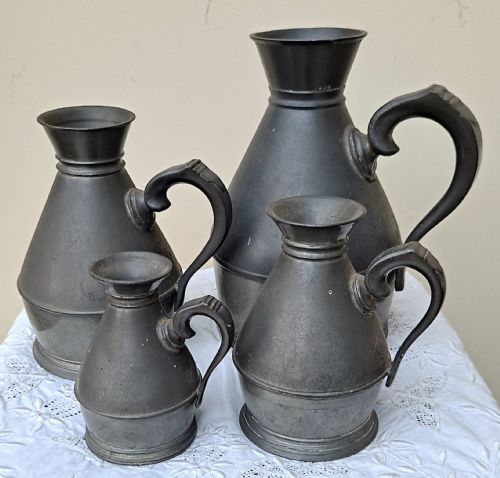
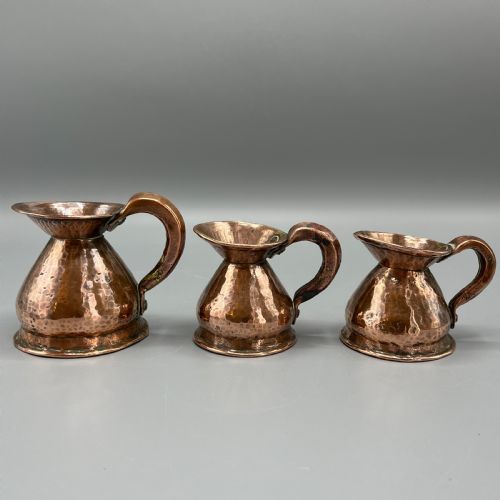
A victorian measuring jug is a utilitarian vessel designed for liquid capacity, most commonly found here as copper and pewter kitchenalia or tavern measures. The selection leans heavily towards robust copper sets and distinct pewter haystack forms originating from English, Irish, and Scottish makers.
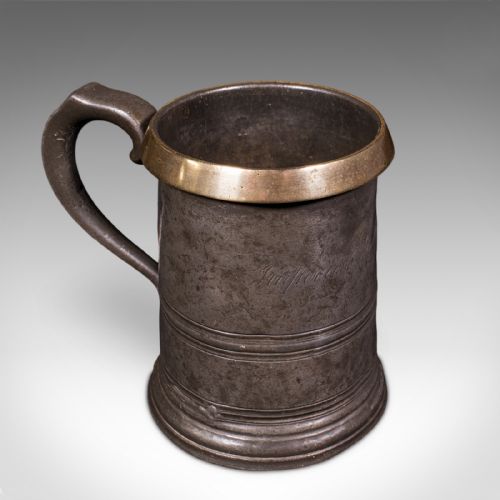
Buyers encounter everything from miniature apprentice pieces to large two-gallon harvest jugs and public house tankards. Regional variations such as East Riding and Jersey cans appear alongside standard graduated sets used for measuring ale and spirits.
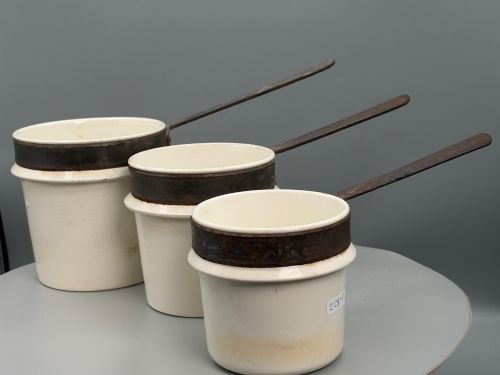
The materials span heavy-duty copper with tin linings, traditional pewter, brass, and white glazed earthenware banded with iron. These pieces reflect the strict capacity standards of nineteenth-century commerce, often carrying VR marks or local tavern engravings.
Materials and construction
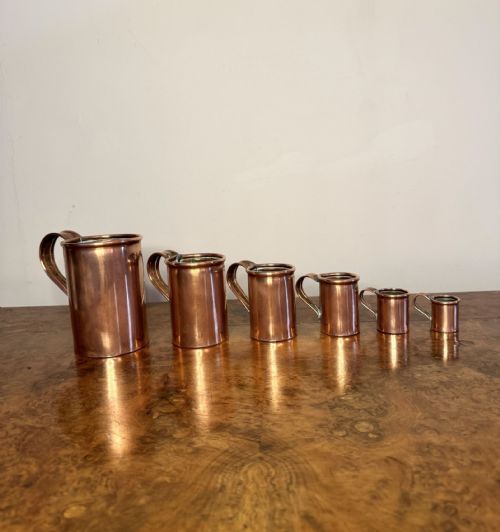
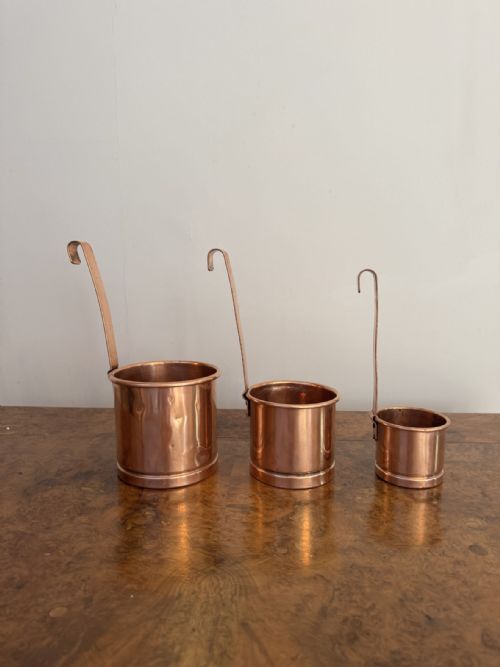
Copper measures are typically fashioned with folded or soldered seams, often fitted with sturdy brass handles and finished with an internal tin lining to safely hold liquids. Many copper examples utilise iron bands or feature heavier gauges for daily tavern life.
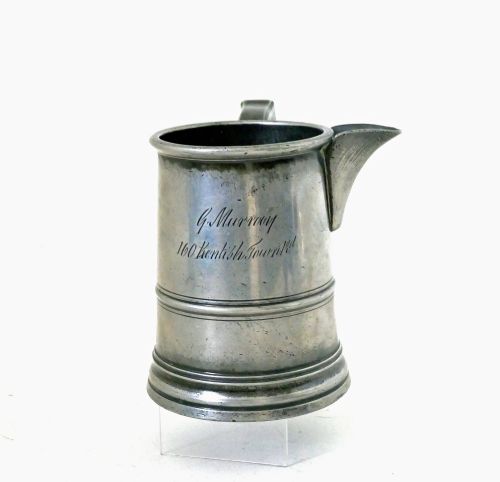
Pewter vessels, particularly the Irish and Scottish haystack forms, rely on skilled metal casting and lathe finishing. Makers shaped the soft metal into bulbous or tapered profiles, applying touchmarks and capacity stamps directly into the body.
Victorian Measuring Jug Retail Price Guide 2026
Typical asking prices for victorian measuring jug among the pieces listed under this phrase on Sellingantiques today, from the lower quarter to the upper quarter. They describe what is for sale here now, not the wider market.
The inventory records regional British and Irish forms, including East Riding and Scottish measures alongside Jersey cans.
Judging quality in metal and ceramic measures
Quality rests in the crispness of capacity stamps, the integrity of the metal gauge, and whether the vessel retains its original form without excessive dents or clumsy repairs. Sets that survive complete and matched across multiple sizes command greater interest than cobbled groups.
Subtle details separate ordinary workshop output from finer tavern pieces, such as clean engraving on public house tankards or the precise proportions of a miniature apprentice piece. The presence of clear maker attribution or verified regional touchmarks elevates a piece beyond standard utility.
Wedgwood·G.Murrouy·J. Bower
The Victorian Measuring Jug Glossary
- Haystack measure
- A traditional British liquid measure characterised by its bulbous base and tapering neck, resembling a stacked pile of hay. These were produced extensively in Ireland and Scotland during the nineteenth century.
- Apprentice piece
- A miniature version of a standard object created by a trainee artisan to demonstrate mastery of a craft. These demonstrate identical construction techniques to full-scale measuring jugs on a smaller scale.
- Breweriana
- Collectable items relating to the brewing and serving of beer, including public house tankards and tavern measures. This category encompasses much of the metalware found in nineteenth-century capacity vessels.
- Touchmark
- An official stamp or hallmark impressed into pewter by a maker or guild to guarantee the alloy standard. These marks help identify the workshop origin and date of pewter measures.
- Imperial measure
- A system of standardised liquid capacity regulated by British law during the nineteenth century. Measures bearing these standards were strictly calibrated for trade use.
Victorian Measuring Jug: Frequently Asked Questions
What is a haystack measure?
A haystack measure is a distinctive nineteenth-century liquid container shaped with a wide base tapering toward the top. They were made primarily in pewter and brass for commercial use.
These vessels served as standard tavern equipment in Ireland and Scotland, designed to hold specific liquid capacities accurately.
How were copper measures used?
Copper measuring jugs functioned as standard capacity vessels in nineteenth-century kitchens, dairies, and public houses. Their tin linings prevented the metal from reacting with liquids.
Graduated sets allowed bartenders and cooks to pour exact quantities of ale, spirits, or other liquids during daily trade.
What do VR marks mean?
The letters VR stand for Victoria Regina, indicating the reign of Queen Victoria. These stamps confirm official government verification of capacity.
Measures bearing these marks met the legal standards required for public house and commercial trade during the nineteenth century.
How do I display a harvest jug?
Large copper and ceramic harvest jugs suit open shelving, mantelpieces, or kitchen dresser displays where their scale and metal patina are visible. Their robust forms anchor a room.
Pairs or graduated sets look best arranged together by size, allowing the natural warmth of the copper or earthenware to stand out.