



Victorian Mahogany Piano
When you search for a victorian mahogany piano stool, you meet sturdy timber seating designed to adjust for the player at the keyboard.
Victorian Mahogany Piano
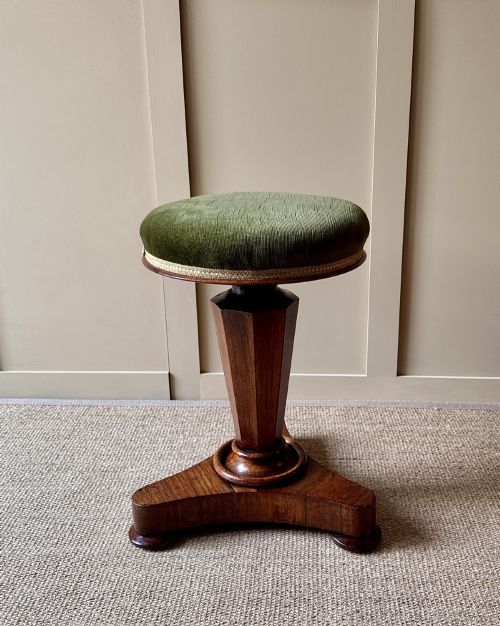
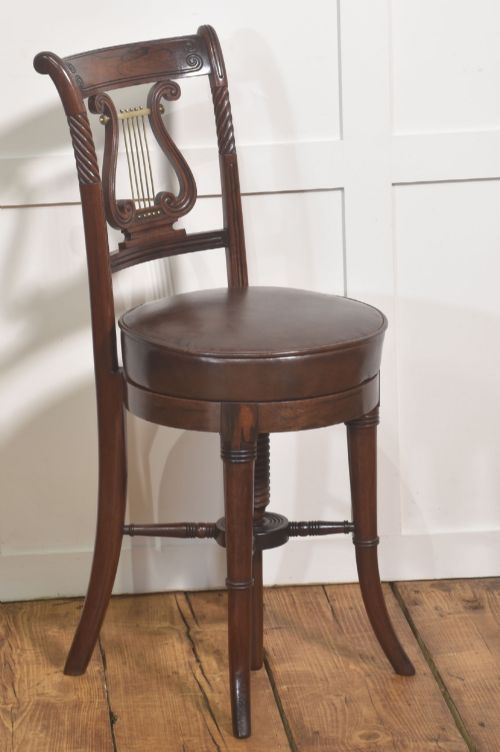
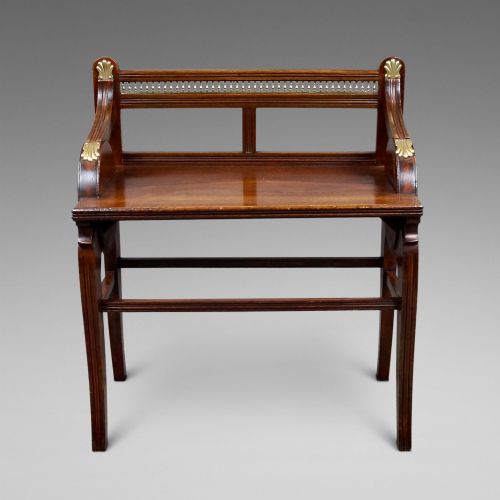
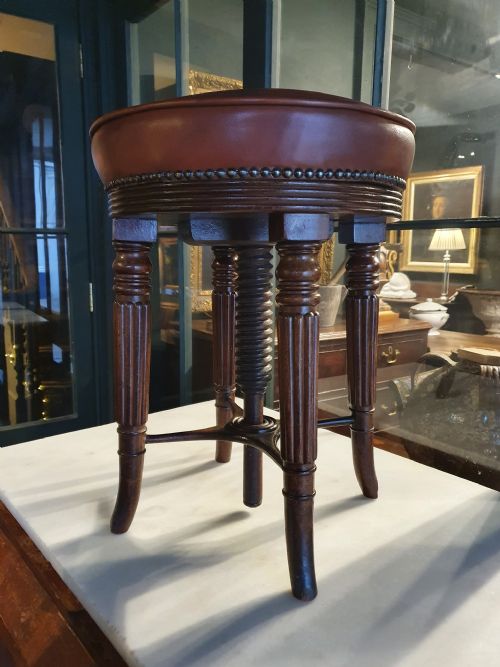
A victorian mahogany piano stool typically takes the form of a circular revolving seat or an oblong bench meant to sit beside keyboard instruments. These pieces range from simple fixed frames to sophisticated rise and fall mechanisms engineered for height adjustment.
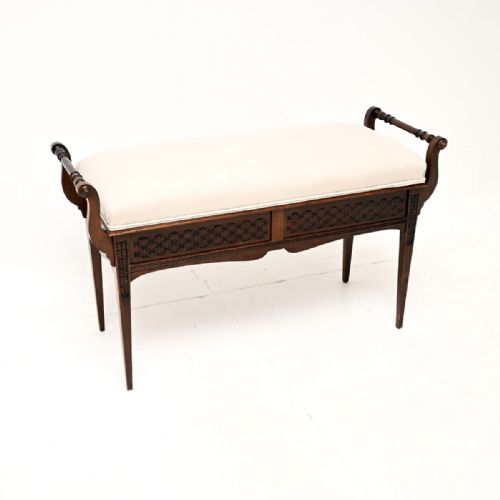
The versions most common on this page date from the nineteenth century, utilising solid timbers and rich mahogany veneers. Makers produced single seats alongside longer duet benches, often incorporating storage compartments beneath hinged lids.
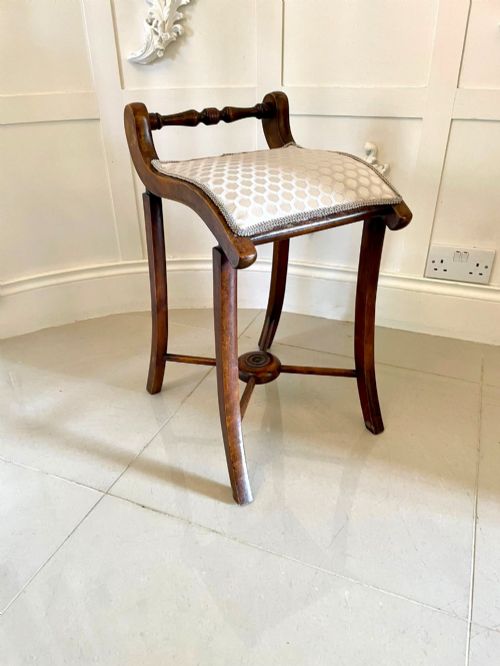
Beyond the standard revolving designs, buyers frequently encounter related forms including X-frame dressing stools and low footstools. These variations share the dense timber construction and turned supports characteristic of the period.
Materials and construction methods
Cabinetmakers built these frames primarily from mahogany, selecting the dense hardwood for its strength and deep reddish-brown grain. Carpenters shaped solid timber and applied carefully matched veneers to curved skirts and sturdy central pillars.
Mechanical components rely on brass screws, threaded iron spindles, and internal wooden gears to achieve the rise and fall action. These metal mechanisms allow the top to rotate smoothly while maintaining stability under the weight of the user.
Upholstery completed the seat, utilising webbing and stuffing covered in original needlepoint, leather, tapestry, or velvet. Artisans secured these textiles with decorative brass tacks or deep buttoning to provide a firm yet comfortable surface.
Victorian Mahogany Piano Retail Price Guide 2026
Typical asking prices for victorian mahogany piano among the pieces listed under this phrase on Sellingantiques today, from the lower quarter to the upper quarter. They describe what is for sale here now, not the wider market.
Recorded forms span revolving stools, duet benches, and X-frame dressing seats.
Distinguishing quality in timber and mechanics
The refinement of the turning and carving separates standard production pieces from finer workshop outputs. Superior examples display crisp acanthus leaves on the pillar or finely fluted legs rather than plain, unadorned turnings.
The integrity of the internal adjustment screw dictates mechanical longevity. High-grade iron and brass threads operate without lateral play, whereas inferior mechanisms loosen and wobble with frequent rotation.
The selection of timber grain and secondary woods indicates the original cost of the piece. Well-figured mahogany veneers and secondary linings of solid oak or mahogany point to superior craftsmanship.
Jennens and Bettridge·Jas Shoolbred·Gillows·J B Cramer
The Victorian Mahogany Piano Glossary
- Revolving piano stool
- A seat featuring a central threaded screw mechanism that raises or lowers the circular top when turned.
- Duet stool
- An elongated bench designed to accommodate two players simultaneously, occasionally featuring hinged storage beneath the seat.
- Rise and fall
- The mechanical action allowing the seat height to be adjusted for the performer.
- X-frame
- A structural base formed by two intersecting curved or straight timber members crossing in the centre.
- Needlepoint
- Hand-stitched canvas work utilised as decorative upholstery on period seats.
Victorian Mahogany Piano: Frequently Asked Questions
How do I adjust the height on these stools?
Most antique revolving stools operate via a central wooden or iron screw concealed beneath the upholstered top. Turning the seat clockwise or anticlockwise raises and lowers the platform along the threaded pillar.
Some later designs utilise a rise and fall mechanism operated by a side lever or internal rack. Users should support the weight of the top while turning to prevent strain on the historical threads.
Are these seats suitable for modern daily use?
These timber frames offer robust construction capable of enduring regular sitting in contemporary domestic settings. The dense mahogany and traditional joinery remain structurally reliable after more than a century.
Buyers planning frequent use should inspect the internal screw mechanism and webbing for stability. Many original upholstery foundations benefit from gentle conservation by a professional.
What is the difference between a duet stool and a solo stool?
Solo stools provide a compact circular or square platform sized for a single musician at the keyboard. They frequently feature a central pillar with three or four carved legs.
Duet stools present an oblong bench format with four independent legs, providing sufficient length for two people. Many duet variants include a hinged lid opening to reveal internal storage space for sheet music.
How do I identify the period of a mahogany stool?
Early nineteenth-century examples often display Regency or William IV characteristics, including heavier pillar supports and robust paw feet. Mid-Victorian pieces introduce richer carving, while later Victorian and Edwardian items lean toward simpler turned legs.
Secondary woods, fixing types, and fastener styles also help date the piece. Machine-cut screws typically indicate manufacture toward the end of the nineteenth century or later.