



Victorian Mahogany Breakfront Shelves
Victorian mahogany breakfront shelves bring stately architectural presence and generous display space to a room, offering the collector a commanding focal point.
Victorian Mahogany Breakfront Shelves
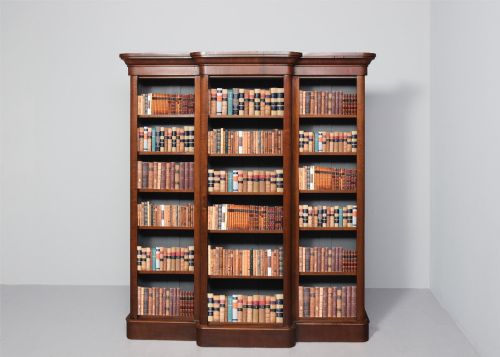
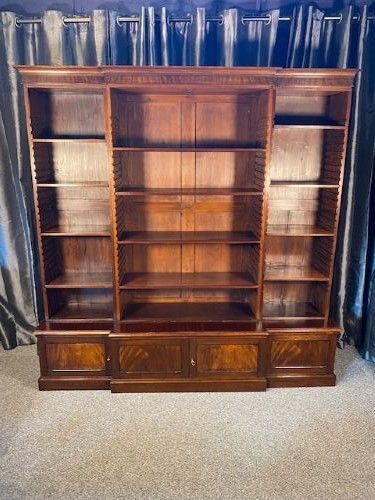
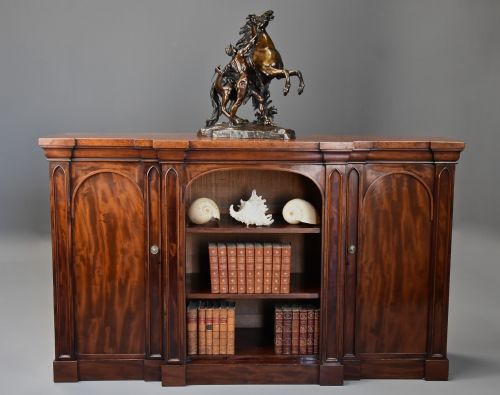
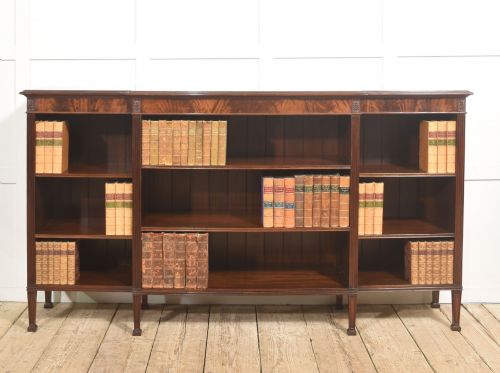
Victorian mahogany breakfront shelves present a grand architectural profile with a central section that projects forward from the flanking wings. These substantial pieces provide ample display and storage capacity for libraries and principal reception rooms.
Most examples encountered here date from the nineteenth century, spanning early Victorian production through to nineteen hundred. The form appears as both open bookcases and glazed library cabinets.
Cabinetmakers constructed these large items to dominate large walls, utilising the stepped forward central bays to break up long runs of timber. This configuration remains highly sought after for both traditional and contemporary interiors.
How they were made
Workshops relied heavily upon solid mahogany and rich flame mahogany veneer to cover expansive surfaces with striking grain patterns. Cabinetmakers selected these figured timbers carefully to create visual drama across the wide front sections.
Higher tier pieces incorporated decorative elements such as cast or gilt ormolu mounts, brass details, and glass panels within the framework. Marble tops and fabric linings also appear on select refined examples from the period.
Victorian Mahogany Breakfront Shelves Retail Price Guide 2026
Typical asking prices for victorian mahogany breakfront shelves among the pieces listed under this phrase on Sellingantiques today, from the lower quarter to the upper quarter. They describe what is for sale here now, not the wider market.
The listings span from the early Victorian era through to nineteen hundred, showcasing materials like flame mahogany, brass, ormolu, and marble.
What varies in quality
The degree of architectural detailing and the selection of timber dictate the standing of an individual piece. Highly figured flame mahogany veneer combined with crisp carving and substantial proportions separates the finest items from standard utilitarian furniture.
Maker attribution and unusual scale also influence desirability among collectors. Diminutive proportions or documented workshop origins elevate a piece far beyond standard production models.
Gillows·Robert Strahan
The Victorian Mahogany Breakfront Shelves Glossary
- Breakfront
- An architectural cabinet design where the central section projects forward beyond the flanking wings. This layout creates depth and shadow across the main facade of the furniture.
- Flame mahogany
- A highly decorative veneer harvested from the fork of the mahogany tree, displaying a characteristic flickering flame pattern. Cabinetmakers reserved this timber for the most prominent visible surfaces.
- Ormolu
- Gilded bronze applied as decorative mounts and hardware on refined nineteenth century furniture. The metalwork catches the light and frames the timber panels.
- Gothic Revival
- A nineteenth century design style incorporating pointed arches, tracery, and medieval architectural motifs. Makers applied these elements to breakfront bookcases to evoke historic ecclesiastical buildings.
Victorian Mahogany Breakfront Shelves: Frequently Asked Questions
Where should I place these shelves?
These large breakfront pieces require a substantial wall in a principal room, such as a library, study, or drawing room, where their architectural proportions can be properly appreciated.
Ensure the chosen wall has adequate width to accommodate the projecting central section and the flanking wings without crowding the surrounding space.
How do I care for mahogany veneer?
Maintain the timber by keeping the surface away from direct sunlight and consistent heat sources, which can dry out and split the polished mahogany veneer.
Apply a traditional wax polish sparingly and buff with a soft cloth to preserve the natural lustre of the wood.
How do I identify a Victorian period piece?
Look for the characteristic dense weight of solid mahogany timbers, traditional hand-cut joinery methods, and period specific stylistic influences such as Gothic revival motifs or French Empire lines.
Construction details and timber ageing provide reliable indicators of nineteenth century manufacture.