
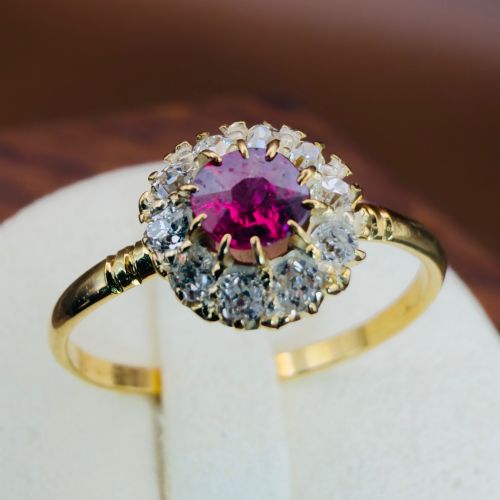
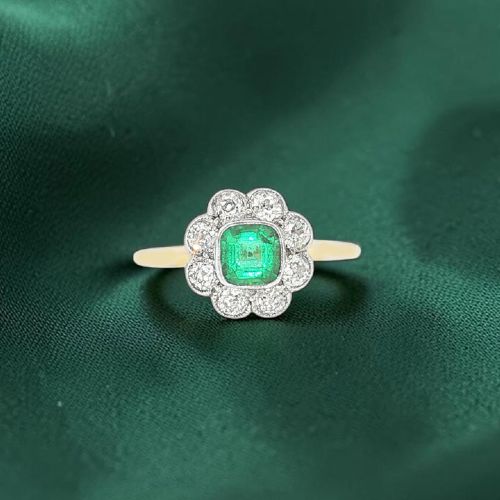
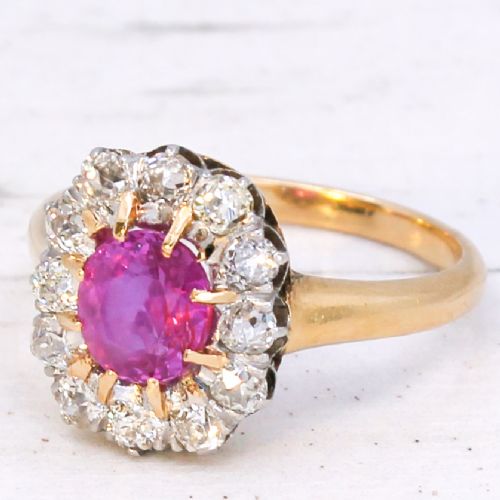
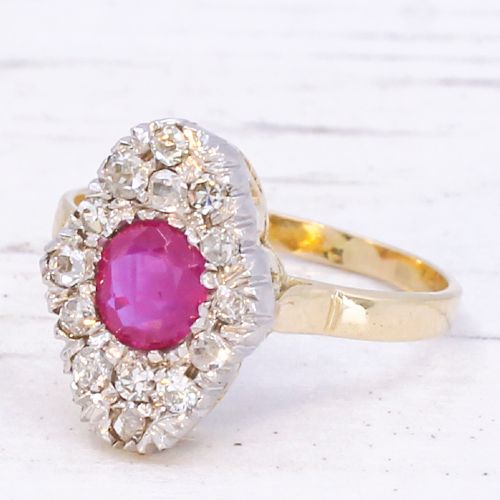


Victorian Gemstone Target Ring
A victorian gemstone target ring draws the eye with its concentric circles of brilliant stones.
Victorian Gemstone Target Ring
A victorian gemstone target ring centres on a bright stone such as a ruby, sapphire, emerald, opal, turquoise or spinel, surrounded by a distinct halo of diamonds or smaller gems. These fine jewellery pieces take the form of rings with cluster settings that mimic the concentric rings of a target.
The versions most commonly met on this page date from the Victorian and Edwardian eras, spanning from the 1870s through to around 1910, alongside occasional later revivals from the mid-twentieth century. Makers constructed these rings primarily in yellow gold and 18ct gold, often incorporating silver settings for the diamond halos.
Every piece presents a distinct geometric arrangement where the central colour contrasts sharply with the sparkling border. Collectors seek out these circular clusters for their bold finger coverage and their vibrant mix of coloured gemstones and diamonds.
How they were made
Goldsmiths shaped these rings using 18ct yellow gold and standard gold for the shanks and mounts, frequently combining silver to hold the smaller accent stones securely. The central gems and surrounding diamonds sit closely together in tight cluster formations.
Craftsmen set Burmese rubies, pink sapphires, spinels, emeralds, opals, turquoise and seed pearls alongside diamonds by hand. Each stone rests within bespoke claw or bezel settings designed to accentuate the circular target profile.
Some Victorian makers hid seed pearls beside fiery rubies, proving that even target rings enjoy a playful side.
What varies in quality
Quality rests in the origin and clarity of the central gemstone, particularly when unheated Burmese rubies or natural spinels occupy the centre stage. The saturation of colour and the absence of heavy inclusions dictate the desirability of the main stone.
The precision of the concentric halo work and the matching proportions of the surrounding diamonds separate finer examples from standard production. Heavier 18ct gold shanks that retain their original thickness also elevate the stature of a piece.
The Victorian Gemstone Target Ring Glossary
- Cluster ring
- A ring featuring a central gemstone encircled by a group of smaller stones. This layout forms the geometric base of the target design.
- Halo
- A concentric border of smaller gems surrounding a larger central stone. It enhances the apparent size and brilliance of the middle gem.
- Seed pearl
- A very small, naturally occurring or cultured pearl used as an accent element. These tiny spheres add a soft lustre to the outer borders.
- Bezel setting
- A method of holding a gemstone in place using a narrow metal rim that wraps around the girdle. It secures the stone smoothly without visible prongs.
Victorian Gemstone Target Ring: Frequently Asked Questions
What is a target ring?
A target ring is a cluster ring featuring a circular design with a central coloured gemstone enclosed by one or more rings of contrasting stones. The layout resembles a shooting target.
These pieces gained immense popularity during the nineteenth and early twentieth centuries for their striking geometric symmetry and colourful impact.
How do I care for antique rings?
Antique gemstone rings require gentle handling because softer stones like opals and turquoise demand protection from harsh chemicals and ultrasonic cleaners. Store them individually in lined boxes to prevent scratching.
Regular checks by a jeweller ensure the ancient claws holding the diamond halo remain secure and tight.
How do I date these rings?
Dating relies on stylistic clues, gemstone cuts, and gold hallmarks that correspond to Victorian or Edwardian manufacturing techniques. The specific proportions of the cluster work often point towards a particular decade.
Comparing the setting style with documented periods helps establish a reliable timeframe for each piece.