


Victorian Farm Animal Art
Victorian farm animal art captures the rural heart of the nineteenth century through oil paintings and framed prints of cattle, sheep, and poultry.
Victorian Farm Animal Art
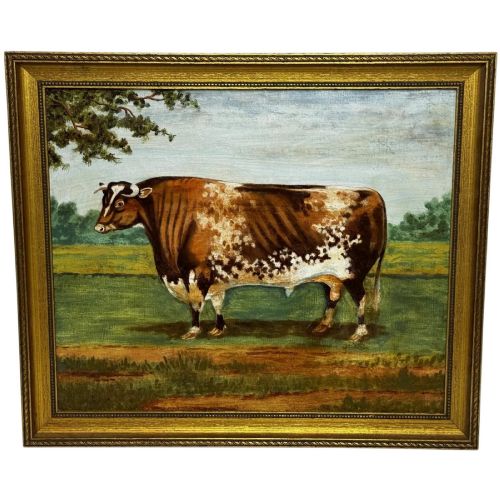
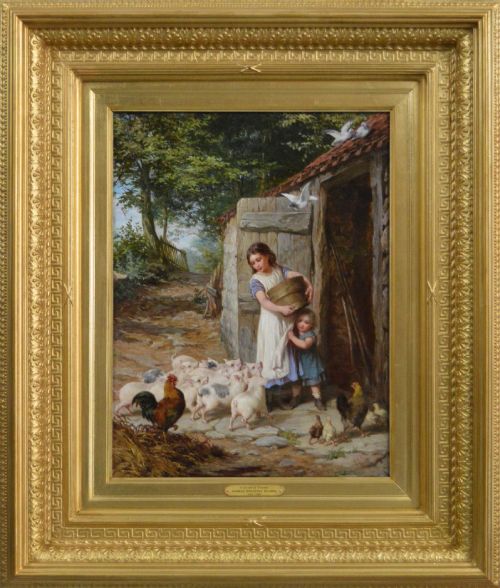
Victorian farm animal art brings pastoral scenes and livestock portraits into the home, focusing heavily on cattle, sheep, horses, and poultry set within rural landscapes and farmyards. Buyers seeking this genre will encounter oil paintings on canvas and board, ranging from detailed individual studies of prized shorthorn bulls to bustling farmyard genre scenes with figures.
The works span the nineteenth century and into the early twentieth century, incorporating British and Belgian schools of animal realism. Framed artwork frequently includes decorative elements such as gold leaf, giltwood, and gesso frames that complement the traditional subjects.
Materials and Technique
Artists of this period worked predominantly in oil paint applied to canvas or wood panels, building up layers to render the texture of wool, hides, and feathers with precision. These traditional supports provided the stability required for detailed realism and atmospheric landscape backgrounds.
The finished works were typically housed in ornate wooden frames embellished with gesso and gold leaf, designed to enhance the visual depth of the pastoral composition.
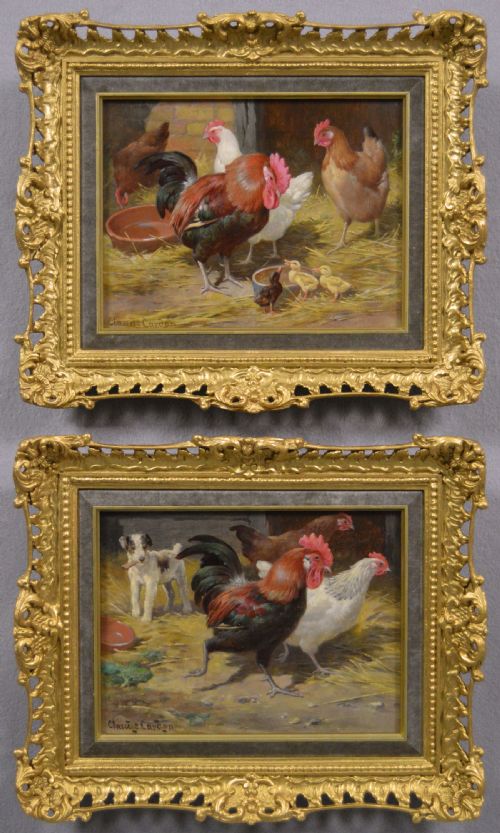
Common motifs include shorthorn bulls, resting sheep, and poultry gathered around rivers and farmyard barns.
Assessing Quality
Quality in these pastoral works rests upon the anatomical accuracy of the animals and the skill with which the artist handles light and texture across fur, fleece, and plumage. Finer examples display a careful balance between the central livestock and the surrounding landscape or farmyard details.
The refinement of the supporting wooden and gesso frames also contributes to the overall integrity of the piece, with period frames adding appropriate historical context to the canvas.
George Augustus Holmes·Claude Cardon·John Frederick Herring Jnr·Samuel Joseph Clark·Thomas Sidney Cooper·Edgar Hunt
The Victorian Farm Animal Art Glossary
- Canvas
- A heavy woven fabric used as a surface for oil paintings. It provides a durable ground that holds fine brushwork and layered pigments.
- Gesso
- A plaster-like mixture applied to wooden frames as a base for gilding. It allows for intricate moulded details and a smooth finish beneath gold leaf.
- Genre Painting
- A pictorial representation of scenes from everyday life. In this context, it often involves figures interacting with farm animals in cottage or yard settings.
- Giltwood
- Wood that has been coated with gold leaf or a gold-coloured finish. It is commonly found on traditional frames surrounding nineteenth-century fine art.
Victorian Farm Animal Art: Frequently Asked Questions
What animals appear in these works?
The subjects include cattle, sheep, horses, pigs, goats, cockerels, hens, and ducks.
These creatures are depicted either individually as prized livestock portraits or grouped together in busy farmyard and landscape settings.
How should I hang these oil paintings?
These artworks suit traditional living spaces, studies, or dining rooms where their pastoral subjects can be appreciated.
Keep them away from direct sunlight and excessive moisture to protect the canvas, oil pigments, and giltwood frames.
What is a genre farmyard scene?
A genre scene depicts everyday activities involving people and animals in a rural environment.
These compositions often show figures feeding poultry, tending to ponies, or working within cottage farmyards.
How do I identify the period?
Dating relies on stylistic markers of nineteenth-century realism, artist signatures, and framing techniques.
Canvas supports, oil paint handling, and associated framing materials like gesso help establish the era of production.