



Victorian Etruscan Earrings
Victorian Etruscan earrings combine classical archaeological inspiration with nineteenth-century goldwork, offering distinct miniature architecture for the ear.
Victorian Etruscan Earrings
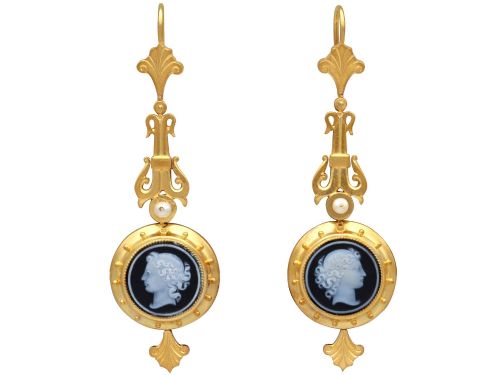
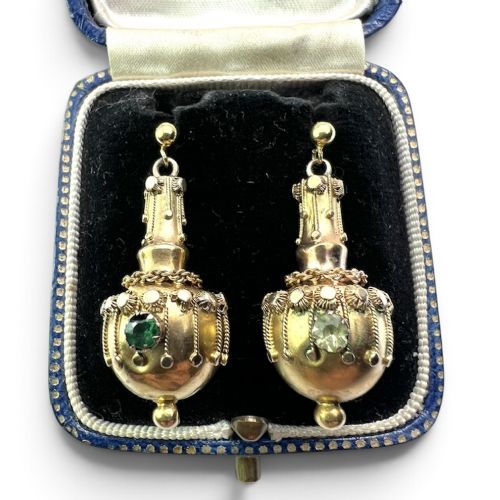
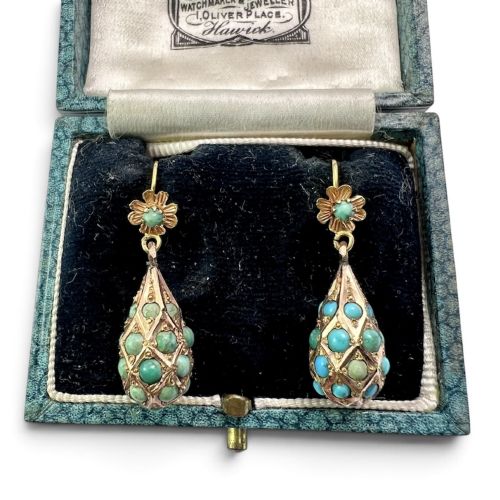
Victorian Etruscan earrings bring classical archaeological motifs into nineteenth-century jewellery, drawing directly from ancient excavations that captivated collectors of the period. You meet drop earrings and dangling designs most often, shaped as amphorae, teardrops, torpedoes, and elaborate wheel forms.
The prevailing style relies heavily on Etruscan revival and classical revival aesthetics, spanning the Victorian era with occasional examples reaching into the Edwardian period. Many pairs incorporate gemstones such as garnet, turquoise, coral, and paste alongside distinct metalwork.
Jewellery sets occasionally appear pairing these earrings with matching brooches or pendants, offering a complete suite of classical ornamentation. Forms range from compact square cross wheel drops to long dangling foxtail tassel designs.
Materials and construction
Gold forms the primary structural medium, appearing as yellow gold, rose gold, and silver gilt, with metal purities registered predominantly in 9ct, 15ct, and 18ct standards. Artisans built these drops and hoops using sheet metal and wire, constructing hollow elements like puff hearts and amphora bodies to keep the substantial sizes wearable.
Surface ornamentation relies on applied wirework and tiny metal granules arranged in geometric patterns, mimicking ancient granulation techniques without modern casting. Gemstones including almandine garnet, turquoise beads, nephrite jade, and shell cameos are set securely into the gold mounts to provide colour contrasts.
Victorian Etruscan Earrings Retail Price Guide 2026
Typical asking prices for victorian etruscan earrings among the pieces listed under this phrase on Sellingantiques today, from the lower quarter to the upper quarter. They describe what is for sale here now, not the wider market.
The archive confirms that garnet, turquoise, and coral remain the dominant gemstones paired with this revival goldwork.
Judgement of quality
Quality rests on the precision of the minute gold wires and tiny granules applied to the surface, where neatness and adherence define superior hands. Finer examples show crisp definition in stamped or chased motifs rather than soft, worn contours.
The selection and match of integrated gemstones, such as calibrated garnets or uniform turquoise beads, elevate a pair above standard production. Heavier gold standards, particularly 15ct and 18ct, alongside complex articulated tassel or drop mechanics, signal ambitious workshop output.
The Victorian Etruscan Earrings Glossary
- Etruscan Revival
- A nineteenth-century design movement inspired by ancient Italian jewellery unearthed during archaeological excavations. It uses granulation, filigree, and classical geometric motifs.
- Granulation
- A decorative technique where tiny spheres of gold are soldered onto a metal background in intricate patterns. This method defines much of the archaeological style.
- Torpedo earrings
- A specific drop earring shape featuring an elongated, spindle-like central element. They hang vertically from hook or wire fittings.
- Foxtail tassel
- Flexible chains constructed from curved interlocking metal links resembling a fox tail, often finishing the bottom of long dangling drops. They add movement and weight to the design.
Victorian Etruscan Earrings: Frequently Asked Questions
How do I clean Victorian gold earrings?
Clean these pieces gently with a soft dry cloth to remove surface dust, avoiding harsh liquid dips that damage softer gemstones like turquoise or coral.
Keep moisture away from the hollow sections and delicate wire soldered joints to preserve the structural integrity of the metalwork.
Are these earrings heavy to wear?
Many Victorian drops look substantial yet utilise hollow construction methods like puffed hearts and thin gold sheets to reduce actual weight on the earlobe.
Heavier examples containing solid gemstones or higher carat gold standards require supportive backings for comfortable all-day wear.
Can I date them by the gold purity?
British pieces often display specific carat marks such as 9ct or 15ct, reflecting regional hallmarking standards and periods of manufacturing legislation.
Lower 9ct standards and silver gilt versions run alongside higher 15ct and 18ct gold builds across the breadth of the nineteenth century.
What is the difference between classical and Etruscan revival?
Classical revival draws broadly upon Greek and Roman architectural and sculptural motifs, while Etruscan revival specifically mimics ancient Italian goldwork techniques.
In practice, makers frequently blended these influences within the same pair of earrings using granulated wire and archaeological shapes interchangeably.