


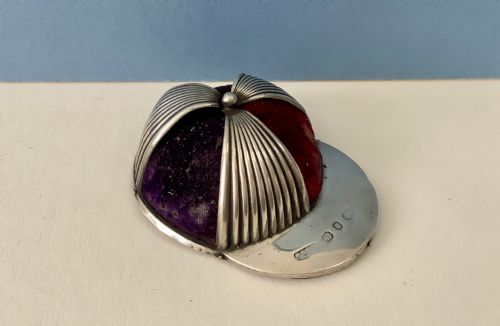


Victorian Equestrian Pin
These Victorian equestrian pin pieces are crafted as miniature horseshoes, hunting bugles, and jockey caps in precious metals for everyday lapel wear.
Victorian Equestrian Pin
A victorian equestrian pin takes the form of a brooch, stick pin, or pin cushion representing the nineteenth-century passion for horses and field sports. The most common examples on this page are horseshoe brooches and jockey cap pins.
Makers shaped these miniature objects during the Victorian, 1860, and Edwardian periods using durable materials suited to small-scale metalwork. Forms range from simple silver horseshoes to detailed gold hunting bugles and novelty pin cushions.
The objects serve as wearable reminders of hunting and riding culture, combining personal adornment with sporting motifs. Collectors encounter them as brooches, stick pins, and functional pin cushions decorated with turquoise and seed pearls.
How they were made
The construction relies on precious metals including 9ct gold, 15ct gold, 18ct yellow gold, and silver. Smiths shaped these materials into hollow or solid forms to build the base of the horseshoe or jockey cap.
Gems and organic materials are set directly into the metal framework to accent the sporting themes. Artisans used turquoise, seed pearls, garnet, and diamond alongside hand-painted porcelain surfaces.
Victorian Equestrian Pin Retail Price Guide 2026
Typical asking prices for victorian equestrian pin among the pieces listed under this phrase on Sellingantiques today, from the lower quarter to the upper quarter. They describe what is for sale here now, not the wider market.
Materials across this selection include 15ct gold, silver, 9ct gold, turquoise, gemstone, seed pearl, 18ct gold, and garnet.
What varies in quality
The standard of design depends on the crispness of the miniature metalwork and the realistic proportion of objects like the jockey cap or hunting bugle. Finer examples display careful soldering and well-balanced compositions that reflect the maker's skill.
Material selection divides standard pieces from more ambitious ones, marked by the use of higher carat golds and matched natural seed pearls or turquoise stones. The presence of gemstones alters the visual weight and richness of the piece.
Helena Wolfsohn
The Victorian Equestrian Pin Glossary
- Stick Pin
- A long pin with a decorative head, worn upright in a cravat, tie, or lapel.
- Brooch
- An ornamental piece of jewellery fastened with a hinged pin and catch on the back.
- Pin Cushion
- A small padded object used for holding pins, here fashioned into novelties like jockey caps.
- Seed Pearl
- A very small natural pearl, often drilled and set in clusters along horseshoe brooches.
- Silver Gilt
- Silver that has been coated with a thin layer of gold.
- Rococo Revival
- A nineteenth-century design style drawing on asymmetrical scrollwork and natural motifs.
Victorian Equestrian Pin: Frequently Asked Questions
What metals were used for these pins?
The listings show items made from silver, 9ct gold, 15ct gold, and 18ct yellow gold.
Silver gilt also appears alongside the solid precious metal variants.
What subjects do the designs represent?
Motifs are drawn directly from equestrian sports and country pursuits.
Common subjects include horseshoes, hunting bugles, and jockey caps.
How do Victorian and Edwardian pieces differ?
Items span the Victorian and Edwardian periods, running from about 1860 onward.
Both eras utilise similar sporting themes, precious metals, and gemstone accents.
What stones decorate the jewellery?
Makers set turquoise, seed pearls, garnet, and diamond into the metal frames.
These gems highlight the horseshoe shapes and cap peaks.