


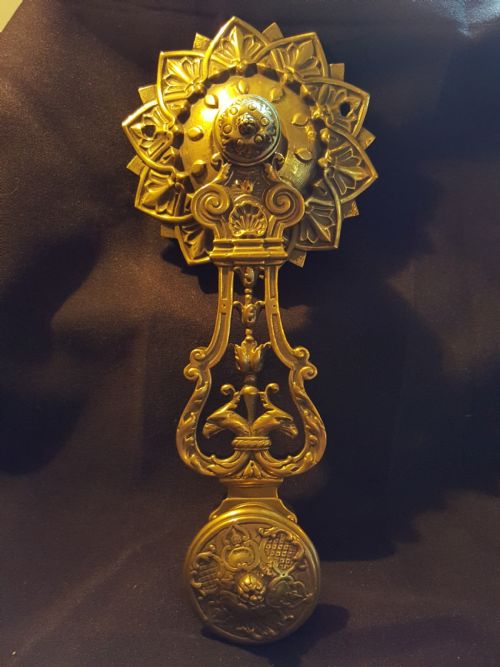


Victorian Door Bell Pull
A Victorian door bell pull brings the tactile weight of nineteenth-century engineering and decoration straight to a front entrance.
Victorian Door Bell Pull
A victorian door bell pull forms part of the architectural hardware designed to operate a mechanical bell system from the exterior of a property. These objects bridge the gap between utility and decoration, providing a functional method for visitors to announce their arrival. The selection spans domestic hardware primarily grouped under door furniture and bell ringers.
Buyers encounter examples originating from the Georgian and Victorian periods, alongside items from around eighteen hundred. Forms range from straightforward brass levers to ornate designs drawing on French Rococo Revival styles. Materials vary from standard metals to combinations featuring horn alongside traditional brasswork.
How they were made
Makers utilised cast brass as the primary structural material for these door pulls, often shaping the metal through traditional founding methods. This allowed workshops to produce robust architectural hardware capable of withstanding daily operation.
Selected examples incorporate horn components, adding a contrasting texture to the metal framework. Surface finishes include gilded metal treatments alongside polished brass and iron configurations.
Victorian Door Bell Pull Retail Price Guide 2026
Typical asking prices for victorian door bell pull among the pieces listed under this phrase on Sellingantiques today, from the lower quarter to the upper quarter. They describe what is for sale here now, not the wider market.
Periods represented in the available pieces span Georgian, Victorian, and the year 1800.
What varies in quality
The degree of ornamentation separates standard hardware from more elaborate examples, particularly where French Rococo Revival influences introduce complex casting and detailed surface relief. Plain geometric shapes sit at one end of the design scale, while heavily styled bell ringers represent a more decorative approach.
Material selection also defines the tier of the piece, with mixed-medium builds combining brass and horn demonstrating greater complexity than single-material brass items. The presence of complete restoration work marks out pieces brought back to working order from raw architectural salvage.
The Victorian Door Bell Pull Glossary
- Bell Ringer
- An alternative term for a mechanical door pull mechanism mounted externally. These devices connect to an internal wire and bell system.
- Architectural Hardware
- Functional fixtures and fittings attached to buildings, including door furniture and entry mechanisms. This category covers both utilitarian items and decorative pieces.
- Cast Brass
- Metal poured into a mould to create solid architectural components. This technique allows for repeating complex patterns and curves.
- French Rococo Revival
- A decorative style characterised by asymmetry, scrollwork and natural motifs. It appears on ornate nineteenth-century metalwork.
Victorian Door Bell Pull: Frequently Asked Questions
How did a Victorian door bell pull work?
These devices connected to an internal wire and crank system linked to a bell inside the house. Pulling the handle outside moved the internal mechanical linkage to sound the alert.
Such systems predated electrical buzzers and relied entirely on metal rods and wires concealed within the walls of the property.
What materials are used in these door pulls?
Brass forms the vast majority of the metalwork found on these pieces, frequently seen in cast or gilded states. Iron and horn also appear as construction materials.
Combinations of brass and horn provide a distinct visual contrast on specific ornate designs from the period.
How do I distinguish Georgian from Victorian pieces?
Georgian examples date from the eighteenth and early nineteenth centuries, displaying the architectural proportions and restraint typical of that era. Victorian hardware often embraces heavier ornamentation and revival styles.
Stylistic cues such as French Rococo Revival details typically point towards the later nineteenth-century manufacturing period.