




Victorian Domestic Genre Scene
A victorian domestic genre scene captures intimate family moments in traditional interiors, offering a window into everyday life that collectors prize for its narrative warmth.
Victorian Domestic Genre Scene
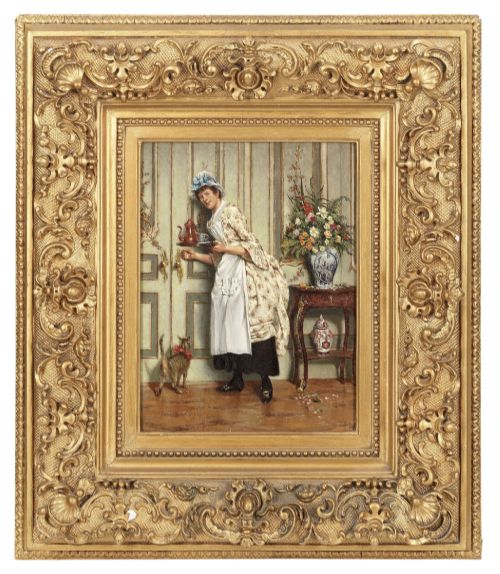
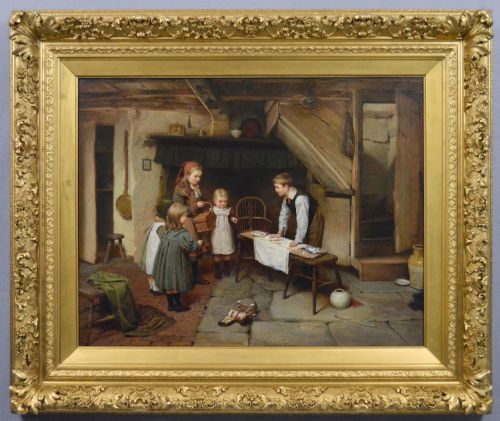
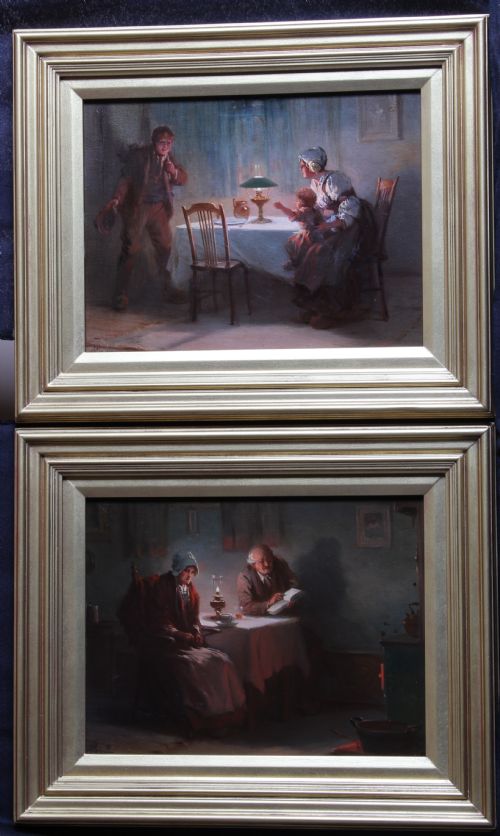
A victorian domestic genre scene depicts everyday indoor life, often showing cottage interiors, family meals, or quiet moments by the hearth. These works focus on ordinary people engaged in domestic tasks rather than grand historical or mythological subjects.
You are most likely to encounter oil paintings and watercolours on canvas, panel, or paper dating from the nineteenth century. These pictures frequently feature figures such as mothers with children, spinning maids, or families enjoying tea.
The style spans British and French traditions, ranging from detailed Victorian genre paintings to Edwardian realism. Each piece records the social textures and domestic habits of the period through narrative composition.
Materials and technique
Artists painted these domestic subjects using oil on canvas, wood panel, or oil on board, building up rich surfaces with oil paint. Watercolour on paper also appears frequently, offering a lighter medium for detailed interior narratives.
Many works retain their original framing executed in gesso and giltwood, often highlighted with gold leaf to enhance the depth of the composition. These frames form an integral part of the physical object as recorded in the evidence.
The listings combine British and French works executed in oil and watercolour across the nineteenth and early twentieth centuries.
Assessing the work
Quality rests upon the artist's ability to render light entering a cottage interior and the psychological interaction between the figures. Stronger examples handle the play of daylight or fireside glow with confident brushwork and balanced composition.
The sophistication of the narrative distinguishes the tier of execution. Pieces that capture nuanced expressions and authentic domestic details command greater attention than formulaic workshop productions.
Stephen Samuel Lewin·James Hayllar·Harry Brooker·Alexander Rosell·James Kyd·George Smith·Théophile Emmanuel Duverger·Henry Spernon Tozer·Pauline Delacroix Garnier·Alfred Provis·Henry Silkstone Hopwood·Jonathan Pratt·Pierre-Louis Bouchard·Charles Lewis
The Victorian Domestic Genre Scene Glossary
- Genre painting
- A pictorial representation of scenes from everyday life, typically depicting ordinary people in domestic settings. This style focuses on narrative and social observation rather than portraiture or landscape.
- Gesso
- A plaster-like material applied to wooden frames and mouldings to create a smooth surface for gilding. It provides the foundation for ornate decorative details on period frames.
- Giltwood
- Timber that has been coated with a thin layer of gold leaf or metallic paint. It is commonly found on traditional frames enclosing nineteenth-century paintings.
- Oil on panel
- A painting technique where pigments bound in oil are applied directly to a wooden support rather than fabric canvas. This method offers a rigid ground that preserves fine detail.
Victorian Domestic Genre Scene: Frequently Asked Questions
What is a victorian domestic genre scene?
It is a painted or watercolour work depicting everyday indoor life, typically showing families or individuals in domestic settings like cottages and country houses.
These artworks focus on narrative moments such as tea time, spinning wool, or resting by the fireside rather than formal portraiture.
How do I date these paintings?
Dating relies on stylistic evidence, artist signatures, and framing materials typical of the nineteenth century and early twentieth century.
Most surviving examples date from the Victorian era, utilising traditional oil or watercolour techniques on canvas, panel, or paper.
Where were these scenes usually set?
The settings generally reflect rural or domestic environments, including Highland cottages, Welsh cottages, and traditional country house interiors.
Artists used these locations to evoke a sense of traditional community and simple domestic routines.
How should I display a framed watercolour?
Watercolours require protection from direct sunlight to prevent the pigments and paper from fading over time.
Displaying them in stable indoor environments away from excessive moisture preserves both the paper and the original giltwood frame.