

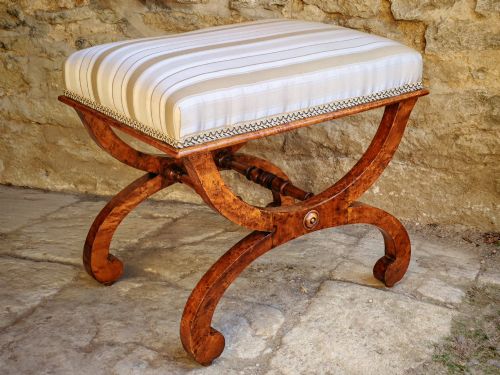


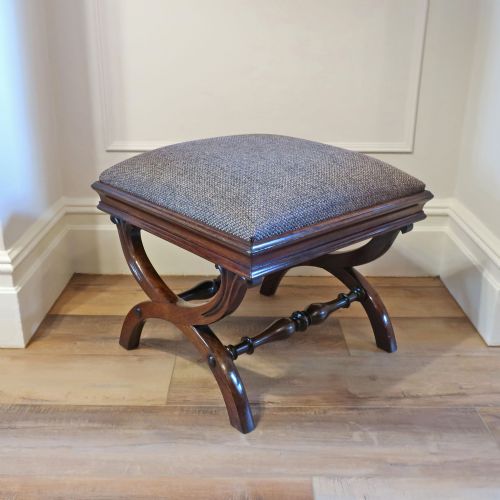


Victorian Curule Stool
These Victorian curule stools combine classical X-frame geometry with rich timbers and upholstery, offering robust portable seating for dressing rooms and parlours.
Victorian Curule Stool
A victorian curule stool draws on ancient Roman folding chair forms, adapting the X-frame silhouette for nineteenth-century domestic use as dressing stools, window seats, and footstools. These pieces emerge across the nineteenth century in various stylistic guises, spanning early Victorian interpretations to later aesthetic movement and Edwardian examples.
The inventory on this page shows pieces originating primarily in the nineteenth century, including specific dates like 1850, 1860, 1880, alongside Edwardian and 1920 entries. Makers adopted forms ranging from simple mahogany and walnut frames to more elaborate Scottish Baronial designs and ebonised pieces bearing gilt or carved details.
Buyers encountering a victorian curule stool will find distinct variations in timber and support structure. While traditional cross-frame and X-frame layouts dominate, related forms such as hall benches and dressing table stools also appear within these listings.
Materials and construction methods
Makers constructed these frames from dense, durable hardwoods including walnut, rosewood, mahogany, satinwood, and burr maple. Some workshops also utilised ebonised wood, bamboo, and brass to achieve specific aesthetic finishes.
Upholstery forms a core element of the construction, employing traditional materials like fabric and velvet. Additionally, certain seating surfaces feature woven cane, whilst structural detailing incorporates carving, gilding, and specialised adjustable mechanisms.
Victorian Curule Stool Retail Price Guide 2026
Typical asking prices for victorian curule stool among the pieces listed under this phrase on Sellingantiques today, from the lower quarter to the upper quarter. They describe what is for sale here now, not the wider market.
Current site listings span the nineteenth and twentieth centuries, incorporating Victorian, Edwardian, and specific dates like 1850, 1860, 1880, and 1920.
Distinctions in craftsmanship
The degree of hand-carving and timber selection separates standard items from superior examples. Finely figured timbers like burr maple and rosewood, coupled with intricate carved elements such as hunting dog heads, elevate the piece.
Structural integrity within the X-frame joints and the quality of the upholstery work dictate the overall execution. Pieces featuring adjustable mechanisms or gilt ebonisation demonstrate higher ambition in workshop production.
The Victorian Curule Stool Glossary
- Curule stool
- A seat featuring an X-shaped frame derived from ancient Roman magistrate chairs. This form allows for intersecting leg supports that create a distinctive cross-frame silhouette.
- Ebonised wood
- Timber treated with a dark stain or finish to imitate ebony. This technique gained particular popularity during the Victorian aesthetic movement for striking visual contrast.
- X-frame
- A structural support consisting of two diagonal pieces crossing in the centre. It provides both rigid load-bearing capacity and a classical architectural profile.
- Scottish Baronial
- A nineteenth-century architectural and decorative style drawing on historic Scottish castles. Furniture from this genre often incorporates robust proportions and traditional carving.
- Cane
- Woven plant material, typically rattan, used to create breathable seating surfaces. This technique appears on lighter frames and benches.
Victorian Curule Stool: Frequently Asked Questions
What is a curule stool?
A curule stool is a low seat built with an intersecting X-shaped frame. The design originates from ancient Roman folding furniture.
In nineteenth-century interiors, makers adapted this classical geometry for domestic utility in dressing rooms, studies, and drawing rooms.
How were these stools used?
These pieces served multiple functional roles around the Victorian home. They acted as dressing table seats, window stools, and movable occasional seating.
Some larger variations functioned as hall benches, providing a sturdy seat for putting on boots or waiting in entryways.
Which woods are most common?
The listings show a strong preference for rich, dense hardwoods. Walnut, rosewood, and mahogany appear frequently across the nineteenth-century pieces.
More specialised examples utilise satinwood, burr maple, and ebonised wood to achieve distinct decorative effects.
How do aesthetic movement pieces differ?
Aesthetic movement stools lean into distinctive finishes like ebonised wood with gilt highlights. They reflect a late nineteenth-century shift toward artistic design principles.
These pieces often showcase simpler structural lines combined with contrasting surface decoration.