


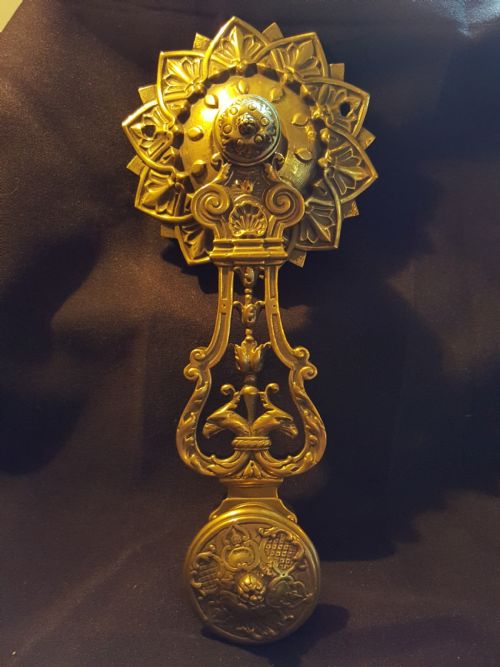


Victorian Brass Bell Pull
These Victorian brass bell pull pieces are mechanical calling devices that summon staff with style, adding tactile period charm to any hallway.
Victorian Brass Bell Pull
A victorian brass bell pull is a piece of architectural hardware designed to connect an entrance to a mechanical bell system inside the house. When you search for this phrase, you encounter functional mechanisms and hanging pulls that served grand country houses and town residences alike.
The versions most commonly met on this page span the Georgian and Victorian eras, taking the form of door hardware, bell ringers, and long hanging straps. They bridge decorative arts and practical engineering, reflecting the domestic habits of the nineteenth century.
Examples range from solid cast brass handles to elaborate embroidered panels fitted with metal mounts. Whether mounted directly to a doorjamb or suspended as a pull, these items retain the physical weight and mechanical purpose of their original installation.
Materials and construction
Metal components rely primarily on brass and cast brass, often shaped into ornate patterns characteristic of Victorian and Georgian designs alongside French Rococo revival influences. Gilded metal also appears among the hardware, providing a bright reflective surface for frequently handled fixtures.
Hanging elements introduce softer textiles into the construction, utilising hand-embroidered silk, wool, and intricate glass beads. These fabric straps combine with horn and metal handles to create durable assemblies capable of withstanding regular pulling force.
Victorian Brass Bell Pull Retail Price Guide 2026
Typical asking prices for victorian brass bell pull among the pieces listed under this phrase on Sellingantiques today, from the lower quarter to the upper quarter. They describe what is for sale here now, not the wider market.
A Victorian caller had to trust that a complex web of concealed wall wires actually made the distant kitchen bell ring.
Assessing quality
Quality rests in the crispness of the casting and the fidelity of the period ornament, where sharper botanical or scroll motifs distinguish finer metalwork from simpler production. The integration between the metal mount and the operating mechanism determines the structural integrity of the piece.
For textile components, the density of the needlework and the security of the beadwork indicate the standard of craftsmanship. Pieces that combine robust cast brass handles with well-preserved silk or wool display a higher degree of original luxury.
The Victorian Brass Bell Pull Glossary
- Bell pull
- A hanging strap or mechanical lever mounted near an entrance to ring a remote bell. These devices allowed visitors to announce their arrival before electric buzzers became common.
- Bell ringer
- A wall-mounted handle or crank mechanism connected to internal wires and bells. They form the rigid operating part of the signalling system.
- Cast brass
- An alloy poured into a mould to create solid, shaped hardware components. This technique allows for detailed relief patterns on handles and backplates.
- Needlework
- Hand-stitched decorative textile work such as silk and wool embroidery. It provides the tactile panel on hanging pulls.
- Rococo revival
- A nineteenth-century design style favouring asymmetrical scrolls, floral motifs, and shell shapes. It heavily influences the ornamentation of ornate hardware.
Victorian Brass Bell Pull: Frequently Asked Questions
How do brass bell pulls work?
These devices operate through a mechanical linkage of wires, cranks, and levers connected to a wall-mounted bell inside the house. Pulling the handle or strap tensions the wire to strike the bell in the servants' quarters.
Most surviving examples retain their metal handles or hanging loops, though the internal wire systems in walls are rarely intact today.
Where should I mount a bell pull?
They traditionally sit beside an entrance door or within a principal hallway as a decorative wall fixture. Many buyers mount them on a wooden backboard or display them framed alongside other architectural salvage.
While original mechanical connections are usually non-functional in modern homes, they make striking vertical decorative accents.
How do I clean antique brass?
Gentle dusting with a soft cloth preserves the natural aged patina that accumulates over generations of handling. Avoid harsh chemical polishes that strip away the historic surface character of the metal.
If textile straps are present, keep them away from direct sunlight and moisture to protect silk and wool fibres.
How do I tell Georgian from Victorian pieces?
Georgian examples generally feature restrained classical proportions and simpler cast brass forms reflecting eighteenth-century taste. Victorian pieces often embrace heavier ornamentation, including ornate floral casting and French revival flourishes.
Needlework pulls with integrated beadwork lean towards the mid-nineteenth century, particularly around the eighteen-fifties.