

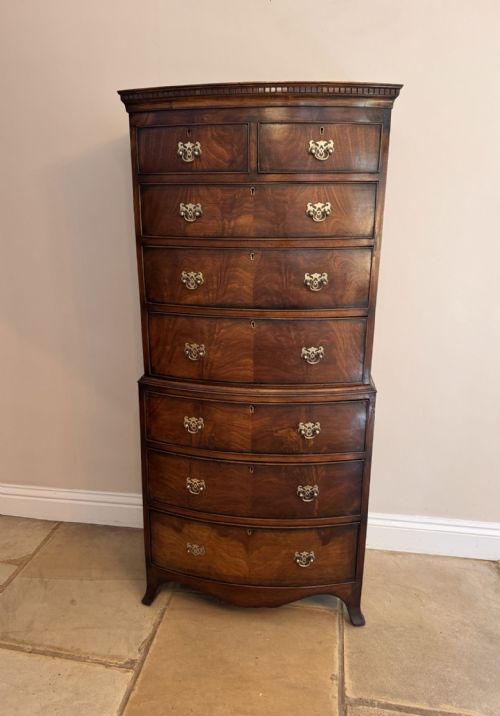
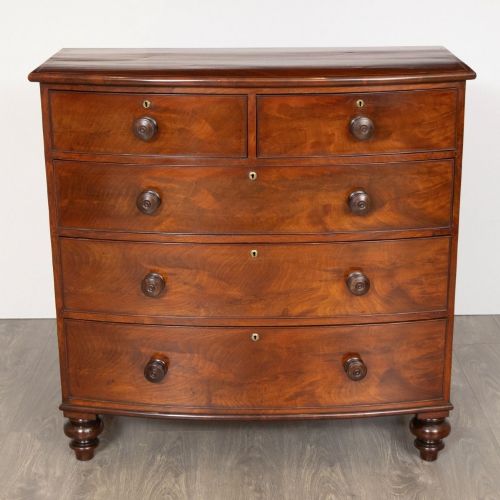

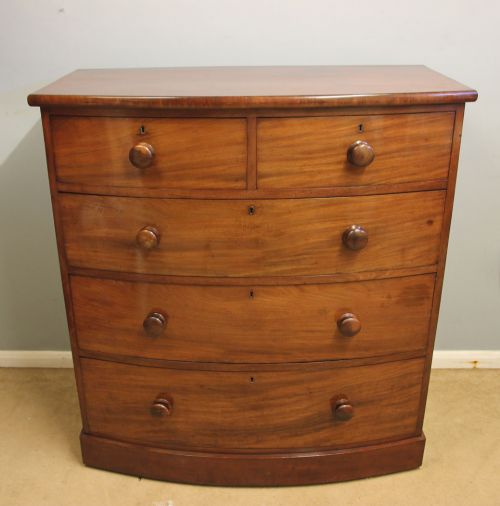


Victorian Bowfront Tallboy
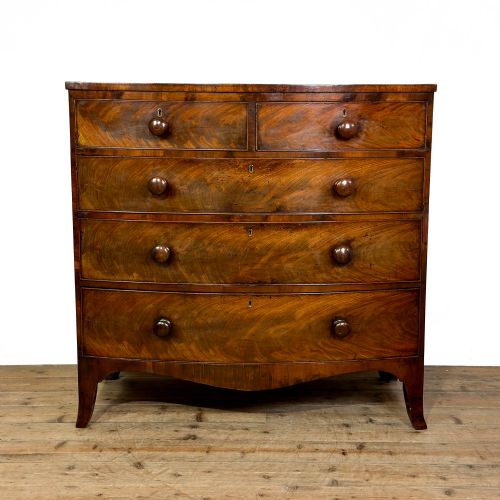
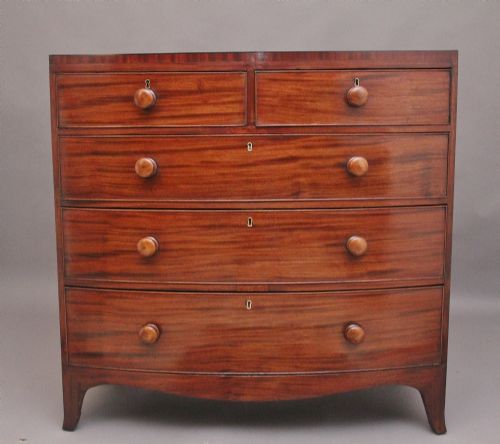
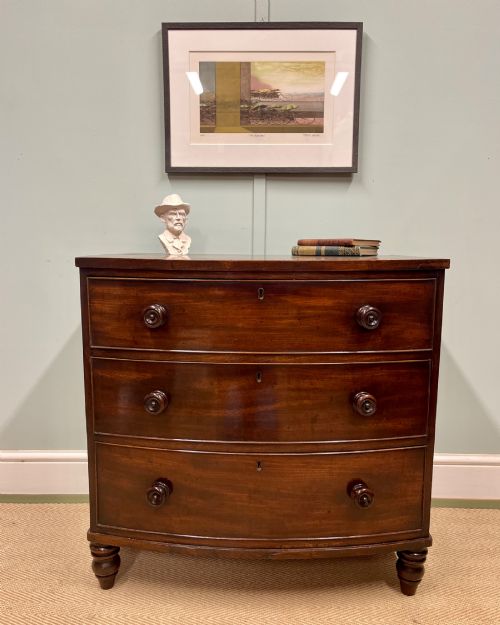
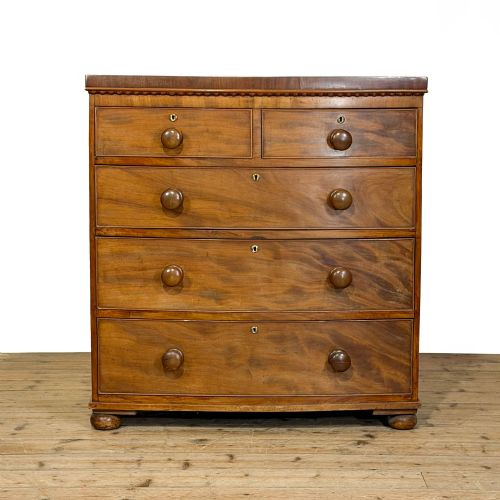
These Victorian bowfront tallboy pieces are handsome mahogany chests of drawers offering curving fronts and generous storage for any bedroom.
Victorian Bowfront Tallboy
A Victorian bowfront tallboy search reveals sturdy mahogany chests of drawers with convex curved fronts, built primarily during the 19th century. Buyers on this page most frequently encounter Victorian and 19th-century mahogany examples featuring multiple stacked drawers for domestic storage.
The assortment includes pieces attributed to various decades of the Victorian era, alongside a few items linked to the Regency style and earlier 19th-century periods. These items range from smaller compact bedside proportions to larger bedroom chests, occasionally incorporating Scotch chest formats.
Most entries display rich mahogany timber, often utilising flame mahogany veneer across the drawer faces to create dramatic grain patterns. Structural carcases frequently rely on secondary timbers such as pine to support the heavier hardwood drawer assemblies.
Materials and construction methods
Cabinet makers constructed these chests using solid mahogany and thin wood veneers laid over pine carcases to achieve the characteristic curved bowfront profile. Drawer fronts often showcase matched flame mahogany veneer, chosen for its swirling visual movement and depth.
Detailing on these pieces includes brass hardware for handles and escutcheons, alongside occasional inlay work using bone or mother of pearl. Joinery relies on traditional hand-cut dovetails for the drawer construction, ensuring durability across the 19th-century pieces.
Victorian Bowfront Tallboy Retail Price Guide 2026
Typical asking prices for victorian bowfront tallboy among the pieces listed under this phrase on Sellingantiques today, from the lower quarter to the upper quarter. They describe what is for sale here now, not the wider market.
Current listings feature pieces predominantly from the Victorian period, utilising mahogany, brass, flame mahogany veneer, and pine.
Distinctions in quality and execution
Quality separates standard utility pieces from exceptional examples through the careful selection of flame mahogany veneer and the precision of the curved drawer fronts. Superior specimens display continuous grain matching across the stacked drawers and meticulous attention to secondary timber selection.
The refinement of the brass hardware, the crispness of any inlay work with bone or mother of pearl, and the tightness of the dovetail joints indicate the skill level of the original workshop. Lesser pieces exhibit simpler wood selection and more utilitarian construction without decorative flourishes.
The Victorian Bowfront Tallboy Glossary
- Bowfront
- A convex curved furniture front that projects outward in an arc. This curved design softens the rigid lines of traditional rectangular chests.
- Flame mahogany
- A highly figured wood veneer sliced from mahogany logs where the grain resembles flickering flames. Cabinet makers prized this figure for principal drawer fronts.
- Dovetail
- An interlocking joint formed by interlocking wedge-shaped fingers. This traditional joinery secures drawer corners against heavy daily pulling forces.
- Escutcheon
- A protective plate surrounding a keyhole. These metal fittings prevent the surrounding wood from wearing down through repeated key usage.
- Secondary timber
- A lesser wood used for hidden internal elements like drawer linings and carcase backs. Pine frequently served this purpose behind mahogany show woods.
Victorian Bowfront Tallboy: Frequently Asked Questions
What is a bowfront chest?
A bowfront chest is a set of drawers featuring a convex, outward-curving front facade that creates a distinct rounded profile.
Cabinet makers of the 19th century used this curving design to soften the rectangular geometry of standard bedroom furniture while providing deep central storage space.
How do I style a tallboy?
These mahogany chests suit traditional bedrooms as primary storage units for folded garments, linens, and personal accessories.
Their substantial timber presence pairs well with neutral walls and traditional room layouts where the curved wooden facade becomes a focal point.
How do I date these chests?
Dating relies on observing construction characteristics, timber types, and hardware styles associated with the 19th century and Victorian periods.
Details such as hand-cut dovetails, brass fittings, and specific veneer choices help distinguish mid-Victorian pieces from earlier Regency-influenced examples.
What wood was used?
Primary surfaces were constructed using mahogany and decorative flame mahogany veneer to create rich brown tones and prominent grain patterns.
Internal structural parts and secondary components often utilised pine to support the heavy hardwood exterior and drawer boxes.