
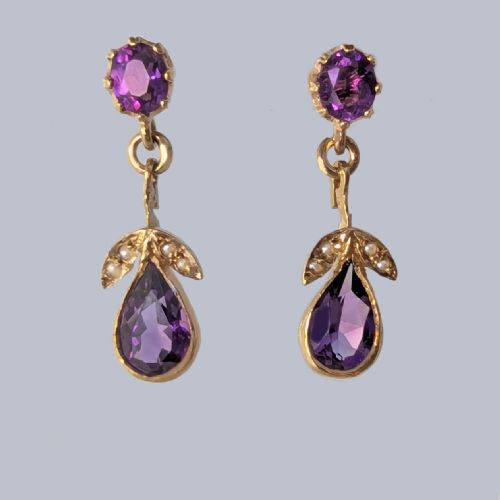


Victorian 9ct Gold Earrings
Victorian 9ct gold earrings encompass historic drop, stud, and hoop designs fashioned in yellow and rose gold alongside gems and natural materials.
Victorian 9ct Gold Earrings
When buyers search for victorian 9ct gold earrings, they encounter historic lobe adornments spanning nineteenth-century periods through to later revivals. The selection frequently includes drop and dangle formats, flower clusters, and organic motifs executed in lower-karat gold.
The pieces on this page heavily feature Victorian and Edwardian aesthetics, alongside later twentieth-century interpretations utilising similar gold alloys. Forms range from simple screwback studs to elaborate articulated drops incorporating stones or carved natural materials.
Buyers routinely find botanical and symbolic shapes, including acorns, leaves, hearts, and floral clusters. These designs demonstrate the lasting popularity of nineteenth-century motifs well into subsequent decades.
How they were made
Jewellery makers utilised 9ct yellow and rose gold alloys to form structural wires, settings, and hollow stamped components such as puff hearts and creole hoops. Metalwork techniques combined casting and wire-working with chased details, sometimes pairing the gold with silver settings for diamond work.
Pieces frequently incorporate gemstones including amethysts, garnets, diamonds, and zircons, alongside organic elements like seed pearls, coral, jet, amber, and shell cameos. Setting methods relied on collets, prongs, and foil-backing to enhance stone colour and luminosity.
Listings feature 9ct gold combined with organic materials such as Whitby jet, coral, shell cameo, amber, and seed pearls.
What varies in quality
The calibre of these earrings depends heavily on the dexterity of the metalwork and the selection of materials. Finer examples display intricate hand-applied details, secure stone matching, and robust articulation in drop elements.
Weight and structural substance differentiate sturdier constructions from lighter stamped components. Superior pieces maintain balanced proportions between the gold mountings and the accompanying gems or organic carvings.
The Victorian 9ct Gold Earrings Glossary
- Dormeuse
- A type of secure earring designed originally for sleeping in, typically featuring a lever-back or hinged wire closure. These pieces remain comfortable for daily wear.
- Cannetille
- A delicate nineteenth-century wirework technique resembling fine gold embroidery or filigree lace. It creates intricate surface patterns using twisted gold threads.
- Pinchbeck
- An alloy of copper and zinc developed to imitate gold, sometimes encountered in historic jewellery settings or associated findings. It predates standard lower-karat gold markings.
- Screwback
- A mechanical earring fitting utilising a threaded post and nut to secure non-pierced lobes. This mechanism allows the wearer to adjust the pressure applied to the ear.
- Briolette
- A drop-shaped gemstone cut with triangular facets entirely around the surface. This cut allows light to enter the stone from multiple angles.
Victorian 9ct Gold Earrings: Frequently Asked Questions
How do I care for antique gold earrings?
Clean these pieces gently with a soft dry cloth, avoiding abrasive dips or ultrasonic machines that can damage softer gems like pearls, amber, or turquoise.
Store them separately in a lined box to prevent scratching between delicate drops, wirework, and delicate stones.
Are these earrings suitable for daily wear?
Many sturdy designs handle regular rotation well, provided the clasps, wires, and screwbacks remain secure and are handled with care.
Fragile configurations involving hollow stamped gold or delicate organic materials benefit from occasional rather than constant use.
How can I tell a Victorian piece from a later revival?
Original nineteenth-century items often show specific hand-assembly traits, patination, and older fastening types like shepherd hooks or early screw mechanisms.
Revival pieces, while employing similar aesthetic vocabulary, may display modern hallmarks or manufacturing traits typical of mid-twentieth-century production.
Did all Victorian earrings require pierced ears?
Not all historic examples required pierced lobes, as makers produced screwback and clip-on mechanisms to accommodate changing fashion and wearer preferences.
Wire hooks and lever-backs remained common for pierced ears, while screwback findings offered an alternative for unpierced lobes.