
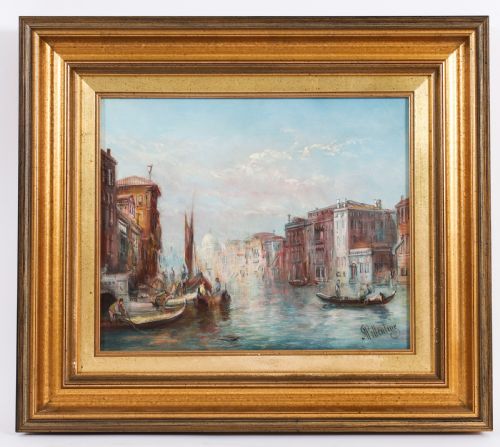
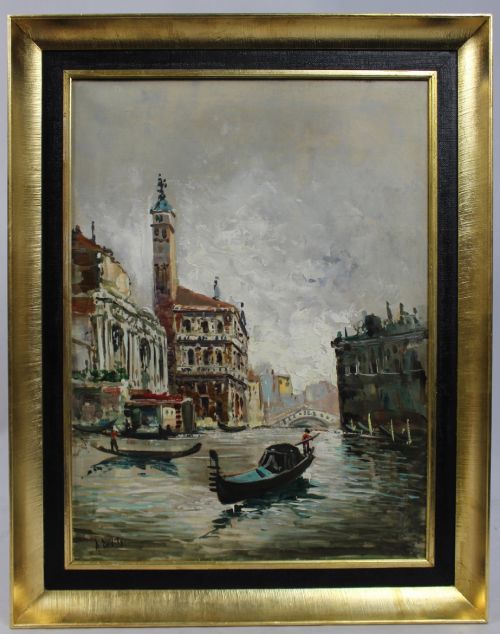


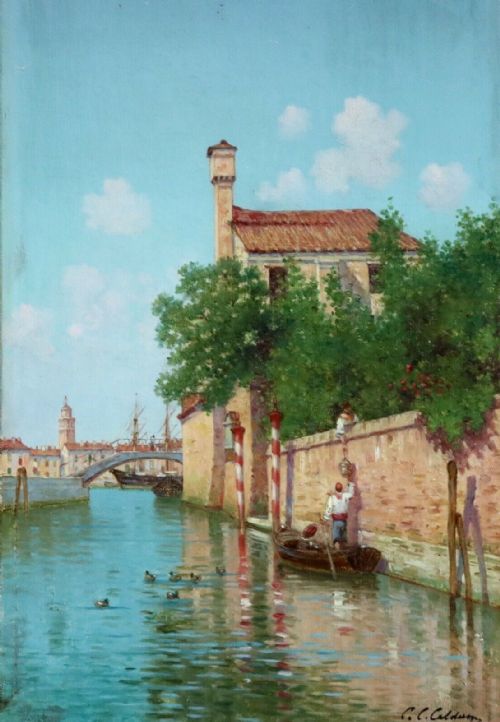
Venetian Gondola Scene Artwork
Venetian gondola scene artwork captures the enduring romance of the canals through painted views of waterways, bridges, and lagoons.
Venetian Gondola Scene Artwork
Venetian gondola scene artwork covers paintings and works on paper depicting the canals, lagoons, and architecture of Venice. These pieces range from Victorian works and nineteenth-century fine art to early twentieth-century views and mid-century impressionism.
The most common formats on this page are oil paintings on canvas and watercolour paintings on paper. Artists capture scenes such as the Grand Canal, the Mocenigo Palace, and the Bridge of Sighs.
The periods represented stretch from the Victorian era and nineteenth century through the 1910s, 1920s, 1930s, and into the 1960s. These works present both detailed architectural studies and looser impressionist interpretations of light on water.
Materials and Methods
The physical works rely primarily on oil paint applied to canvas or paper support. Artists also utilise watercolour, pastel, gouache, and ink pen to render the atmospheric light and reflections characteristic of the Venetian lagoon.
Many of these paintings and watercolours are housed in wood frames, often with gilded wood or gilt finishes. These frames complement the traditional nature of the fine art and support the preservation of the canvas or paper.
Listings include works executed in oil, watercolour, pastel, gouache, and ink across Victorian, nineteenth-century, and mid-century periods.
Assessing Quality
Quality in these Venetian scenes rests upon the handling of light, water reflection, and architectural perspective. A stronger piece demonstrates confident brushwork and atmosphere, whereas weaker examples can feel static or formulaic in their composition.
The reputation of the artist and the period execution heavily influence the standing of the work. Named nineteenth-century and twentieth-century painters command greater attention through their established skill in capturing the specific mood of the canals.
Alfred Pollentine·Antonio DeVity·F.D. Campo·Marc Aldine·Jane Vivian·Vittore Zanetti Zilla·Antoine Bouvard Senior·Charles Clement Calderon
The Venetian Gondola Scene Artwork Glossary
- Oil on Canvas
- Pigment suspended in a drying oil applied to a stretched woven fabric surface. This combination allows for rich colour blending and textured brushwork.
- Watercolour
- A paint consisting of pigment suspended in a water-based solution applied to paper. It creates luminous, translucent washes of colour.
- Gouache
- An opaque water-based paint that includes a binding agent and white pigment to create solid, flat areas of colour. It is frequently combined with watercolour or pastel.
- Impressionism
- A style of painting focusing on the visual impression of the moment, particularly shifting light and colour. Artists utilise visible brushstrokes rather than smooth blending.
- Gilt
- A thin layer of gold leaf or gold paint applied to wooden frames or surfaces. This technique adds decorative brilliance and protects the underlying material.
Venetian Gondola Scene Artwork: Frequently Asked Questions
What periods do these Venetian artworks cover?
The selection spans from the Victorian era and the nineteenth century through the early twentieth century, including the 1910s, 1920s, and 1930s. Mid-century impressionist works from the 1960s also appear.
Each period brings a distinct approach to capturing the light and architecture of the canals, moving from detailed Victorian fine art to looser impressionist interpretations.
Which materials are used in these pieces?
The primary materials are oil paint on canvas and watercolour on paper. Some works also incorporate pastel, gouache, and ink pen.
Many of these paintings feature wooden frames finished with gilt or gilded wood to enhance the presentation of the artwork.
How do I identify the subject of a canal painting?
Venetian artworks frequently depict recognisable landmarks such as the Grand Canal, the Mocenigo Palace, and the Bridge of Sighs. Gondoliers navigating the waterways are a central motif.
Signatures, inscriptions, and framing often help trace the specific artist and the era in which the view was painted.
How should I display a canvas or watercolour painting?
Oil paintings on canvas and watercolours on paper benefit from placement away from direct sunlight and excessive humidity. Proper framing protects the edges and supports the structure of the piece.
Wall placement should account for eye-level viewing to appreciate the brushwork and atmospheric detail of the scene.