

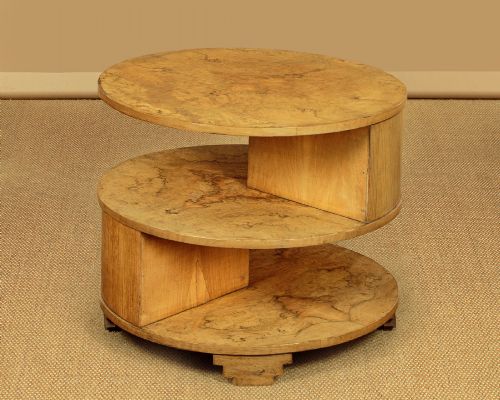


Veneer Coffee Table
A veneer coffee table brings rich timber grain and polished presence to a room, showing the careful work of twentieth-century cabinet makers.
Veneer Coffee Table
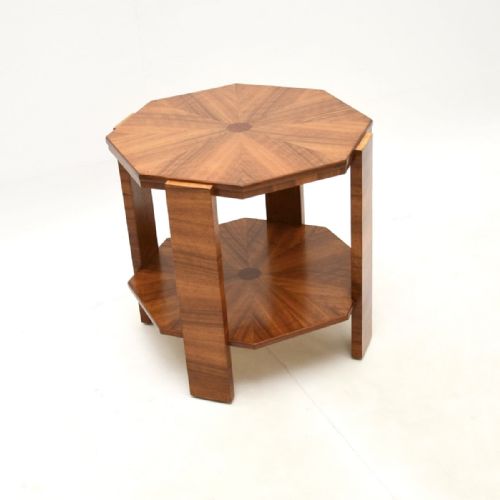
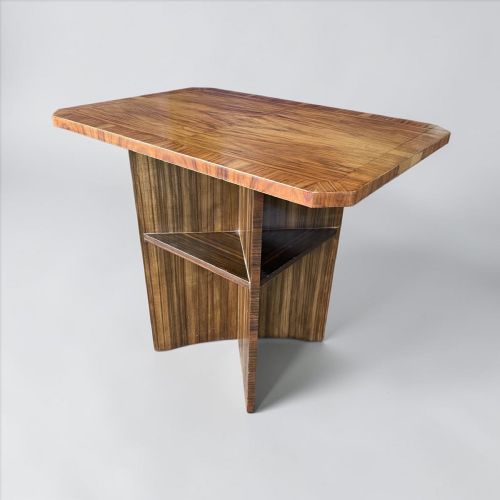
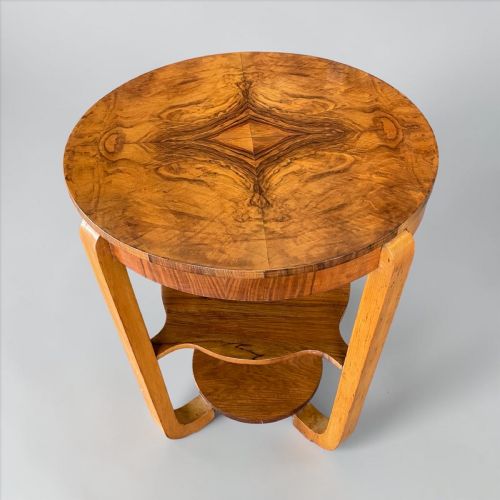
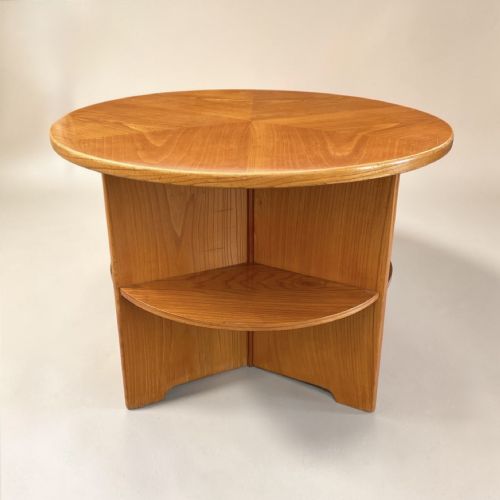
When you search for a veneer coffee table, you encounter low occasional furniture designed to display the natural patterning of choice timbers. The selection spans the early twentieth century, with Art Deco examples and revival styles appearing most frequently alongside pieces from the nineteen-thirties and nineteen-twenties.
The forms range from circular and square tables to long occasional pieces and two-tier designs intended for sitting beside seating. Walnut and burr walnut dominate the selection, accompanied by yew wood, maple, rosewood, birch, elm, and mahogany.
Origins stretch across English workshops and continental makers, including Scandinavian pieces in birch and alder root, alongside French marquetry. These tables served as functional centrepieces in domestic spaces, combining solid timber frames with decorative surface veneers.
How they were made
Cabinet makers sliced thin leaves of decorative timber, such as burr walnut, yew wood, oyster veneer, and birds eye maple, applying them to stable secondary wood cores to create striking grain patterns without wasting scarce hardwoods. This technique allowed craftsmen to mirror figures across tabletops or arrange circular oyster cuts in intricate geometric arrays.
Makers reinforced these structures with hardwood frames in walnut, mahogany, oak, or beech, sometimes incorporating brass mounts, carved details, or inlaid banding. French polish or clear varnishes were applied and rubbed down by hand to protect the delicate surface and deepen the natural lustre of the timber.
Veneer Coffee Table Retail Price Guide 2026
Typical asking prices for veneer coffee table among the pieces listed under this phrase on Sellingantiques today, from the lower quarter to the upper quarter. They describe what is for sale here now, not the wider market.
Yew wood oyster veneer tables appear frequently in archival records, pointing to a distinct group of early twentieth-century occasional pieces.
What varies in quality
The distinction between standard domestic items and finer pieces lies in the selection and bookmatching of the veneer. Tables featuring highly figured burr walnut, symmetrical oyster cuts, or contrasting maple and rosewood inlay demonstrate superior craftsmanship from specialised workshops.
Construction methods also set examples apart, with heavier framing, stable multi-tier bracing, and careful edge banding indicating higher production standards. The depth of the finish and the preservation of the original timber surface determine the overall integrity of the piece.
The Veneer Coffee Table Glossary
- Burr walnut
- A prized timber harvested from walnut tree growths, yielding swirling, knotty patterns. Cabinet makers select it for high-end table tops.
- Oyster veneer
- Small circular or oval slices cut transversely across small branches or roots, resembling oysters. Artisans arrange them in repetitive geometric patterns.
- Bookmatching
- A technique where adjacent veneer slices are opened like a book and applied side by side. This creates a symmetrical, mirrored pattern across the table surface.
- Art Deco
- A design style spanning the nineteen-twenties and nineteen-thirties, favouring geometric lines and stylised forms. Tables from this period often utilise contrasting exotic timbers.
- Marquetry
- The art of applying small pieces of veneer to a structure to form decorative pictures or patterns. French tables often utilise this technique on square tops.
Veneer Coffee Table: Frequently Asked Questions
How do I date an art deco coffee table?
Art deco coffee tables typically date from the nineteen-twenties and nineteen-thirties, identifiable by their geometric forms and contrasting veneers such as maple and walnut.
They often lack the revival ornamentation of earlier decades, focusing instead on clean lines and the natural beauty of polished wood.
Where were these tables made?
These tables originated in workshops across England, France, and Scandinavia, reflecting regional preferences in timber choice and decorative style.
English pieces frequently utilise walnut and yew, while Scandinavian examples often showcase birch, alder root, and elm.
How should I clean a veneered surface?
Clean veneered surfaces with a soft, dry cloth to remove dust, avoiding excessive moisture or chemical polishes that can damage old finishes.
Maintaining a stable room temperature protects the thin timber layer from splitting or lifting over time.