
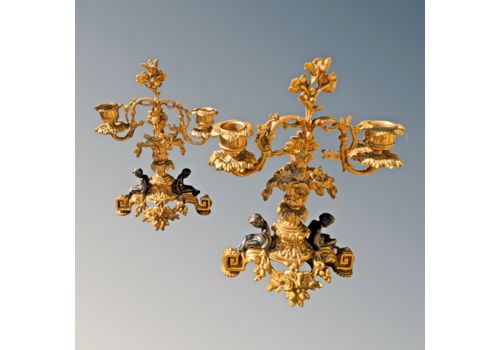


Two Light Bronze Candelabra
These two light bronze candelabra bring distinct nineteenth century French refinement to a mantelpiece or side table.
Two Light Bronze Candelabra
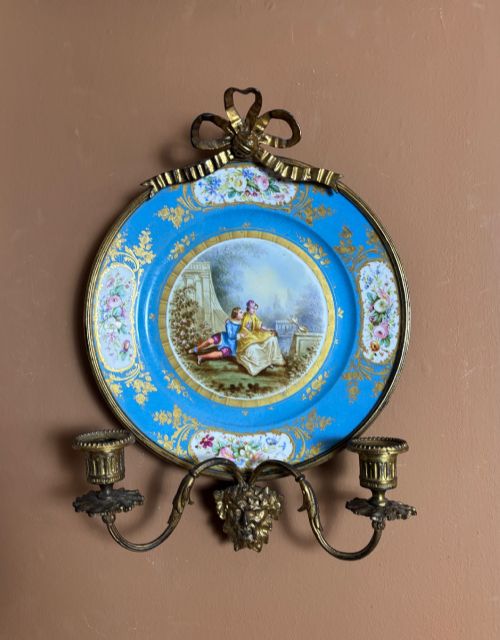
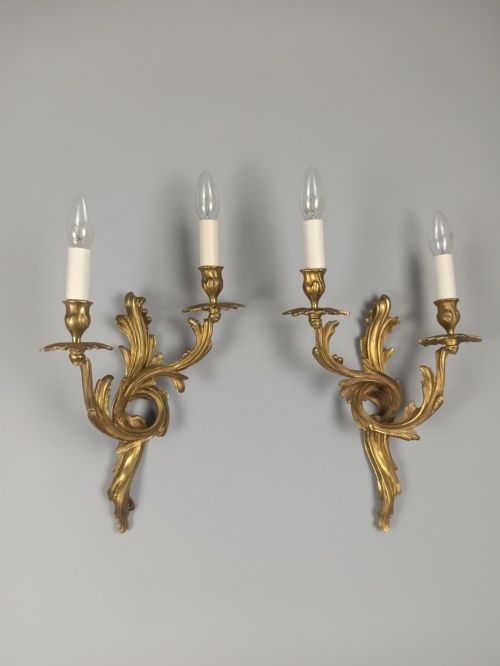
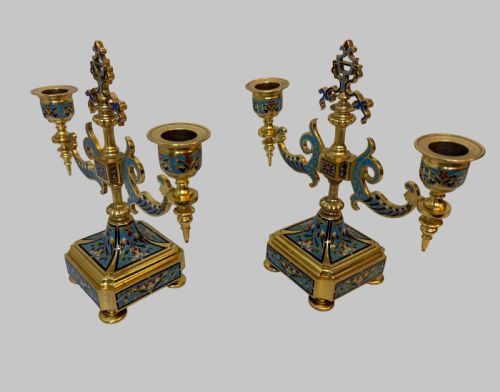
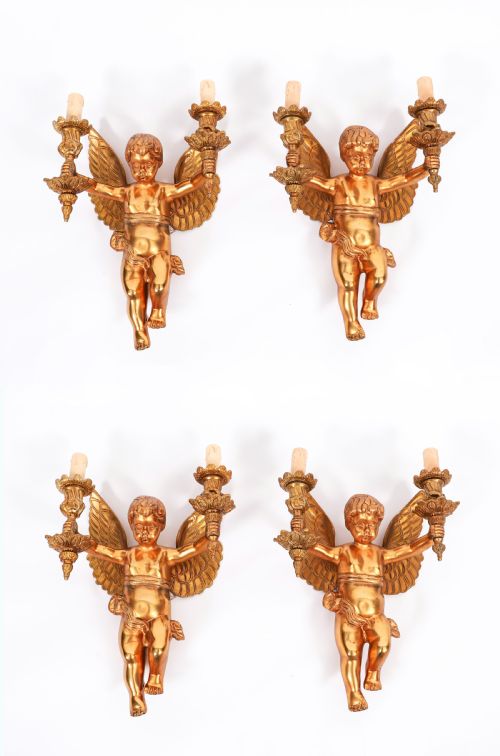
When you search for two light bronze candelabra, you encounter items designed to hold multiple candles, most frequently configured as pairs originating from nineteenth century France. The selection spans distinct forms including tabletop candelabra, wall lights, and wall sconces, alongside occasional adaptations into lamps or candlesticks.
The aesthetic vocabulary draws heavily on established classical and revivalist motifs, including French Second Empire, Rococo Revival, Louis XVI, and Empire styles. Figural elements such as cherubs frequently appear supporting the arms, alongside architectural details rendered in gilt bronze, ormolu, and patinated bronze.
Beyond standard tabletop candelabra, the inventory incorporates hybrid decorative objects integrating materials like Sevres porcelain, champleve enamel, and marble. These pieces reflect diverse production dates across the nineteenth and early twentieth centuries, anchored by Regency and Victorian periods.
How they were made
The manufacture of these lighting fixtures relies on metal casting techniques using bronze, brass, and copper alloys. Artisans applied patination to create dark, textured surfaces on the bronze figures, contrasting sharply with the bright gleam of gilt bronze and ormolu components.
Ornate details and sculptural elements, such as cherubs and acanthus leaves, were cast separately before being chased and assembled by hand. Mounts, arms, and bobeches were then secured to structural bases constructed from contrasting materials like white or coloured marble and porcelain.
Listings feature items incorporating marble, porcelain, and champleve alongside gilt and patinated bronze.
What varies in quality
Another differentiator lies in the depth and durability of the gilding and patination, where high quality ormolu displays a rich, warm tone rather than a flat, bright yellow finish. The integration of secondary materials, such as polished marble bases or detailed Sevres porcelain inserts, further elevates the overall execution.
Auguste Cain·Claude Clodion·François-Christophe-Armand Toussaint
The Two Light Bronze Candelabra Glossary
- Ormolu
- Gilt bronze created by applying a finely ground high-carat gold-mercury amalgam to a bronze object before heating. This traditional French technique produces a rich, durable golden surface finish.
- Patinated Bronze
- Bronze treated with chemical solutions to alter its surface colour, usually resulting in dark brown or greenish tones. This finish provides contrast against bright gilt metal mounts.
- Champleve
- An enamelling technique where troughs or cells are hollowed out of the metal surface and filled with vitreous enamel paste before firing. The resulting design shows vibrant colour framed by thin metal lines.
- Bobeche
- A removable collar or small dish placed below the candle socket to catch dripping wax. It protects the arms and main body of the candelabrum from damage.
- Torchere
- A tall ornamental stand or candelabrum designed to hold a light source. In nineteenth century French pieces, these often take the form of patinated figural bronze torch-bearers.
Two Light Bronze Candelabra: Frequently Asked Questions
What periods do these pieces date from?
The available selection primarily comprises nineteenth century examples, with specific pieces originating during the Regency and Victorian eras, alongside early twentieth century French production.
Stylistic indicators such as French Empire, Louis XVI, and Rococo Revival provide further context for dating individual items.
How were two light candelabra used?
These fixtures served to illuminate rooms by holding two candles simultaneously upon tables, mantels, or wall sconce brackets.
They functioned both as practical lighting devices and as decorative centrepieces within period interiors.
What materials are combined with the bronze?
Manufacturers frequently combined cast bronze and ormolu with contrasting natural and manufactured materials.
Common additions include carved marble bases, Sevres porcelain sections, and champleve enamel detailing.
How do I identify French Empire style?
French Empire style pieces rely on classical symmetry, military motifs, and references to ancient Roman and Greek art.
They often feature patinated bronze figures contrasted with bright gilt ormolu mounts and architectural lines.