


Twin Arm Silver Sconces
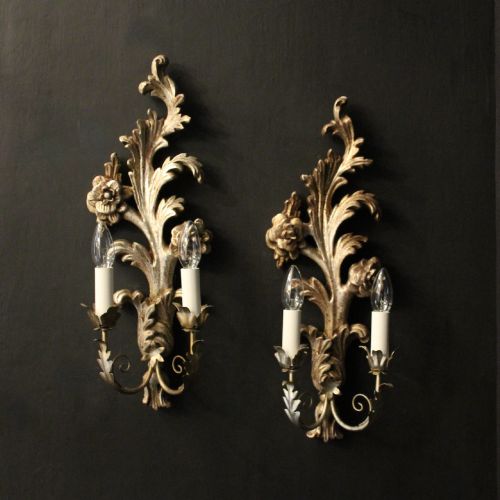
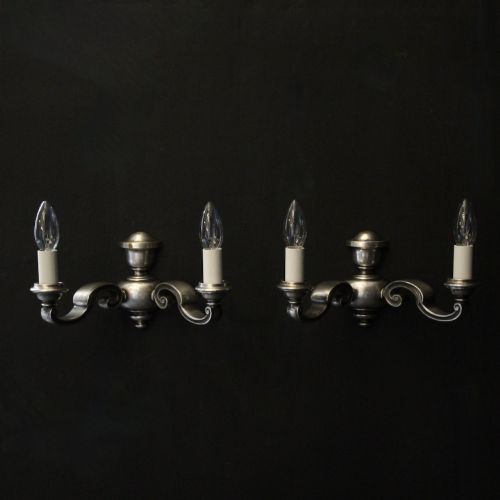
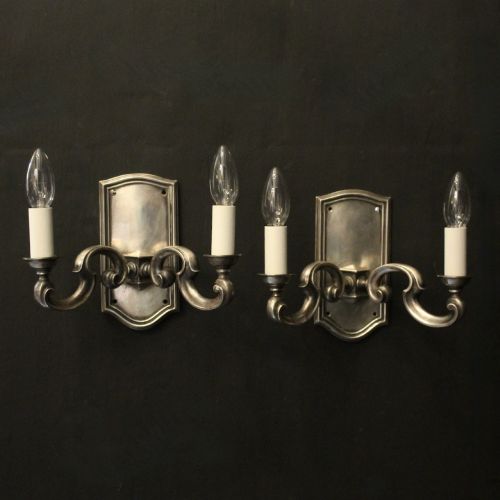
These twin arm silver sconces bring concentrated candlelight and reflection to a room, catching the eye with their silvered and gilded surfaces.
Twin Arm Silver Sconces
Twin arm silver sconces encompass wall lights and wall mounted candle holders designed with two branches to project illumination across a room. The selection spans the Victorian period, the Edwardian era, and the 1930s, alongside pieces dated across the early twentieth century.
The forms on this page draw heavily on historical revivals and regional aesthetics, including French Chateau, Grand Regency, Italian Baroque, and Art Nouveau styles. Buyers will frequently encounter English and French examples executed as pairs or sets.
Object types on offer range from standard wall lights to candelabra and detailed figural designs incorporating cherubs and mermaids. These pieces function primarily as decorative wall lighting that marries metalwork with reflective finishes.
Materials and construction
Makers utilised a diverse palette of metals and base materials, applying silver plate, silver leaf, and silver gilt over brass, bronze, and gessoed wood. Crystal drops and cut glass elements frequently augment the metallic structures to enhance light dispersion.
Surface treatments define the visual character of these fixtures, combining burnished silver leaf with intricate giltwood carvings and cast metal components. The application of silvering and gilding creates varied textural depths across Florentine and French provincial designs.
Several Edwardian wall lights feature highly detailed mermaids holding candle sockets, bringing a touch of mythological drama to the hallway.
Assessing craftsmanship and finish
Quality reveals itself in the crispness of cast details and the depth of the carved or moulded elements, such as the expression on a cherub or the elaboration of acanthus scrolling. Finer examples display meticulous hand-chasing on the metal arms and secure, well-fitted joinery.
The integrity of the surface finish dictates distinction, separating evenly applied silver leaf and rich silver gilt from flat or uniformly sprayed modern coatings. The inclusion of original cut glass or crystal components also elevates an object above simpler utilitarian alternatives.
The Twin Arm Silver Sconces Glossary
- Sconce
- A wall-mounted lighting fixture designed to hold candles or electric lamps and project light outward into a space.
- Silver Gilt
- A silver or silver-plated object that has been coated with a thin layer of gold, combining the cool tone of silver with warm golden highlights.
- Giltwood
- Timber, often gessoed and carved, that has been decorated with gold or silver leaf to simulate solid precious metal.
- Candelabra
- A branched candlestick or lamp holding multiple lights on separate arms.
- Silver Plate
- A thin layer of silver fused or electroplated onto a base metal such as brass or copper.
Twin Arm Silver Sconces: Frequently Asked Questions
How do I wire antique wall sconces?
Many wall lights from the Edwardian period and the nineteen-thirties were originally designed for candles or gas and have since been adapted for electricity by modern restorers.
Qualified electricians should install these fixtures using appropriate backplates and secure fixings to ensure safety with period wiring.
Can I hang these sconces in a hallway?
Narrow corridors and entrance halls benefit greatly from wall-mounted lighting because twin arm sconces project very little into the walking space.
Placing them at eye level creates a warm wash of reflected light against the wall surface without obstructing movement.
How do I clean silvered brass wall lights?
Dusting with a soft, dry cloth prevents the accumulation of grime on delicate silver leaf and giltwood surfaces without risking abrasion.
Avoid chemical silver dips entirely, as they strip away vintage plating and applied leaf finishes from the underlying metal.
Are these sconces sold as pairs?
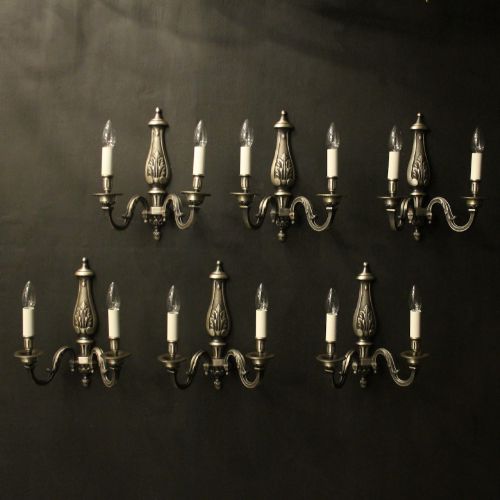
Many listings feature balanced pairs designed to flank a mirror, fireplace, or doorway in traditional symmetrical interior schemes.
Larger sets of three, six, or seven pieces also appear for use across extensive drawing rooms or dining spaces.