
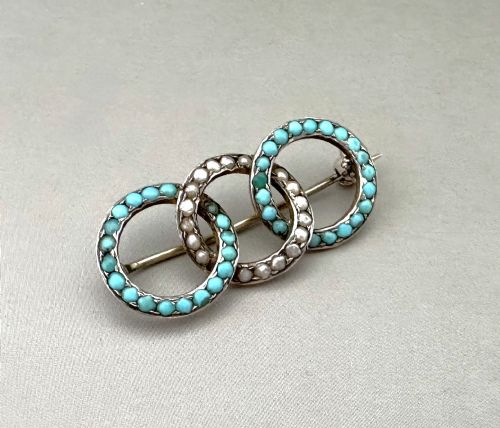


Turquoise Pearl Ring
A turquoise pearl ring brings together vivid blue stones and lustrous organic gems in gold bands crafted during the Victorian and Edwardian eras.
Turquoise Pearl Ring
A turquoise pearl ring unites two distinct organic and mineral gems within gold settings typical of the nineteenth and early twentieth centuries. These pieces emerge predominantly from Victorian and Edwardian workshops, spanning periods from late Georgian times through to nineteen hundred.
The evidence shows these rings appear in multiple forms, including double row bands, navette clusters, buckle styles, and multi-row stacking arrangements. The most frequent iteration on this page is the classic Victorian cluster ring pairing bright turquoise cabochons with seed pearls.
Makers utilised various carats of gold, ranging from nine carat up to eighteen carat yellow and rose gold, alongside silver gilt settings. Alongside traditional rings, the broader jewellery category includes earrings, posy holders, and brooches featuring the same signature gemstone combination.
Materials and construction
Goldsmiths constructed these rings using cast and fabricated gold bands in nine, twelve, fifteen, and eighteen carat purities, frequently employing yellow and rose tones. Metalwork often incorporates detailed engraving, navette shapes, or cluster frameworks designed to hold small turquoise stones and pearls securely.
The gems themselves combine polished turquoise cabochons with natural, seed, or cultured pearls, occasionally accented by small old cut diamonds. Gemstones are secured using close settings, claw settings, or channel mounts, depending on the specific nineteenth-century design.
Listings demonstrate that turquoise and pearl combinations appear across rings, earrings, and brooches manufactured in Victorian and Edwardian workshops.
Evaluating quality and craftsmanship
Quality in these pieces rests upon the uniformity and natural colour of the turquoise alongside the matching lustre of the pearls. Higher grade examples maintain intact stones without significant matrix discolouration or surface wear.
The construction of the gold mount dictates the standard of the piece, with heavier fifteen and eighteen carat gold bands showing crisper hand engraving and more secure stone settings than lighter nine carat alternatives.
The Turquoise Pearl Ring Glossary
- Cabochon
- A gemstone shaped and polished with a smooth convex surface rather than faceted. This style highlights the natural flat colour of turquoise.
- Seed pearl
- A very small, naturally occurring pearl, often pierced and threaded or set closely in pavé arrangements. They provide delicate white accents around central turquoise stones.
- Navette
- A boat-shaped or marquise design that tapers to points at both ends. This silhouette elongates the finger when worn.
- Silver gilt
- Sterling silver that has been coated with a thin layer of gold. This technique offered a rich appearance while utilising mixed metals.
- Trilogy ring
- A ring featuring three principal stones set in a row. In these pieces, turquoise and pearls alternate across the band.
Turquoise Pearl Ring: Frequently Asked Questions
What is a turquoise pearl ring?
A turquoise pearl ring is an antique or vintage piece of jewellery featuring a combination of turquoise stones and pearls set into gold. These rings date primarily from the Victorian and Edwardian periods.
Craftsmen arranged the stones in clusters, rows, and navette shapes, utilising yellow and rose gold ranging from nine to eighteen carats.
How do I date a Victorian ring?
Dating a Victorian ring involves examining the gold purity hallmarks, style of the setting, and any engraved inscriptions on the band. Hallmarks often include town marks and date letters corresponding to specific assay office years.
Stylistic cues such as navette cluster designs or rose gold hues also point towards late nineteenth-century manufacturing trends.
Are pearls in antique rings natural?
Many antique rings feature natural or seed pearls formed organically in saltwater or freshwater molluscs before cultured pearls became widespread in the twentieth century. These natural pearls show specific structural characteristics under magnification.
Seed pearls were particularly favoured in Victorian cluster designs to frame brighter gemstones.
How should I care for antique turquoise?
Turquoise is a porous gemstone that reacts poorly to harsh chemicals, cosmetics, and prolonged immersion in water. Cleaning requires only a soft, dry cloth rather than liquid jewellery dips.
Protecting the ring from knocks prevents damage to both the soft turquoise cabochons and the delicate pearls.