

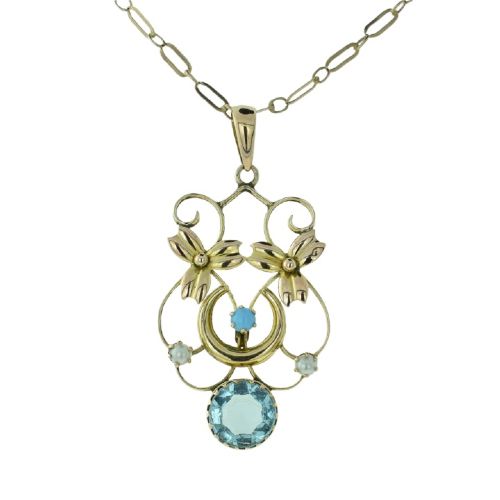


Turquoise Drop Necklace
A turquoise drop necklace brings together vibrant blue stones and delicate precious metals in pieces that collectors treasure for their historical charm.
Turquoise Drop Necklace
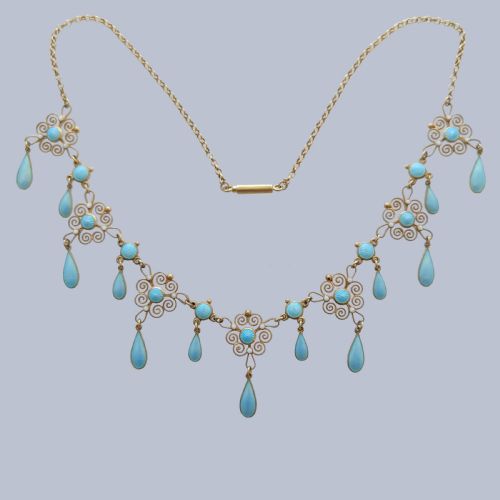
The pieces on this page span several forms, from single pendants in gold and silver to matched jewellery sets. Makers and designers of these items utilised natural turquoise, matrix turquoise, and pearls alongside enamel work to create striking focal points.
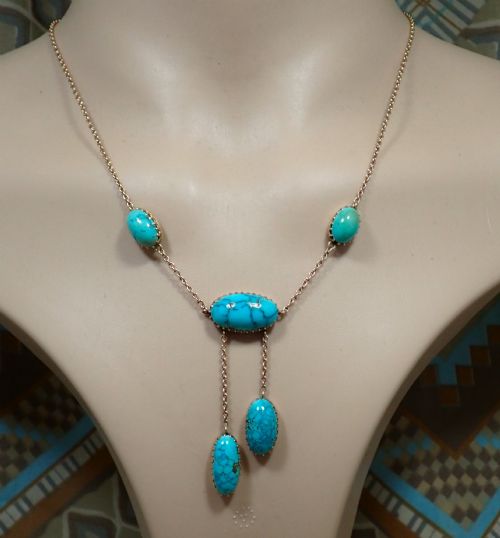
Victorian and Edwardian examples dominate the selection, often pairing turquoise with pearls in halo or negligee settings. These necklaces reflect the decorative shifts of the nineteenth and early twentieth centuries, offering tangible examples of historical jewellery design.
How they were made
Goldsmiths and silversmiths shaped these pieces using 9ct gold, 15ct gold, silver, and 9ct rose gold to set the stones securely. Metalwork techniques included fine filigree and structural mounts designed to support hanging drops and central pendants.
Craftsmen combined turquoise cabochons with pearls, enamel, and occasional accent stones like blue topaz. Settings ranged from closed mounts to open-back designs that allowed light to pass through the gems.
Turquoise Drop Necklace Retail Price Guide 2026
Typical asking prices for turquoise drop necklace among the pieces listed under this phrase on Sellingantiques today, from the lower quarter to the upper quarter. They describe what is for sale here now, not the wider market.
Listings feature 9ct gold, 15ct gold, and silver alongside natural turquoise, matrix turquoise, pearls, and enamel across Victorian and Edwardian periods.
What varies in quality
The sophistication of the metalwork and the integration of secondary elements like enamel or pearls set finer examples apart. Artisanal execution in the mountings reflects the standards of specific workshops and movements, distinguishing standard production from exceptional design.
The grade and natural matrix pattern of the turquoise stones contribute significantly to the visual impact of each piece. Pendants that maintain original chain links and undamaged enamel show superior preservation over time.
Deakin & Francis·Murrle Bennett·Dorrie Nossiter·Liberty & Co
The Turquoise Drop Necklace Glossary
- Negligee necklace
- A style featuring two unequal drops suspended from a central motif, popular during the Edwardian period. This configuration creates a distinct asymmetrical vertical line on the chest.
- Cabochon
- A gem polished to a smooth convex surface rather than faceted. This cut highlights the natural colour and matrix variations of turquoise.
- Parure
- A matched set of jewellery intended to be worn together, typically including a necklace, earrings, and a ring or brooch. Such suites share matching materials and stylistic motifs.
- Halo pendant
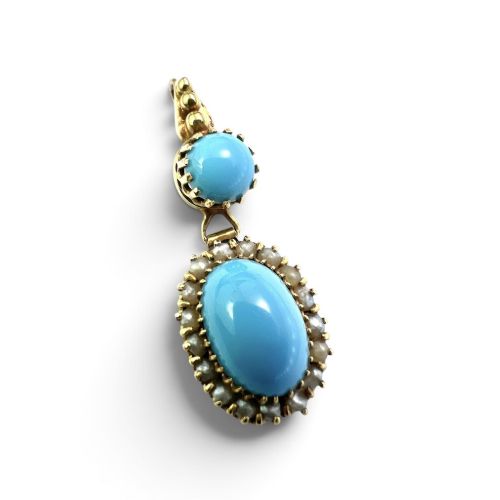
- A central stone encircled by a border of smaller gems, usually pearls or diamonds. This arrangement enhances the visual presence of the main turquoise drop.
- Filigree
- Delicate ornamental work of fine wire, usually gold or silver, formed into open lace-like patterns. It requires high technical skill from the metalsmith.
Turquoise Drop Necklace: Frequently Asked Questions
What periods do these necklaces come from?
The pieces span the Victorian era, Edwardian period, Arts and Crafts movement, and mid-century designs. Each era brings distinct metal choices and mounting styles.
Victorian items often feature rich gold and pearl pairings, while Arts and Crafts examples showcase hand-worked silver and enamel.
What metals are used in these settings?
Makers utilised silver, 9ct gold, 9ct rose gold, and 15ct gold for these pendants and necklaces. The choice of metal often reflects the prevailing style of the manufacturing period.
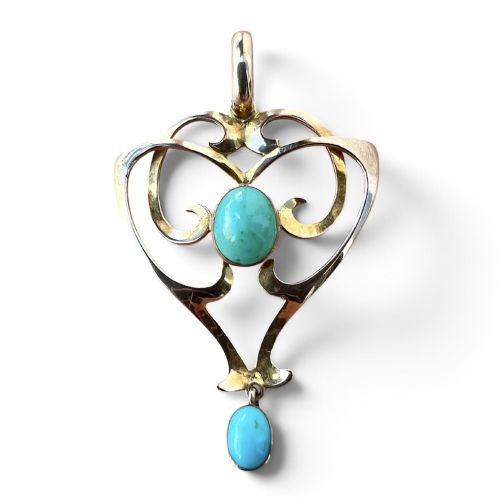
Silver frequently appears in Arts and Crafts and Art Nouveau pieces, while gold is common in Victorian and Edwardian work.
Are pearls commonly paired with turquoise?
Pearls frequently accompany turquoise in halo pendants, negligee necklaces, and clustered cluster designs. This combination was particularly favoured during the Victorian and Edwardian periods.
White pearls provide a neutral contrast that highlights the bright blue hues of the turquoise stones.
What is matrix turquoise?
Matrix turquoise contains visible web-like veins of the host rock running through the stone. This natural webbing creates unique patterns across the surface of the gem.
Such stones were frequently utilised in Arts and Crafts jewellery to emphasise natural, unpretentious materials.