

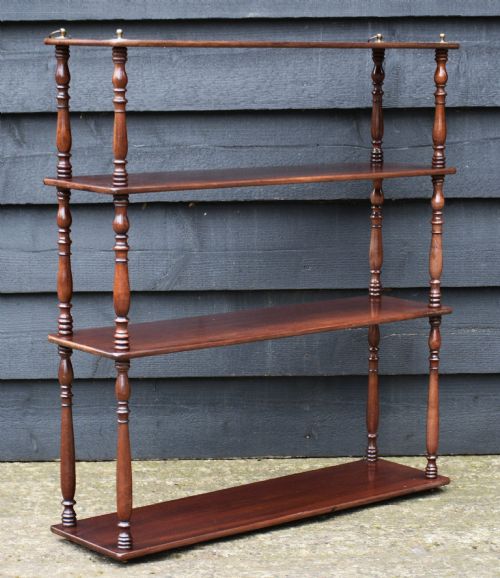
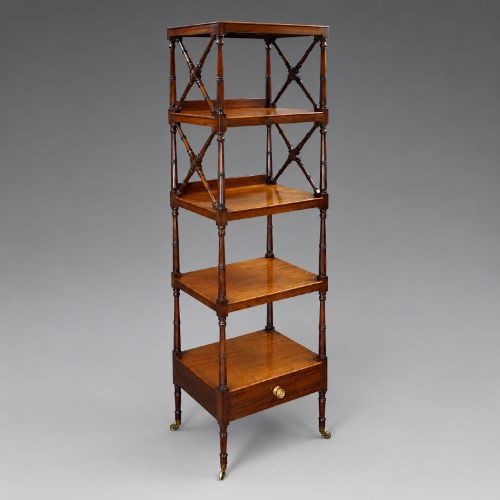
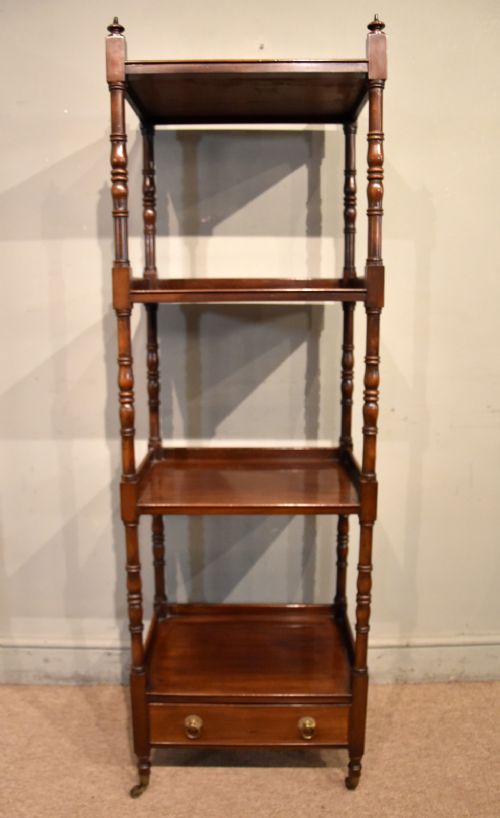
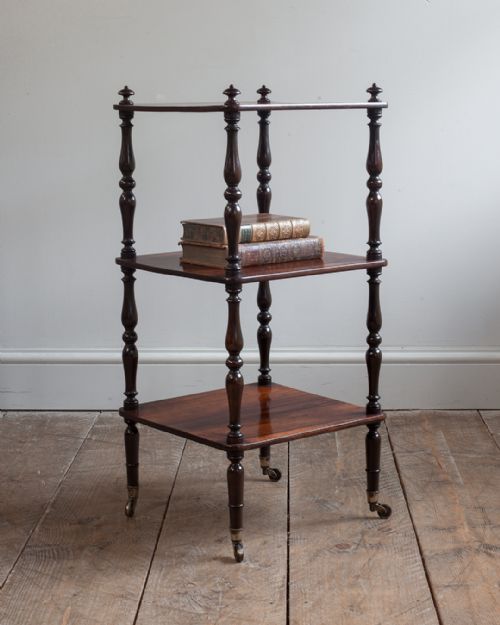




Turned Wood Whatnot
Turned wood whatnot stands bring tiered display and practical shelving to a room, offering upright timber tiers held by shaped uprights.
Turned Wood Whatnot
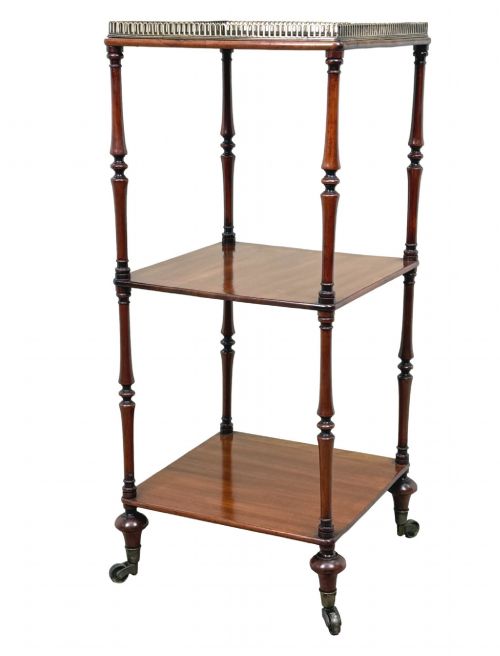
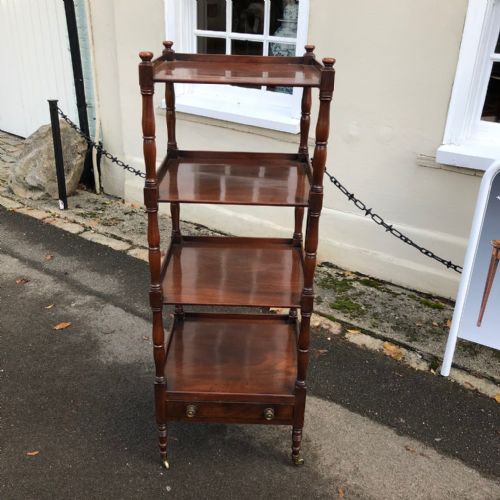
A turned wood whatnot is a multi-tiered open display stand designed for books, ornaments, and small collections. The items appearing on this page span Georgian, Regency, William IV, and Victorian periods, often taking freestanding forms with three or four tiers.
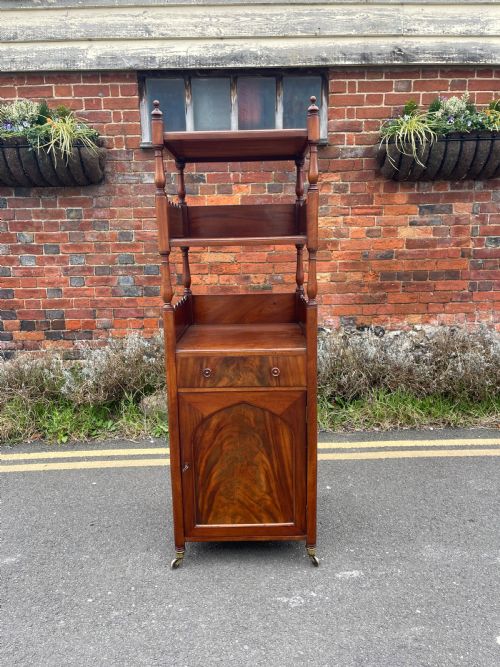
Most examples seen here are constructed from mahogany, rosewood, walnut, and burr walnut, alongside ebonised wood and oak. Buyers will also encounter wall hanging shelves, corner units, and cupboard base variants among the standard freestanding open stands.
These pieces function primarily as vertical display furniture, using minimal floor space while providing several horizontal surfaces. The tiers are regularly divided by slender turned supports that give the furniture its defining vertical rhythm.
Materials and construction methods
Cabinet makers utilised dense hardwoods such as mahogany, rosewood, and walnut for their strength and fine grain, occasionally employing marquetry inlay for decorative surface enrichment. Timber shelves are supported by precisely turned wooden columns or pillars that screw or peg directly through each tier.
Brass castors often appear on the feet of freestanding nineteenth-century examples to allow easier movement across carpets and floorboards. Joinery relies on traditional tiered framing, where upright turned supports act as the structural backbone holding each horizontal shelf in rigid alignment.
Turned Wood Whatnot Retail Price Guide 2026
Typical asking prices for turned wood whatnot among the pieces listed under this phrase on Sellingantiques today, from the lower quarter to the upper quarter. They describe what is for sale here now, not the wider market.
Period styles represented across the inventory span Georgian, Regency, William IV, and Victorian eras.
Factors determining quality and construction standard
The choice of primary timber sets the initial distinction, with figured burr walnut, rich rosewood, and dense mahogany sitting at the upper end of the scale compared to plain oak or standard pines. Timber selection dictates the visual depth of the grain and the overall weight of the structure.
Turned supports demonstrate craftsmanship through the crispness of their profile cutting and the stability they lend to multiple tiers. Refined proportion between the shelf areas and the turned columns separates standard utility items from more ambitious cabinet work.
The Turned Wood Whatnot Glossary
- Whatnot
- An open shelving unit with multiple tiers used for displaying ornaments and books. It emerged in the eighteenth century and remained popular through the Victorian era.
- Etagere
- A French term for a piece of furniture consisting of a set of open shelves for displaying small objects. It is frequently used interchangeably with the English whatnot.
- Burr walnut
- Timber taken from a walnut tree growth showing complex, swirling grain patterns. It is typically sliced into veneers for decorative surfaces.
- Marquetry inlay
- The art of applying small pieces of veneer to a structure to form decorative patterns or pictures. It adds distinct visual contrast to flat shelf surfaces.
Turned Wood Whatnot: Frequently Asked Questions
What is a turned wood whatnot used for?
A turned wood whatnot serves as an open shelving unit designed to hold books, ceramics, and small decorative items.
Its multiple tiers allow owners to display collections vertically without taking up excessive floor space in a living area or bedroom.
How do I tell a Regency whatnot from a Victorian one?
Regency pieces often display cleaner architectural lines and restraint in ornamentation, frequently dating from the early nineteenth century.
Victorian variants tend to introduce heavier mahogany or walnut timber, richer grain finishes, and occasionally elaborate turned supports or corner configurations.
Can I place a freestanding whatnot on carpet?
Most freestanding nineteenth-century examples are equipped with small brass castors on the feet to facilitate movement across floor surfaces.
Heavier loaded shelves benefit from being positioned on flat flooring or secured if placed on thick carpets to ensure complete stability.
What is the difference between a whatnot and an etagere?
The terms describe similar multi-tiered open display furniture originating from different European traditions during the Georgian and Victorian periods.
Both styles utilise upright turned supports to divide horizontal shelves, though etagere often implies a slightly more decorative French influence.