
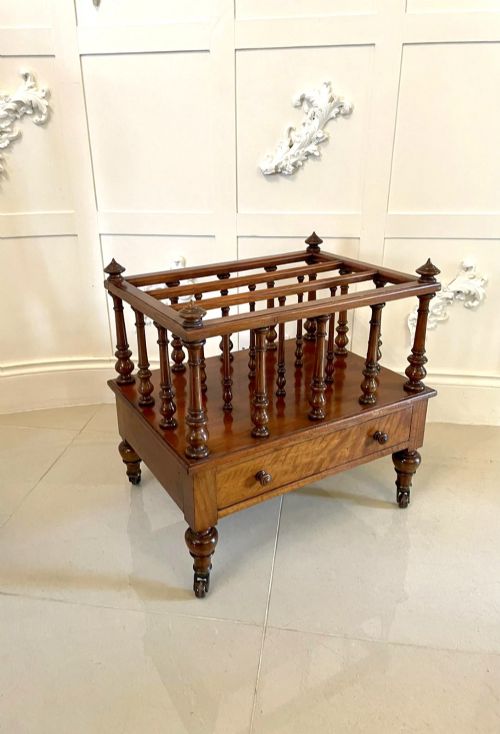
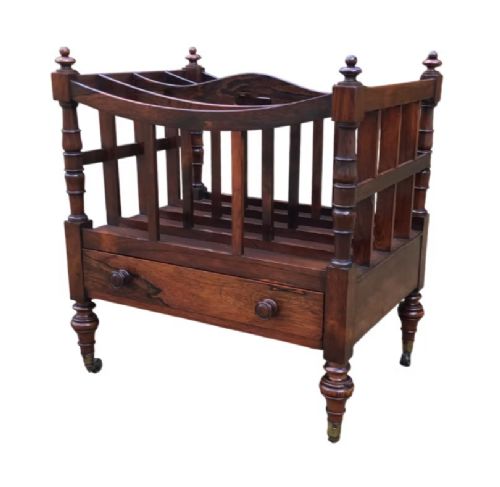
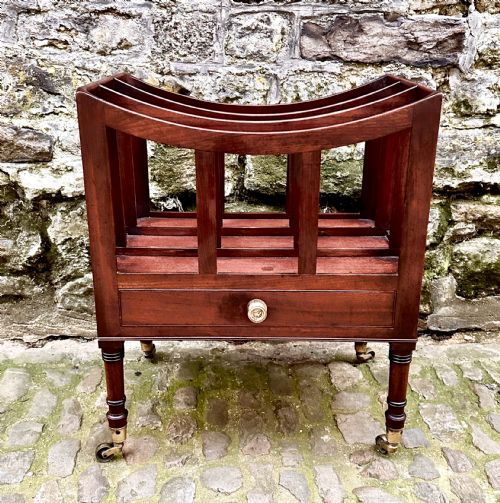
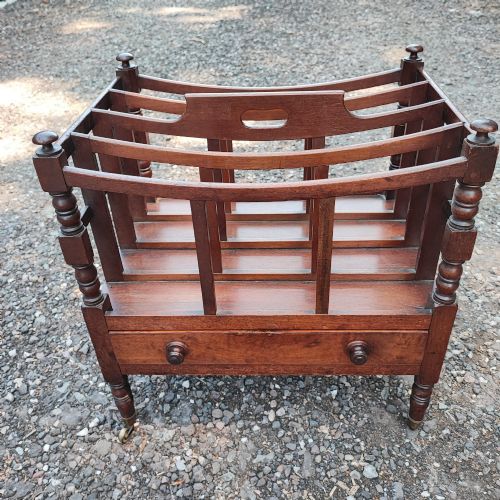




Turned Wood Canterbury
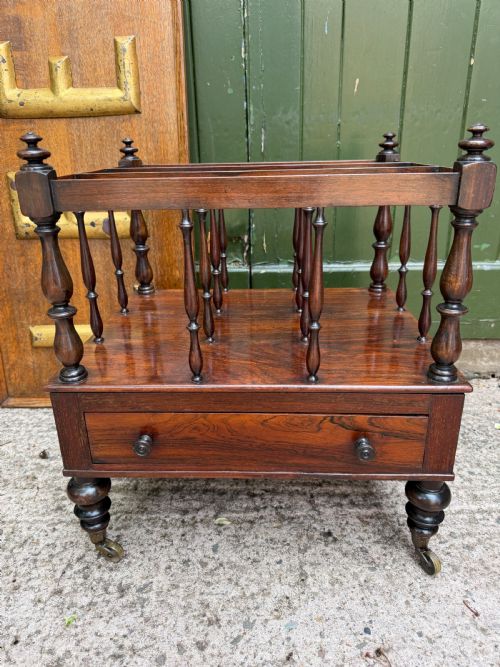
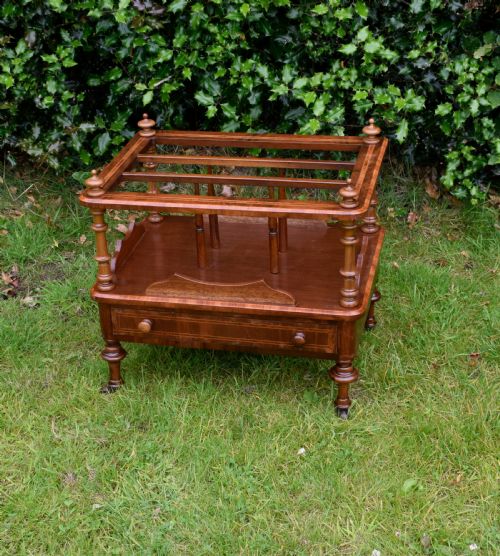
A turned wood canterbury organises folios, sheets and papers with timber turned uprights and divided sections.
Turned Wood Canterbury
A turned wood canterbury serves as a compartmentalised stand for sheet music, magazines, and newspapers in a sitting room or music room. Pieces found here span the Georgian, Regency, William IV, and Victorian periods, often taking the form of freestanding racks with multiple divisions.
Makers designed these stands with boat shapes, drawers beneath the divisions, and carrying handles for mobility. Surviving examples demonstrate the evolution of the form from early nineteenth-century mahogany models to mid-Victorian walnut and ebonised variations.
Materials and construction
Cabinet makers utilised dense hardwoods such as mahogany, rosewood, and figured walnut to construct the framework and divisions of each canterbury. Brass fittings, boxwood inlay, and metal castors frequently appear as secondary materials on Regency and Victorian examples.
Turned wood components form the structural uprights and carrying spindles, combining with slatted or panelled dividers to hold folios upright. Drawers integrated into the base incorporate traditional joinery alongside turned wooden knobs.
What determines quality
The choice of timber grain defines the visual merit of a canterbury, with highly figured walnut and rich rosewood commanding attention above plain surfaces. Cabinet work such as crisp boxwood inlay and integrated drawers indicate higher workshops.
Proportion and scale separate standard production from refined pieces, particularly where turned columns and carrying handles balance the division count. The inclusion of original brass castors and robust structural framing preserves the integrity of the stand.
Shoolbred
The Turned Wood Canterbury Glossary
- Canterbury
- A low stand with divisions used for holding sheet music, books, or newspapers. The form originated in the late eighteenth century and often includes a low drawer.
- Folio
- A large sheet of paper or musical score stored flat or upright within the divisions of a stand. These items required dedicated storage near pianofortes.
- Boat shaped
- A curved profile given to the base or rails of certain Regency stands. This contour mirrors the hull of a small boat.
Turned Wood Canterbury: Frequently Asked Questions
What is a turned wood canterbury used for?
These stands hold sheet music, magazines, and newspapers within divided compartments near seating areas or musical instruments. Nineteenth-century households relied on them to keep folio papers tidy and accessible.
Many examples incorporate a small drawer beneath the rack for storing smaller accessories like tuning keys or writing materials. Their portable nature allowed servants to move them about the room as needed.
How do I date a canterbury?
Dating relies on timber selection, decorative motifs, and structural lines associated with specific historical periods. Georgian and Regency pieces typically feature mahogany with linear proportions.
Victorian and mid-Victorian examples often employ walnut, rosewood, or ebonised finishes with heavier turned elements and elaborate division designs.
Did canterburys have drawers?
Several models incorporate a shallow drawer situated directly beneath the vertical divisions. This addition provided extra storage for small items related to reading or music practice.
Drawers on these pieces are constructed using traditional dovetail joints and operated with small turned wooden knobs or brass pulls.
Are all canterburys made of mahogany?
While mahogany appears frequently across Georgian and Regency pieces, other dense timbers were widely utilised by makers. Rosewood and walnut became particularly prominent during the William IV and Victorian eras.
Makers also applied decorative techniques such as boxwood inlay and ebonising to enhance the appearance of the primary wood.