
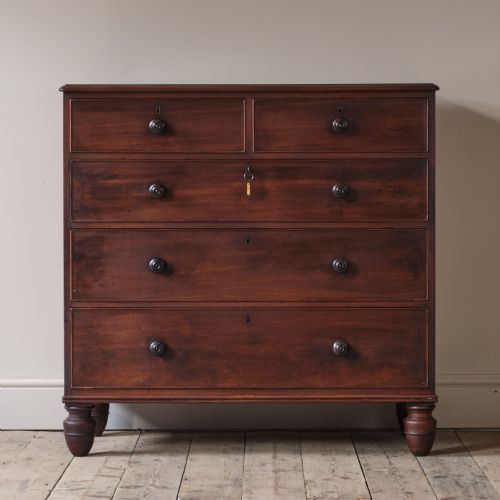
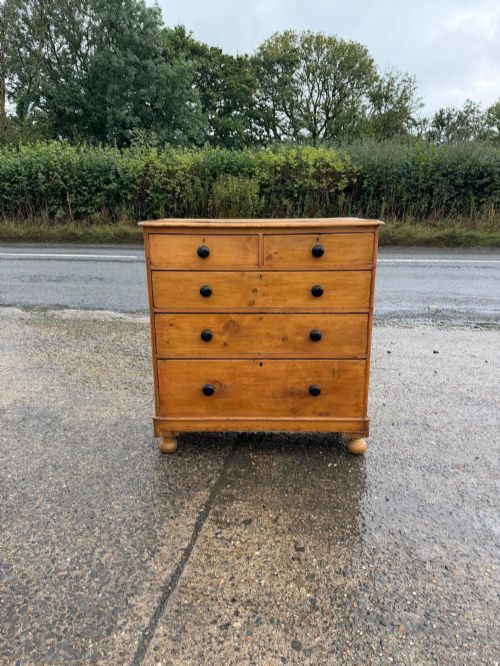
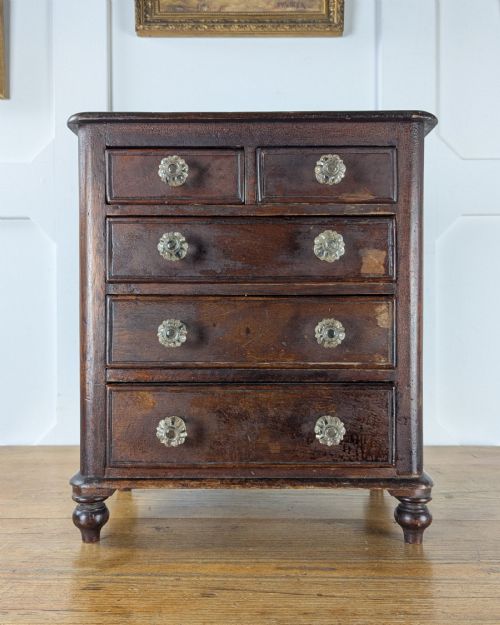
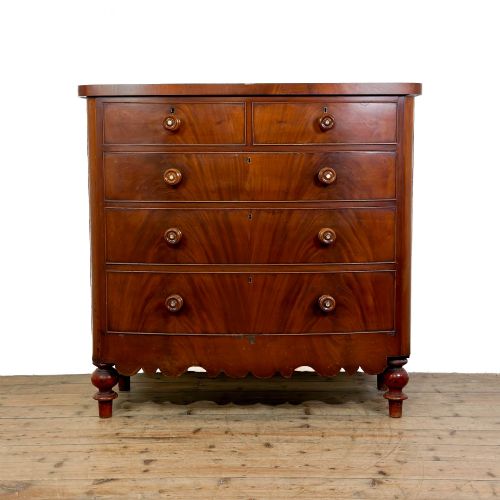


Turned Foot Chest Drawers
These turned foot chest drawers offer sturdy storage and honest timber construction, bringing time-worn character and practical proportion to any room.
Turned Foot Chest Drawers
A turned foot chest drawers unit provides compartmentalised storage through stacked horizontal drawers raised on distinct circular or lathe-turned supports. These pieces emerge across Georgian, Regency, and Victorian periods, reflecting shifting domestic tastes in storage.
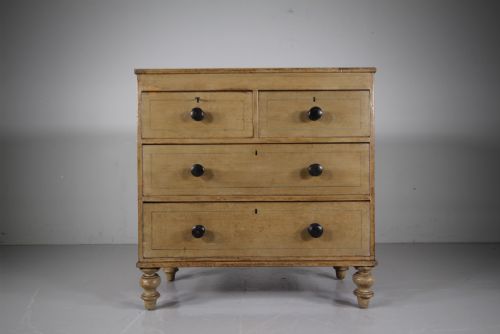
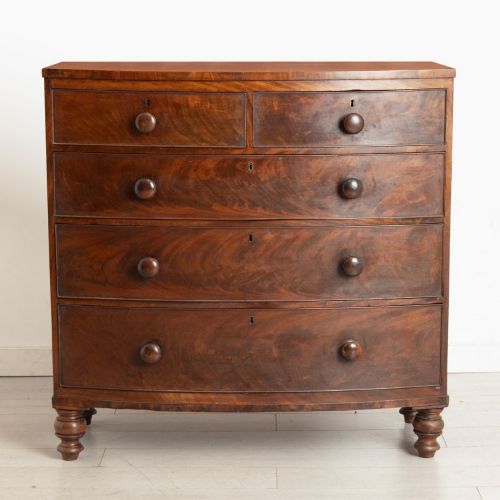
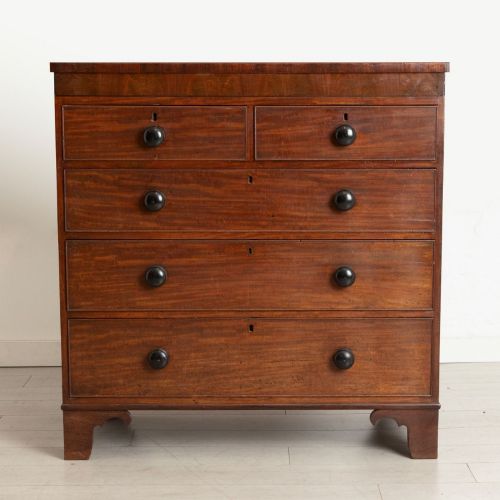
The most common examples encountered on this page are Victorian pine pieces, often painted or showing their original grain, alongside grander mahogany and George IV bow front variations. Smaller items such as apprentice chests and Welsh vernacular coffor bach pieces also appear on these turned supports.
Buyers seek these forms for their robust utility and architectural silhouettes, which anchor modern and traditional interiors alike. Every period brings distinct timber choices and drawer configurations to the floor.
How they were made
Cabinet makers utilised solid timbers such as mahogany, oak, and pine, selecting each wood for its structural stability and grain pattern. Secondary woods like pine appear within drawer linings and carcass backs.
Joinery relied on hand-cut dovetails for drawer construction, ensuring durability under daily use. Lathes shaped the signature turned feet and matching wooden knobs from matching or contrasting timber stocks.
Listings feature pieces spanning the Georgian, Regency, and Victorian periods, constructed from mahogany, pine, and oak.
What varies in quality
The sophistication of the timber selection and the crispness of the turning define the upper tier of these pieces. Figured mahogany veneers and finely executed dovetailing distinguish high-status workshop production from utilitarian country furniture.
Surface finish plays a substantial role in distinction, with original paint schemes and patinated surfaces holding greater visual integrity than later refinished examples. The retention of original brass hardware or matching turned wooden knobs completes the integrity of the piece.
T & G Seddon
The Turned Foot Chest Drawers Glossary
- Bow front
- A convex curved cabinet front popular during the Georgian and Regency eras. This curved profile softens the linear geometry of a room.
- Dovetail
- An interlocking joint formed by interlocking wedge-shaped fingers. This traditional carpentry method secures drawer corners against lateral pulling forces.
- Commode
- A European term for a low chest of drawers or cabinet. These pieces often feature decorative veneers and elaborate mounts.
- Coffor Bach
- A small Welsh vernacular chest or coffer, often mounted on turned feet. These miniature storage boxes served domestic utility or bridal purposes.
Turned Foot Chest Drawers: Frequently Asked Questions
What periods do these chests span?
The pieces span from the early eighteenth century through the Regency era and into the Victorian period. Each era introduces distinct proportions and regional woodworking traditions.
Cabinet makers adapted their forms to suit contemporary domestic needs while retaining the foundational turned foot support.
Are these chests made of solid wood?
Construction relies heavily on solid timbers including pine, oak, and mahogany. Secondary woods appear in hidden structural areas like drawer bases and internal framing.
Finer examples incorporate decorative veneers over stable foundational woods to achieve striking surface patterns.
How do I care for antique pine?
Maintain these surfaces by avoiding direct sunlight and excessive humidity fluctuations. Regular dusting with a dry cloth protects the underlying timber or painted finish.
Wax polishing can be applied sparingly to unpainted wooden surfaces to maintain moisture levels in the grain.
What is an apprentice chest?
An apprentice chest is a small-scale demonstration piece created by a woodworker learning their trade. These miniature chests contain fully functioning drawers built with the same joinery techniques as large furniture.
Their compact scale made them practical portable items for travelling craftsmen to display their skills.