


Tripod Music Lectern
A tripod music lectern supports scores and books on a sturdy three-legged base, offering adjustable heights and angled book rests for practical daily use.
Tripod Music Lectern
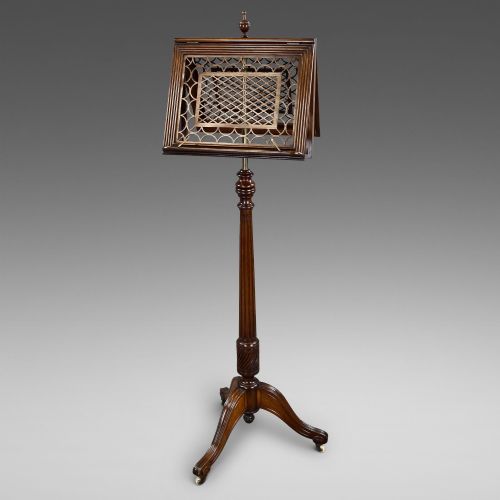
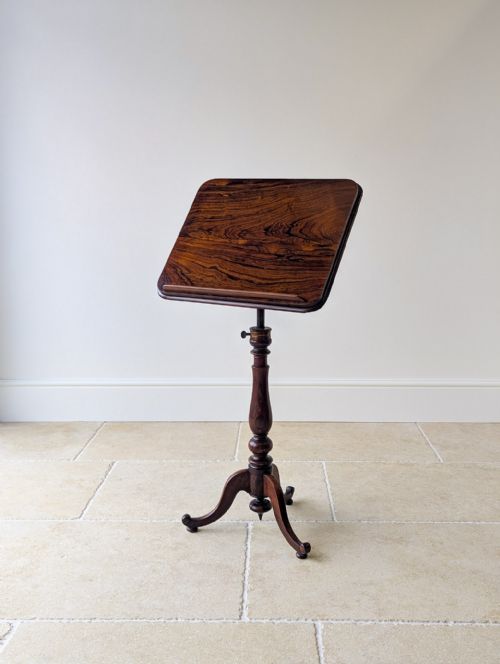
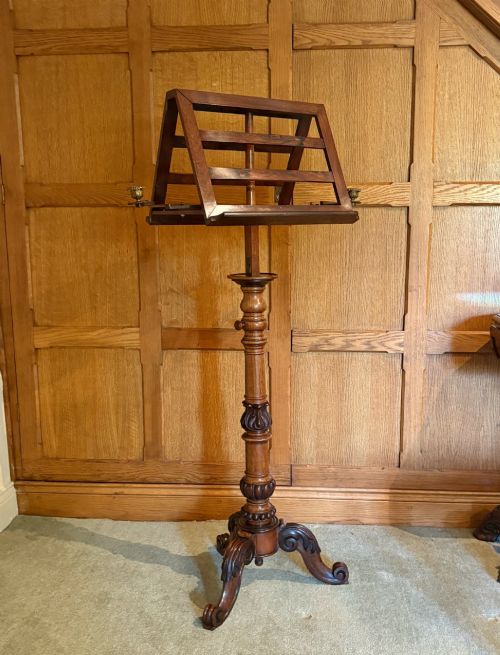
A tripod music lectern serves as an adjustable stand for holding sheet music or reading material, featuring a stable three-legged base. The selections found here span from the Georgian and Regency periods through the Victorian era up to the early twentieth century.
Buyers encounter various forms including dedicated music stands, duet stands, and reading tables that double as manuscript holders. Woods such as mahogany, rosewood, walnut, and oak predominate across these nineteenth and early twentieth-century examples.
Many items incorporate mechanical adjustment mechanisms, allowing the user to alter both height and reading angle. Fretted designs and lyre-shaped supports appear frequently among the Victorian and Regency pieces listed on this page.
How they were made
Cabinetmakers constructed these stands using solid timbers and decorative veneers like burr walnut, rosewood, and mahogany. Turning and carving shape the upright shafts and tripod legs, while brass fittings provide the adjustable joints.
Inlay and satinwood details adorn finer surfaces, and ebonising techniques alter the appearance of specific woods. Fretted music desks involve intricate piercing work to lighten the visual weight of the solid timber.
Mahogany, walnut, and rosewood represent the primary timbers across these listings, spanning the Georgian, Regency, and Victorian periods.
What varies in quality
The sophistication of the turning, carving, and timber figuring distinguishes standard examples from exceptional ones. Denser hardwoods and complex double-sided duet formats generally indicate higher workshop standards.
The precision and integrity of the adjustment mechanisms determine everyday usability. Original brass screws and smoothly operating ratchets elevate a piece above those with replaced or stiff hardware.
GILLOWS
The Tripod Music Lectern Glossary
- Lectern
- A stand with a slanted top designed to hold a book or music score at a comfortable reading angle. These pieces often feature adjustable shafts.
- Tripod
- A three-legged base providing stability on uneven floors. This configuration appears commonly on nineteenth-century reading and music tables.
- Duet stand
- A wider music stand designed to accommodate two musicians reading from the same shared score. These often feature fretted or pierced wooden music desks.
- Lyre-shaped
- A decorative motif resembling a classical stringed musical instrument, frequently incorporated into the central support of music stands.
- Fretted
- Woodwork pierced with ornamental openwork patterns. This technique lightens the visual load of solid mahogany or walnut music desks.
Tripod Music Lectern: Frequently Asked Questions
What is a tripod music lectern?
A tripod music lectern is a freestanding support with three legs and an adjustable top designed to hold scores or books.
These pieces combine furniture craftsmanship with functional mechanics to serve musicians and readers.
How do I adjust the height?
Adjustment typically involves a sliding central shaft secured by a brass thumbscrew or a ratcheted mechanism behind the desk.
Users loosen the fitting to raise or lower the rest to the desired level before tightening it securely.
Are these stands suitable for daily use?
Many nineteenth-century stands remain robust enough for regular reading or playing when handled with appropriate care.
Their adjustable components allow them to function as practical modern desk accessories or music stands.
What woods were used?
Cabinetmakers utilised dense timbers such as mahogany, walnut, rosewood, oak, and gonçalo alves for strength and appearance.
Secondary veneers and satinwood inlay often decorated the more elaborate Victorian and Regency examples.