
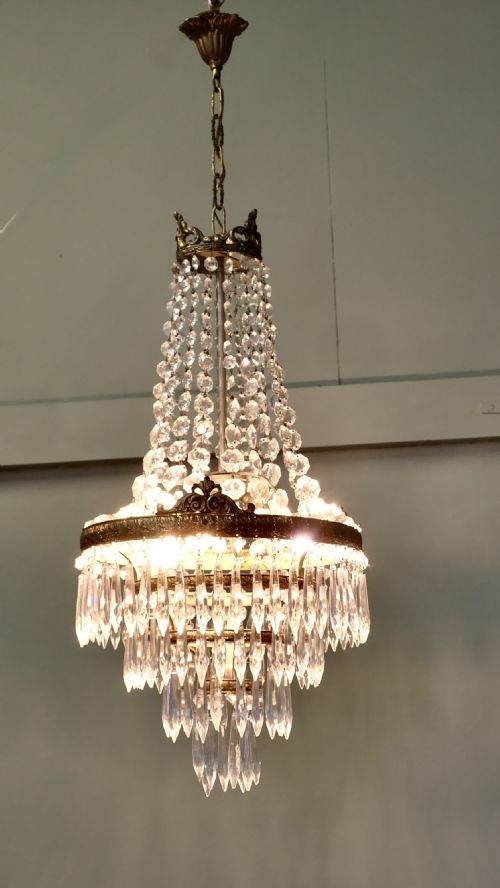
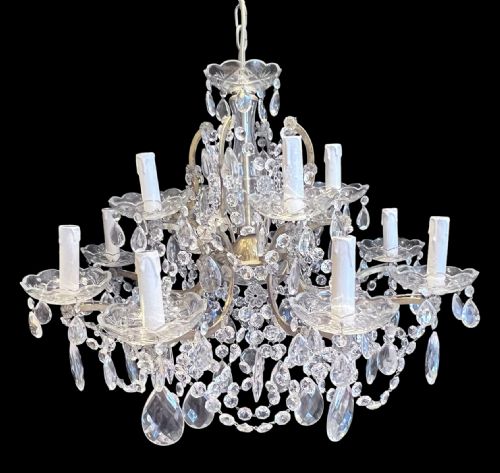
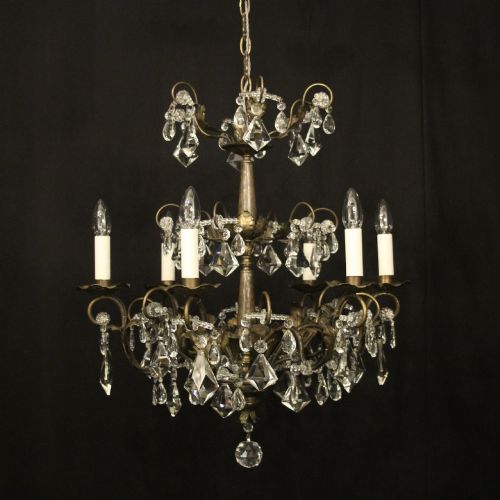
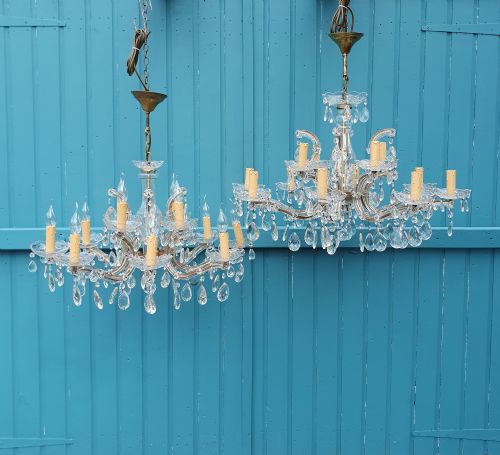
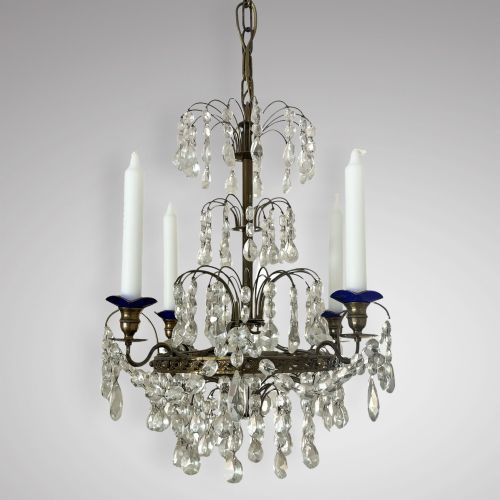


Traditional Tiered Crystal Chandelier
A traditional tiered crystal chandelier brings overhead sparkle and period presence to a high-ceilinged room.
Traditional Tiered Crystal Chandelier
A traditional tiered crystal chandelier combines multi-level candle arms or lights with cascading glass elements. Buyers seeking a traditional tiered crystal chandelier will find examples stretching from the late nineteenth century through the Edwardian era and into the 1920s and 1930s.
The selections span English, French, Italian, and Bohemian workshops, ranging from modest twelve-light setups to massive ballroom fixtures with dozens of branches. Common configurations include double-tiered frames, tent and bag arrangements, and dramatic waterfall drops.
Formats vary from restrained brass frames to heavily gilded bronze and silver-plated structures laden with swags and pendants. Most pieces rely on substantial iron, brass, or bronze skeletons to support heavy arrays of glass and crystal components.
Materials and construction
Makers built the structural frames using cast brass, bronze, and gilt metal, occasionally applying silver gilding to create reflective metallic bases. These sturdy skeletons support the weight of multiple candle arms and branching tiers.
Cut glass and lead crystal formed the hanging elements, shaped into drops, beads, swags, and spikes that refract light across a space. Skilled artisans wired these components onto the metal framework using fine wire connections.
Ballroom chandeliers in this selection scale up to an impressive forty-one lights for truly grand spaces.
Elements of quality
Quality depends heavily on the clarity and cut of the crystal components, where sharp, deep facets create superior light refraction compared to plain moulded glass. The density of the drops and the complexity of swags also dictate how grand the fixture appears when lit.
The underlying metalwork contributes significantly to the integrity of the piece, with heavy cast bronze and gilded frames outlasting lighter, simpler iron structures. Original matching drops and complete arm counts separate well-preserved antiques from assembled or heavily restored examples.
The Traditional Tiered Crystal Chandelier Glossary
- Cut crystal
- Glass containing lead oxide that is laboriously hand-cut and polished to maximise sparkle and light dispersion. This material marks out the higher-tier fixtures in the collection.
- Tent and bag
- A lighting format featuring an upper conical canopy of crystal strands dropping down to a gathered bag shape beneath. English makers produced notable examples of this specific silhouette.
- Waterfall chandelier
- A multi-tiered design where cascading rows of crystal drops create the visual effect of falling water. These fixtures often feature numerous concentric rings.
- Gilt metal
- A metallic base coated with a thin layer of gold leaf or gilt paint to impart a rich, warm tone. It frequently underpins French and Italian chandelier frames from the nineteenth and early twentieth centuries.
- Beaded arms
- Chandelier branches completely enveloped or trimmed with small threaded glass beads. This decorative treatment appears frequently on Florentine and Edwardian pieces.
Traditional Tiered Crystal Chandelier: Frequently Asked Questions
How do I clean a crystal chandelier?
Cleaning requires a specialist glass cleaning spray and soft cloths, working carefully around each individual drop and arm.
Many collectors prefer to clean the components in situ rather than dismantling the entire metal frame and risking delicate wire connections.
How many lights do I need?
Light counts range from modest six-arm setups up to massive forty-one-light ballroom fixtures depending on the scale of the room.
Larger double-tiered arrangements provide substantial illumination suited to high ceilings and spacious dining or reception areas.
Where were these chandeliers made?
Production centres include England, France, Italy, and Bohemia, each bringing distinct regional styling to the metalwork and crystal arrangement.
Italian workshops often favoured gilded Florentine frames, while French makers produced elaborate Empire and Rococo revival designs.
Can I adjust the hanging height?
Height adjustment depends on the original chain and ceiling rose provided with the specific antique fixture.
Professional electrical installation is essential to support the substantial weight of these metal and crystal structures safely.