


Traditional Sapphire Ring
A traditional sapphire ring brings together deep blue corundum and brilliant diamonds in gold or platinum settings across periods from the Victorian era to the later twentieth century.
Traditional Sapphire Ring
When you search for a traditional sapphire ring, you encounter finger adornments designed around blue corundum, frequently accompanied by diamonds. The selections span Victorian, Edwardian, Art Deco, mid-century, and 1970s vintage aesthetics, uniting historical periods in a single category.
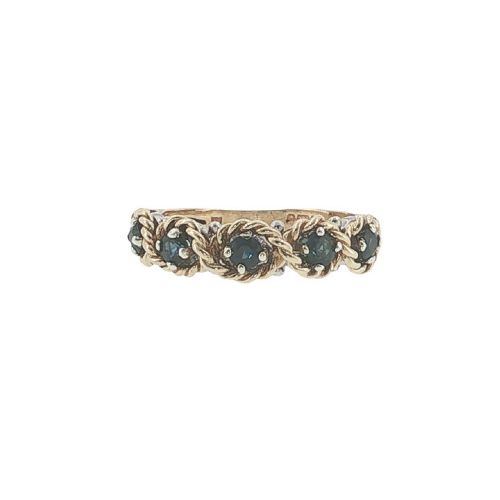
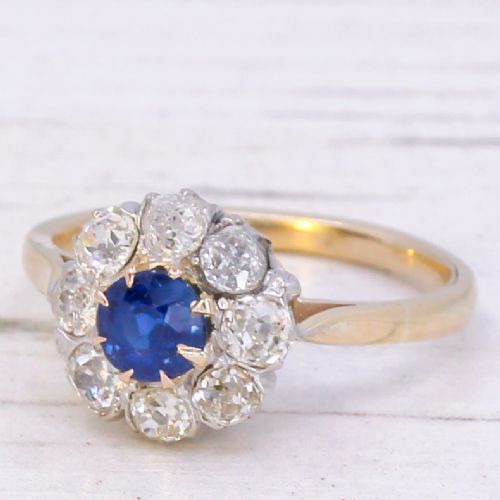
The most common forms on this page include cluster rings, five stone band rings, half eternity rings, and engagement rings. These pieces utilise settings in 9ct gold, 18ct yellow gold, 18ct white gold, and platinum to frame the central stones.
Origin and period distinctions shape the appearance of each piece, ranging from the ornate arrangements of the Victorian style to the geometric lines of Art Deco and the cleaner profiles of the 1950s and 1960s. Each configuration demonstrates how jewellers arranged gemstones to maximise visual impact.
How they were made
The construction of these rings relies on precious metals such as gold in 9ct and 18ct purities, alongside platinum and 18ct white gold. Goldsmiths shaped these metals to form secure bands and intricate settings that support the principal sapphire and surrounding diamonds.
Gemstone selection dictates the character of each piece, incorporating standard sapphires alongside specific stones like Ceylon sapphire and opal. Diamond accents are integrated through cluster formations, half hoop designs, and multi-stone arrangements.
Materials documented across the collection include yellow gold, white gold, platinum, opal, and Ceylon sapphire.
What varies in quality
The distinction across the range rests on the weight and presence of the central gemstones, moving from modest stone sizes up to substantial carat measurements. The interaction between the sapphire and the supporting diamonds defines the visual hierarchy of the piece.
Material composition also establishes variation, with higher gold purities and the use of platinum creating different levels of durability and weight. The complexity of the mounting, whether a tight cluster or a structured half eternity band, reflects the ambition of the original maker.
The Traditional Sapphire Ring Glossary
- Cluster ring
- A ring featuring a central gemstone surrounded by a group of smaller stones, typically diamonds framing a sapphire.
- Half eternity ring
- A band set with gemstones across the upper half of the hoop rather than completely encircling the finger.
- Ceylon sapphire
- A sapphire originating from Sri Lanka, known for a particular vibrancy and depth of blue colour.
- Platinum
- A dense, durable precious metal used in jewellery manufacture for its strength and bright white appearance.
- Five stone band ring
- A linear setting featuring five stones spaced evenly across the top of the band.
Traditional Sapphire Ring: Frequently Asked Questions
What periods do these rings come from?
The pieces span multiple eras including the Victorian period, the 1930s Art Deco movement, the 1950s, 1960s, and later twentieth century vintage pieces.
Each period brings distinct mounting styles and gemstone arrangements that reflect the jewellery design trends of their respective decades.
What metals are used in these settings?
Settings are constructed from 9ct gold, 18ct yellow gold, 18ct white gold, and platinum.
These materials provide the structural integrity required to secure sapphires and diamonds while offering different metal tones.
How are the diamonds arranged around the sapphire?
Diamonds appear in various configurations including surrounding clusters, half eternity bands, half hoop arrangements, and five stone line settings.
These layouts complement the central blue stone by adding contrasting brilliance and geometric structure.
Are all sapphires identical in origin?
While many pieces feature standard sapphires, specific examples highlight stones such as Ceylon sapphire.
Geographic origin and natural variation contribute to the specific shade of blue seen in each individual gemstone.