


Traditional Sapphire Dress Ring
A traditional sapphire dress ring brings together deep blue stones and brilliant diamonds in gold and platinum mountings.
Traditional Sapphire Dress Ring
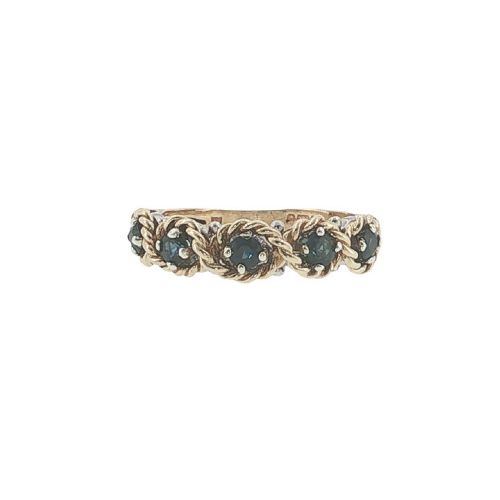
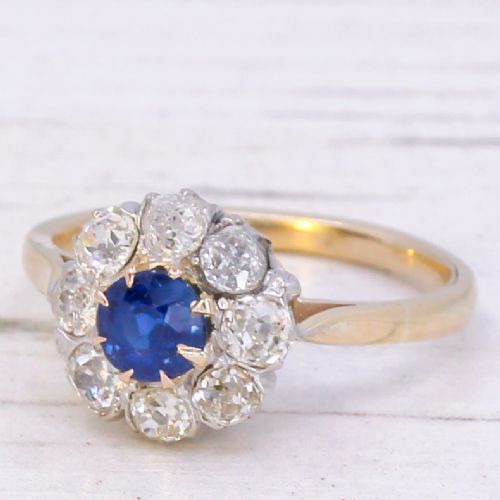
A traditional sapphire dress ring takes several familiar forms across the Victorian, Art Deco, and mid-century periods. Cluster rings and five stone bands appear most often on this page.
Makers set these blue stones in yellow gold, white gold, and platinum alongside diamonds. Pieces range from Victorian half hoop designs to later twentieth-century styles.
How they were made
Goldsmiths worked in 9ct gold, 18ct gold, white gold, and platinum to house sapphires, Ceylon sapphires, and opals. Diamonds frame the central blue stones in cluster and multi-stone settings.
Workshops utilised durable precious metals to secure gemstones in structured band and cluster arrangements that survived decades of daily wear.
Listings span the Victorian era, 1930s, 1950s, 1960s, and later decades, utilising gold, platinum, sapphires, diamonds, and opals.
What varies in quality
Quality rests on the depth of colour in the sapphire and the clarity of the surrounding diamonds. Heavier gold and platinum mountings demonstrate superior construction.
Fine craftsmanship shows in the secure claw settings and balanced proportions of cluster and five stone band layouts.
The Traditional Sapphire Dress Ring Glossary
- Cluster ring
- A ring featuring a central gemstone surrounded by a border of smaller stones, typically diamonds. This arrangement maximises surface brilliance on the finger.
- Ceylon sapphire
- A sapphire originating from Sri Lanka, known for a specific bright and lively blue hue. These stones frequently appear in mid-century cluster settings.
- Half hoop ring
- A band set with a row of gemstones across the upper half of the finger. Victorian examples often utilise this design for alternating stones.
- Platinum
- A dense, durable white metal used for secure gemstone settings. It holds fine detail well without tarnishing over time.
Traditional Sapphire Dress Ring: Frequently Asked Questions
What periods do these rings come from?
The pieces span from the Victorian era through the 1930s, 1950s, 1960s, and later twentieth-century decades.
Each period brought distinct mounting styles, such as Victorian half hoops and Art Deco clusters.
Which materials are most common?
Gold and platinum form the primary mountings, in both 9ct and 18ct variations.
Sapphires and diamonds dominate the stones, though occasional opals appear in cluster configurations.
How do cluster rings differ from band rings?
Cluster rings group surrounding diamonds around a central sapphire to create a broad face.
Band rings arrange stones in a single linear sequence across the finger.
What is a Ceylon sapphire?
It is a sapphire sourced from Sri Lanka, valued for its distinct vivid blue tone.
These stones often feature in mid-century cluster rings alongside brilliant cut diamonds.