







Traditional Rural Village Art
Traditional rural village art captures the quiet rhythms of English country life through nineteenth-century oils and watercolours.
Traditional Rural Village Art
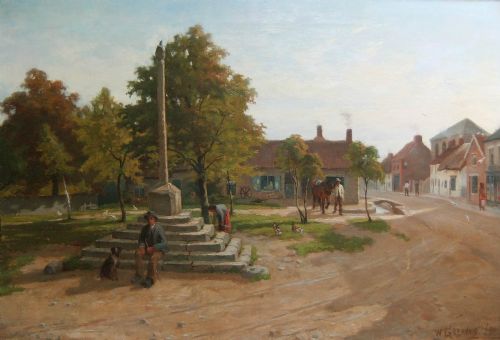
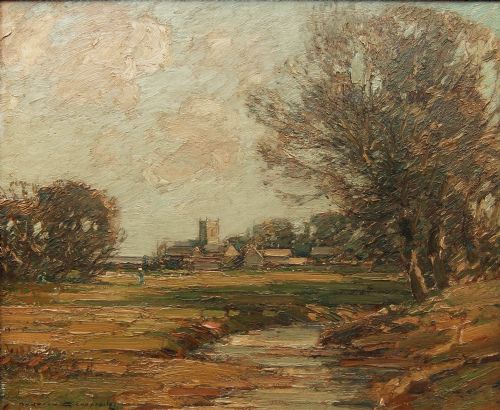
Traditional rural village art comprises oil paintings and watercolours depicting country settlements, farm landscapes, and village taverns across England. These works document rural scenes from the nineteenth century into the early twentieth century.
The version most frequently met on this page is the framed oil on canvas or paper watercolour, often signed by the artist. These pieces showcase local architecture, horses, and country lanes.
Subjects range from Yorkshire and Derbyshire to Sussex, Hampshire, and Norfolk. They present an intimate window into historic rural communities.
Materials and Technique
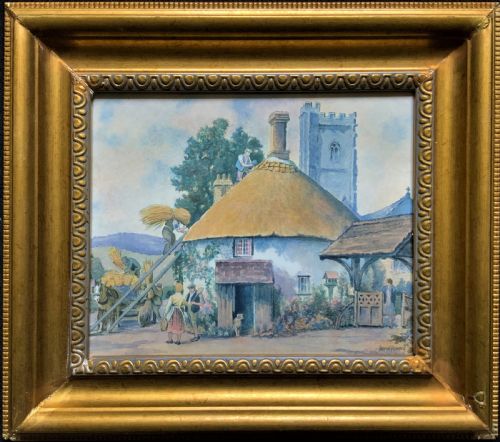
Painters applied oil paint or watercolour onto canvas, paper, or prepared panels to create these village scenes. Many surviving pieces retain their period gilt and gesso frames.
Artists worked in realist and impressionist modes, capturing light upon cottages, rivers, and fields. Pigments were brushed to render fine details of daily country life.
Several canvases squeeze an entire village tavern, a working windmill, and wandering horses into a single domestic frame.
Judging Quality
Quality rests in the handling of light, atmosphere, and composition within the landscape. Works by documented painters demonstrate firmer command of perspective and natural colour.
The integrity of the original canvas, paper support, and period gilt framing influences the overall character of the piece.
William Greaves·Fred Lawson·John Edward Bale·Robert Hollands Walker·Kershaw Schofield·Georgina Lara·Alfred Rimmer·David Heward·John Holland Snr
The Traditional Rural Village Art Glossary
- Oil on Canvas
- Pigment suspended in drying oil applied to stretched woven fabric. This medium allows for rich texture and deep colour layering.
- Watercolour
- Paint consisting of water-soluble pigments on paper. It creates luminous, transparent washes often used for topographical landscapes.
- Gilt
- A thin layer of gold applied to wood or gesso frames. It provides a decorative metallic finish characteristic of period framing.
- Gesso
- A plaster mix applied to wooden frames as a smooth base for gilding. It gives ornamental mouldings their sharp definition.
- British Impressionism
- A painting style focusing on light and everyday subjects. It emerged in the late nineteenth century as artists moved outdoors.
Traditional Rural Village Art: Frequently Asked Questions
What periods do these village paintings cover?
The selection spans the nineteenth century through the early decades of the twentieth century. Most works date from the Victorian and Edwardian eras.
Artists active during these decades recorded changing rural landscapes before modern development altered traditional village boundaries.
How should I hang an oil painting?
Hang paintings away from direct sunlight and steady heat sources to protect the canvas and paint layers. Proper wall placement prevents warping of the wooden stretcher.
Ensure the wall fixings support the weight of the piece, particularly if the work retains its heavy period gilt frame.
Are watercolours framed differently than oils?
Watercolour paintings require glass protection to shield the paper and pigments from atmospheric moisture and dust. Oils on canvas remain open to the air.
Both types frequently use gilt and gesso frames appropriate to their nineteenth-century origins.
How do I identify a village watercolour?
Watercolours utilise translucent washes on paper rather than the thick texture of oil paint. They often depict detailed topographical views of specific English counties.
Signatures and dates on the paper help connect the work to known regional artists of the period.