


Traditional Oak Dining Storage
Traditional oak dining storage pieces bring substantial character and robust utility to a room, offering deep drawers and sturdy shelving for tableware.
Traditional Oak Dining Storage
Traditional oak dining storage encompasses sideboards, dressers, court cupboards, and dresser bases designed to organise and display dining rooms. These pieces originate from various eras, including the 18th century, the Victorian period, the Edwardian era, and the 1920s.
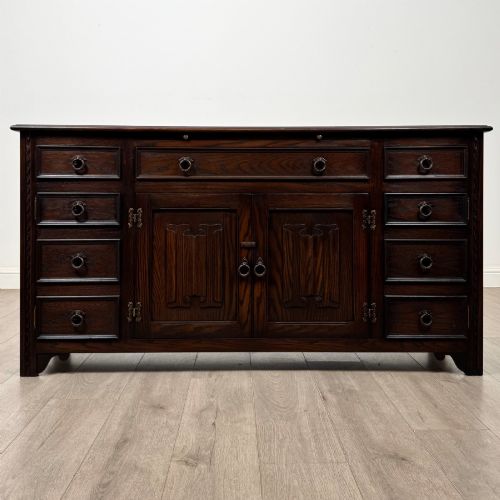
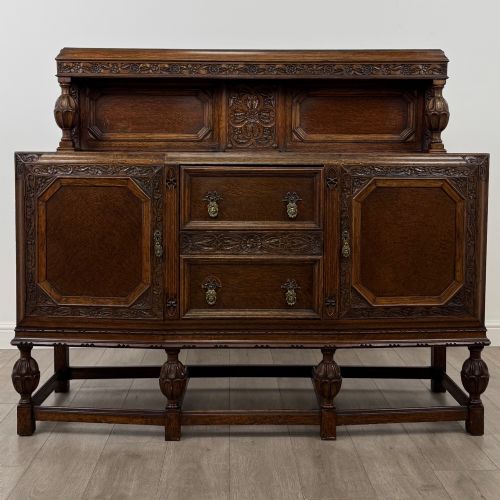
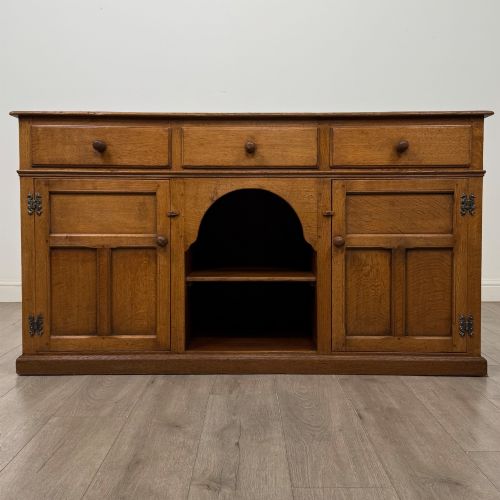
The most common forms you will encounter on this page are sturdy oak sideboards and functional dresser bases. They often incorporate carved details, breakfront drawers, or mirror backs reflecting styles such as Jacobean Revival, English Country, and Arts and Crafts.
How they were made
These items are constructed primarily from solid oak, sometimes highlighted with golden oak tones, and complemented by hardware in brass, iron, copper, and other metals. Secondary timbers such as pine or mahogany occasionally appear in internal construction.
Joinery techniques focus on durability, utilising solid timber construction to support heavy tableware. Carved ornamentation adorns doors and panels, particularly on pieces influenced by Jacobean Revival and Arts and Crafts aesthetics.
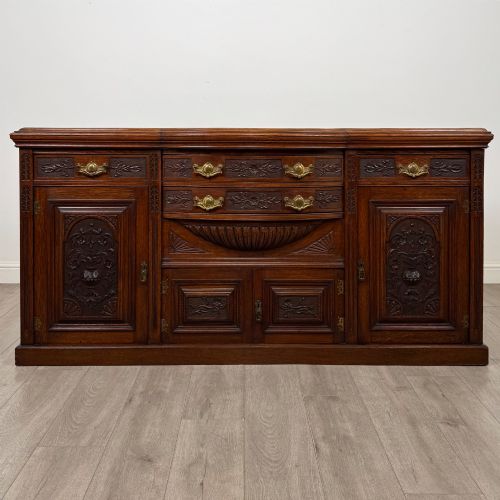
Some Edwardian carvers clearly grew tired of plain panels and decided every available inch required a rosette.
What varies in quality
Quality rests on the depth of hand-carved detailing and the selection of the timber, particularly where golden oak or dense grain patterns are concerned. Superior examples exhibit crisper execution in the carved panels and mouldings.
The integrity of the construction and the proportion of the hardware, such as brass pulls or iron hinges, distinguish standard utility items from finer cabinetwork. Consideration of the period style, from 18th-century country pieces to Edwardian interpretations, also influences the character of the item.
The Traditional Oak Dining Storage Glossary
- Dresser base
- A low storage unit with drawers and cupboards, traditionally used in dining rooms or kitchens before the addition of upper shelving tiers.
- Court cupboard
- An enclosed antique cabinet featuring recessed upper sections supported by carved posts or columns.
- Breakfront
- A piece of furniture where the central section projects forward from the flanking sections, creating visual depth.
- Jacobean Revival
- A later style emulating the heavy, rectilinear furniture and deep geometric carving of the 17th century.
- Golden oak
- A warm, light-yellowish brown timber finish popular in Edwardian and early 20th-century cabinetry.
Traditional Oak Dining Storage: Frequently Asked Questions
What is a dresser base?
A dresser base is a heavy, low-set piece of dining furniture featuring rows of drawers and lower cupboards. It provides substantial surface area and storage without upper plate racks.
These pieces were traditionally utilised for keeping serving dishes and cutlery close to the dining table.
How do I date an oak sideboard?
Dating relies on observing the combination of timber colour, construction marks, and stylistic motifs such as Jacobean carving or Art Nouveau lines. Hardware styles and secondary woods also offer clues.
Earlier pieces from the 18th century display different proportions and hand-working marks compared to Edwardian or 1920s revivals.
Where should I place a court cupboard?
Court cupboards require adequate wall space and clearance because of their projection and substantial depth. They work best as focal points in spacious dining rooms.
Ensure the piece is positioned away from direct heat sources to protect the solid oak timber.
What distinguishes Arts and Crafts oak furniture?
Arts and Crafts pieces emphasise honest construction, solid materials, and understated decoration rather than excessive ornamentation. They often highlight the natural grain of the oak.
Stylistic restraint and functional utility define this approach to dining storage.